

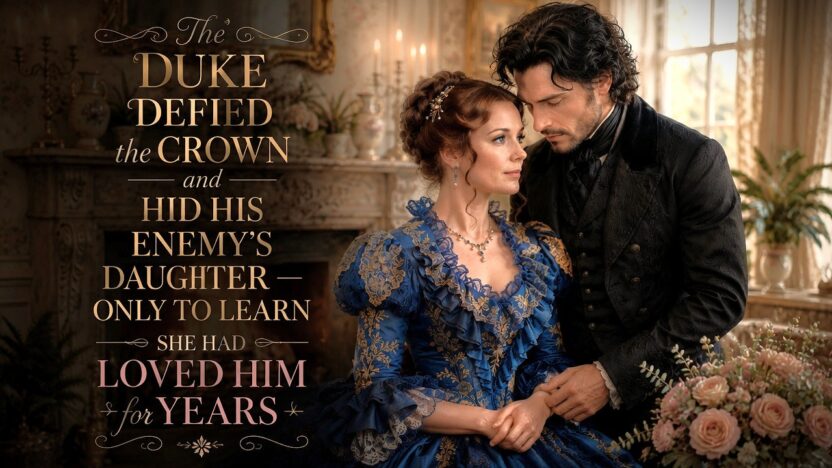
“Come no closer unless you mean it, Nathaniel.”
He stopped at once. Behind the narrow panel, officers crossed the room beyond them while rain whispered against the wood. “May I?” he asked. Rosamund placed her ungloved hand over his heart. If discovered, he could lose Caldermere, and she might lose the right to testify. Yet the greater danger was believing his protection had become love. Months earlier, she had arrived at his door carrying treasonous letters bound in blue silk.
The night of her arrival had begun with rain hard enough to erase the road.
At Caldermere, the windows of the west drawing room rattled beneath the weather, but Nathaniel Harrow did not look up. He sat alone under three lamps, reading a Home Office warrant that required neither his signature nor his consent. The document named Adrian Bellamy, Marquess of Loxley, as a conspirator against the Crown. It authorized the seizure of correspondence, accounts, and property connected to his household.
At the bottom, in smaller script, appeared the name of his daughter.
Lady Rosamund Bellamy was to be detained for questioning.
Nathaniel read the sentence twice. His thumb pressed the edge of his signet ring until the crest turned inward against his palm.
He had spent fourteen years repairing what his father’s politics had damaged. Caldermere’s farms were solvent again. The northern villages had survived two poor harvests without losing their leases. One accusation of obstruction could reverse all of it.
A servant entered before Nathaniel could fold the warrant. “Your Grace, there is a woman at the east door.”
“At this hour?”
“She would give no name. She asked for you.”
The sensible answer was to send for the magistrate. The lawful answer was to notify the officers already traveling north. Nathaniel rose and placed the warrant beneath a leather folio.
“Ask Lady Margaret to join me in the entrance hall.”
The east entrance was used by estate agents, tradesmen, and tenants who preferred not to cross the grand front steps. When Nathaniel reached it, rain had blown across the stone floor. A cloaked figure stood beneath the lamp, one hand gripping a traveling case.
She raised her face.
Time returned him to a churchyard eleven years earlier, where a young woman in gray had stood beside her mother’s grave while her father argued politics with the bishop. Nathaniel had found her alone, her gloves soaked through, and held an umbrella above her without asking questions she could not answer.
He had thought of that afternoon perhaps twice in all the years since.
“Lady Rosamund.”
Her wet lashes lowered briefly. “Your Grace.”
She was no longer the young woman society had praised for quiet obedience. At thirty-five, her composure had weight behind it. Her dark blue eyes were tired but direct, and the hand holding the case did not tremble until he looked at it.
“You should not be here,” he said.
“No.”
“The Home Office has issued a warrant.”
“I know.”
Lady Margaret arrived behind him, her walking stick striking the floor once. She took in Rosamund’s soaked cloak, the empty corridor, and Nathaniel’s expression.
“We may continue discussing a lady’s danger beside an open door,” she said, “or remember that civilization occasionally begins with a fire.”
Nathaniel stepped aside.
Rosamund hesitated before crossing the threshold. That hesitation told him she understood what entering his house could cost them both. An unmarried woman under suspicion could not spend a night beneath an unmarried duke’s protection without inviting conclusions more enduring than truth.
Yet the road behind her held worse dangers.
Lady Margaret led them into a morning room where a fire still burned. Nathaniel removed Rosamund’s cloak by grasping only the wet fabric at her shoulders. Even so, he became aware of the narrow space between them, the warmth beneath the wool, and the faint scent of bergamot and rain.
She noticed his care not to touch her. Something moved in her expression and disappeared.
Margaret rang for tea, dry clothing, and a trusted maid, then sat opposite Rosamund.
“You have ten minutes before I decide whether my nephew is behaving nobly or stupidly,” she said. “They are not always different conditions.”
Rosamund placed the traveling case on the table. From it, she removed letters bound with a narrow blue silk ribbon.
“My father was arrested yesterday morning. By noon, officers had sealed the estate office and frozen every Loxley account. They questioned the steward, dismissed half the servants, and searched my rooms.”
Nathaniel remained standing. “How did you leave?”
“Through the old dairy path. A groom took me to the western boundary. I traveled the rest of the way in a tenant’s cart.”
“You endangered them.”
Her chin rose. “I gave the driver no name. Remaining would not have protected anyone.”
The answer was neither defensive nor careless. It belonged to a woman accustomed to calculating harm without pretending she could prevent all of it.
Nathaniel looked at the letters. “Why bring these to me?”
“Because the warrant names properties beyond Loxley. Caldermere is not included yet, but the correspondence refers to railway surveys near your northern villages. If the accusation stands, the Crown can seize the land of every man named as an associate.”
“Your father spent twenty years attempting to weaken my family.”
“He did.”
The honesty silenced the room.
Rosamund loosened the blue ribbon. “I am not asking you to believe him innocent of every wrongdoing. He collected private correspondence without permission and used it to embarrass rivals. He believed public virtue excused private arrogance.”
Lady Margaret’s brows lifted.
“But he did not plan an insurrection. These letters contain phrases he would never use. They refer to meetings that occurred while he was elsewhere. Someone altered them after they were signed.”
Nathaniel picked up the top page. The paper was dry despite her journey. She had protected the evidence better than herself.
“You expect me to recognize his language?”
“I expect you to recognize his enemies.”
Their eyes met.
There was the true challenge. Not a plea for rescue, but an appeal to judgment. She had come because she believed his knowledge could expose what affection could not.
He read several lines. One mentioned an acquisition along the Caldermere-Loxley boundary. Another referred to unrest among tenant farmers who had never shown the slightest interest in revolution, though they held strong opinions about drainage.
“Croft must see these,” he said.
Rosamund’s shoulders lowered slightly. “Then you believe me?”
“I believe the papers deserve examination.”
“That is not the same thing.”
“No.”
Lady Margaret rose. “Excellent. You are already disagreeing with precision.”
Nathaniel continued. “The officers will come here. Sir Ambrose Kersey knows the history between our families. He may claim you sought protection from me, or that I abducted you to obtain the evidence.”
Rosamund pressed her thumb briefly to her lower lip. “There is an abandoned dower house beyond the east gardens. It does not appear on newer estate plans.”
Nathaniel went still. “How do you know that?”
“My mother visited Lady Margaret years ago. I remember maps.”
Margaret gave a quiet sound of approval.
The dower house stood apart from the main residence, screened by old yews, with a private path to the chapel ruins. Margaret’s presence could make Rosamund’s stay barely defensible, but secrecy would remain essential.
By morning, every person dependent upon Caldermere might be endangered by his choice.
Rosamund began retieing the letters. Her fingers tightened the ribbon into a hard knot.
“If you mean to surrender me,” she said, “do it before your servants are implicated.”
Her calm revealed more than fear would have done. She expected duty to win. She had expected it before crossing his threshold.
Nathaniel thought of his brother leaving England beneath another accusation, and of the silence their father had called prudence. He thought of villages that could be stripped from families through evidence no one had examined.
Then he turned his signet ring outward.
“You will go to the dower house with Lady Margaret,” he said. “Croft will join us at first light. Until we understand what these letters prove, no officer will take them, or you, without answering to me.”
Rosamund studied him as though the man before her did not match the one she had prepared herself to face.
“This may cost you everything.”
“It may.”
“And you still intend to help me?”
Nathaniel looked at the blue ribbon between her hands.
“I intend,” he said, “to look again.”
By dawn, the rain had softened to a silver mist over the east gardens. The dower house smelled of cold stone, lavender polish, and ashes revived in haste. Rosamund had slept little. Each time the wind moved through the yews, she expected officers at the door and imagined Nathaniel regretting the promise he had made.
Instead, she heard Nathaniel’s measured steps on the gravel shortly after eight.
Lady Margaret admitted him with Mr. Elias Croft, a compact man whose iron-gray whiskers and ink-stained fingers made him look assembled from legal documents. He bowed to Rosamund without hesitation, though courtesy did not equal approval.
“Your Grace has informed me that we are examining evidence before deciding whether to ruin the estate,” Croft said.
Nathaniel removed his gloves. “Mr. Croft prefers clarity in the morning.”
“I prefer it at every hour.”
Rosamund almost smiled.
They arranged the letters across the old dining table. Nathaniel had brought estate maps, railway surveys, and three ledgers. Beside Rosamund’s chair, without comment, he placed a fresh lamp, a sharpened pencil, and tea prepared with bergamot rather than the stronger blend served the previous night.
She looked at the cup, then at him.
“You remembered.”
“You did not finish the other kind.”
It was such a small observation that she could not answer. Her father remembered her usefulness and the names of men she was expected to influence. He rarely remembered what she preferred.
Croft opened a ledger.
For two hours, they compared dates, seals, and handwriting. Rosamund explained that her father dictated most political letters but added private notes himself. Three papers contained phrases copied from his public speeches, phrases so recognizable that they appeared designed to prove authorship.
“Too recognizable,” Nathaniel said.
“Precisely. My father never repeated himself in private. He believed repetition made a man predictable.”
Croft traced a line of figures. “These properties were all assessed within six months of the same railway survey.”
Nathaniel bent over the map. His shoulder came close to Rosamund’s, though not near enough to touch. “The proposed line was rejected.”
“The public proposal was rejected,” Croft corrected. “A revised route could cross Loxley’s western farms and enter Caldermere at North Fell.”
Rosamund followed the route. “Every landowner named in the supposed conspiracy controls part of that corridor.”
The room became quiet.
If the government seized those estates after convictions for treason, the land could be sold under favorable terms to approved investors. The accusation would not merely remove political opponents. It would create a private fortune.
Nathaniel straightened. “Who had access to the original correspondence?”
“My father. His secretary. Two clerks. Sir Ambrose Kersey’s office received copies after the spring inquiry.”
Croft’s mouth tightened. “Kersey has promoted railway consolidation for years.”
“That proves motive, not alteration,” Nathaniel said.
Rosamund turned toward him. “You defend him carefully.”
“I distrust conclusions reached before evidence.”
“Even when the conclusion protects you?”
His gray-green eyes settled on hers. “Especially then.”
She saw that his discipline was not coldness. It was fear trained until it resembled principle. He would rather doubt his own advantage than risk becoming unjust.
Lady Margaret, seated near the fire, said, “You may both continue admiring each other’s moral severity after luncheon.”
Rosamund looked down. Nathaniel reached for the same page at the same instant. Their fingertips met.
Neither moved.
The contact lasted no more than a breath, but she felt the warmth of his skin with humiliating precision. His gaze dropped to their hands. His expression did not change, yet his other thumb pressed against his signet ring.
Rosamund withdrew first and turned the page.
By noon, they had identified a discrepancy in one seal. The wax carried the Loxley crest, but a hairline fracture crossed the lion’s hind leg, as though the seal had been removed and reset.
“There may be a duplicate matrix,” Croft said. “Or the original was used by someone within the house.”
Rosamund’s stomach tightened. “My father kept an older seal in the ruined chapel. He said a Bellamy ought to have one place where government men could not reach.”
Nathaniel’s mouth almost curved. “Your father’s faith in chapels appears selective.”
“His faith in hiding places was sincere.”
The chapel stood beyond the flooded garden path, half covered in ivy. Lady Margaret accompanied them, using her walking stick to test the muddy ground.
At the deepest stretch of water, Nathaniel offered his arm to Rosamund.
The gesture was entirely proper. Margaret walked only a few paces behind them. Yet Rosamund felt the strength beneath his coat when she placed her gloved hand upon his sleeve. He shortened his stride so she would not have to hurry.
“You need not walk as though I am made of glass,” she said.
“I am walking as though the path is flooded.”
“You altered your step.”
“You observe too much.”
“So do you.”
His reserve softened. “That may be why this arrangement is proving inconvenient.”
The ruined chapel had no roof over the nave, but the vestry remained dry. Rosamund found the loose stone behind a warped panel and reached into the recess. Her fingers closed around a metal box.
The lid resisted. Nathaniel steadied it while she forced the rusted clasp. When it broke, the sharp edge cut her palm.
She drew in a breath.
Nathaniel took her wrist, then stopped. His grip loosened immediately.
“May I see?”
Rosamund removed her glove and turned her hand into his.
The cut was shallow, but blood brightened her palm. Nathaniel wrapped it with a clean handkerchief. Cedar and damp leather surrounded her, carrying the impossible memory of an umbrella held above her in a churchyard.
“You once did this before,” she said.
His fingers paused. “Bandaged your hand?”
“Not exactly.”
She had not intended to speak of it. The memory had belonged to her for eleven years, untouched because she had never offered it to anyone again.
“My mother’s funeral,” she continued. “Everyone was speaking to my father. You found me behind the church and held an umbrella over me.”
Nathaniel tied the linen. “I remember the rain.”
“You said nothing comforting.”
“I was not certain comfort from a stranger would be welcome.”
“You remained anyway.”
He kept her hand in his after the knot was secure. The contact was no longer required. Rosamund felt his pulse against the base of her thumb, steady but not calm.
“It was the first kindness anyone gave me that did not ask me to be composed in return,” she said.
Nathaniel looked at her as though she had placed something breakable into his keeping.
“My brother used to say silence could be kind,” he said. “I believed him too late.”
The admission altered the air. Rosamund knew of the younger Harrow son who had died abroad beneath rumors of betrayal. Nathaniel’s face revealed guilt carried so long it had become posture.
“You could not save him,” she said.
“No. But I might have stood beside him before he needed saving.”
Lady Margaret’s footsteps approached. Nathaniel released Rosamund’s hand, though slowly enough that the absence felt deliberate.
Inside the box, they found an obsolete Loxley seal and a folded railway map marked with initials matching those in Kersey’s office. It was not proof of forgery, but it connected the hidden seal to the disputed route.
Croft examined the map. “This is sufficient to begin tracing payments.”
“Begin only,” Nathaniel said.
Rosamund watched him close the box. His voice had returned to public precision, but his signet remained turned outward.
On the walk back, he offered his arm again. This time, she accepted before the path required it.
That evening, as the lamps burned low over the dining table, the blue ribbon lay loosened between their papers. Nathaniel read beside her in companionable silence, and Rosamund understood that the danger had changed.
She had come to Caldermere fearing he would surrender her to the Crown.
Now she feared the moment when duty would require him to let her go.
The danger announced itself three days later in the form of a carriage bearing the royal arms.
Rosamund saw it from the dower-house window as it turned beyond the yews. The blue ribbon slipped from her fingers and fell across the papers.
Nathaniel was beside her before the wheels stopped.
“Lady Margaret is in the morning room,” he said. “Croft has taken the copied accounts through the chapel path. The original letters must remain with you.”
“With me?”
“If Kersey finds them in my possession, he will call them stolen evidence. If he finds you here, he will call your presence proof of collusion.”
Rosamund gathered the letters. “And what will he call you?”
Nathaniel’s expression was unreadable. “Disappointed, I imagine.”
The answer was dry, but his thumb had already found the edge of his signet ring.
Hoofbeats and male voices sounded beyond the garden. There was no time to reach the chapel. Lady Margaret entered carrying her walking stick, her face composed enough to receive royalty or repel an invasion.
“Sir Ambrose has brought four officers,” she said. “He claims the right to search every building on the estate.”
“Does he know she is here?” Nathaniel asked.
“He knows enough to enjoy pretending he does.”
The dower house contained an old priest’s passage built during a less tolerant century. Its entrance lay behind carved paneling in the former music room. The space was narrow, unlit, and large enough for two people only if neither objected to the other’s breathing.
Nathaniel opened it.
Rosamund did not move. “If they discover us together inside—”
“They must first discover the passage.”
“That was not my concern.”
His gaze held hers. A woman hidden in darkness with an unmarried duke would not be granted the dignity of complicated truth. Her father’s enemies would call her his mistress. His enemies would call her the payment for treasonous papers. Any testimony she later gave would be stained by the suggestion that she had traded intimacy for protection.
Nathaniel understood. She saw it in the tightening of his jaw.
“You may remain with my aunt,” he said. “She will state that you came to her, not to me.”
“And when they question the servants?”
He did not answer.
Rosamund placed the letters beneath her bodice, where no officer could demand them without creating a scandal of another kind. Then she stepped into the passage.
Nathaniel followed and drew the panel closed.
Darkness settled around them.
The hidden space smelled of old wood, dust, cedar from his coat, and the faint bergamot that clung to her own sleeves. Beyond the panel, the front door opened. Sir Ambrose’s voice carried through the house with soft, impeccable courtesy.
Nathaniel stood behind Rosamund, not touching her. There was nowhere else for him to stand.
Each breath she took brought the wool of his coat close to her shoulder blades. Rain began against the outer wall, a fine whisper gathering strength. She could hear the measured rhythm of his breathing and, beneath it, the uneven beat he could conceal from everyone except the woman standing inches away.
Sir Ambrose entered the music room.
“I confess, Lady Margaret, I had not expected to find the house occupied.”
“My nephew preserves his buildings,” Margaret replied. “Some men preserve only their ambitions.”
A pause followed.
Rosamund could imagine Kersey’s pale expression remaining polite.
“The Marquess’s daughter has been seen traveling north,” he said. “Your family’s history with hers makes this estate an obvious destination.”
“Our history makes it the least obvious destination.”
Nathaniel shifted slightly. His hand brushed the fabric at Rosamund’s waist, then withdrew at once.
The accidental contact left warmth behind.
An officer began opening cupboards. Wood struck wood. Boots crossed the floor only a few feet away.
Rosamund felt Nathaniel lean nearer, his mouth close to her ear.
“If the panel opens, remain behind me.”
She turned her head as far as the narrow space allowed. “You cannot protect my testimony by presenting yourself as my captor.”
“That is not what I meant.”
“It is what they will say.”
His breath touched her temple. “Then tell me what you require.”
The question unsettled her more than an order would have done. Nathaniel possessed the power to decide nearly everything in this house, yet he was asking her to name the shape of his protection.
“Stand beside me,” she whispered. “Not before me.”
He was silent for a moment.
Then he moved until his shoulder aligned with hers.
Outside, Kersey spoke again. “His Grace has risked much for political neutrality. It would be unfortunate if a sentimental decision undid fourteen years of work.”
Nathaniel’s body became still.
Rosamund knew the words had found their intended wound. Caldermere was not merely a title or fortune. It was tenant roofs repaired before winter, grain purchased after failed harvests, leases preserved when profit advised eviction. Kersey threatened lives whose names Nathaniel knew.
She reached back in the darkness and found his hand.
He did not close his fingers around hers immediately. He waited.
Rosamund turned her palm into his, giving the answer he required.
His hand closed with restrained care.
The officer’s steps approached the panel. A gloved hand tested the carving near the hidden latch. Nathaniel’s grip tightened once, then eased, as if reminding himself that her hand remained by choice.
Rosamund could feel the signet ring against her skin, its crest turned inward.
She rotated it with her thumb until the Harrow emblem faced outward.
Nathaniel drew a quiet breath.
The officer moved away.
Relief should have made Rosamund release him. Instead, she became aware of every point at which they nearly touched. His chest behind her shoulder. His breath at her hair. His bare fingers joined with hers while government men searched for her beyond a wooden wall.
She had imagined his closeness in younger years, then disciplined herself out of the habit. She had told herself that loving him privately harmed no one because it asked nothing of him.
Now his hand remained around hers, and silence no longer felt safe.
Nathaniel released her only to place both hands against the walls, creating space she did not need.
“Come no closer unless you mean it, Nathaniel.”
He stopped at once.
The use of his name altered the darkness. He did not answer with authority or wounded pride. He waited until she turned enough to face him.
“May I?” he asked.
Rosamund removed one glove with her teeth and pressed her bare hand against his chest.
His heart struck hard beneath her palm.
She had seen Nathaniel command rooms without raising his voice. She had seen him examine evidence that threatened everything he had rebuilt. Until that moment, she had never felt the cost of his control.
He lowered his forehead toward hers, stopping before contact.
Rosamund closed the final distance.
The gesture was more intimate than any embrace. His forehead rested against hers while their joined breathing warmed the narrow space. One of his hands hovered near her waist but did not touch.
“If they find you here,” he whispered, “they may never allow your evidence to be heard.”
“If they find you here, they may take Caldermere.”
“I know.”
“And still you came into this passage with me.”
“I could not leave you alone in the dark.”
The words struck the oldest, quietest place within her.
“You did not leave me alone in the rain either,” she said.
His eyes closed. “Rosamund.”
She had waited eleven years to hear her name spoken in that voice.
“There is something you must understand,” she said. “My trust did not begin when I arrived at your door. Nor did my regard.”
Nathaniel lifted his head just enough to see her face. “Danger can make gratitude resemble many things.”
The careful answer wounded her because it revealed the belief beneath it. He thought her feelings were an obligation created by rescue. Even now, he could imagine risking his estate for her more easily than he could imagine being loved without earning it.
“This began before the danger,” she said.
His hand rose toward her cheek, then stopped.
She leaned into his palm.
The touch was warm, almost reverent. His thumb rested beneath her cheekbone. Rosamund felt him bend nearer, slowly enough that she could have turned away.
She did not.
Their breath mingled. The distance between their mouths narrowed until desire ceased to be an abstract, manageable thing.
Then Sir Ambrose spoke directly outside the panel.
“Remove the molding.”
Nathaniel withdrew his hand.
The loss of his touch was immediate, but so was the reason. This was not a servant’s interruption or a convenient accident. Their lives, their evidence, and hundreds of innocent families stood on the other side of the wall.
Rosamund retied the blue ribbon around the letters beneath her gown. Nathaniel turned his signet outward and placed his body beside hers, exactly as she had asked.
The molding scraped.
Lady Margaret’s walking stick struck the floor sharply. “You will not dismantle a Harrow property without written authority specifying structural damage.”
Kersey replied with smooth patience. “Then perhaps His Grace will explain why he has avoided us.”
A door opened in the corridor.
Nathaniel’s voice dropped to a whisper. “When Margaret draws them toward the chapel, take the rear path to Croft’s cottage. He has instructions to bring you to her London house.”
Rosamund stared at him. “You arranged my removal.”
“I arranged a choice. You may take it or refuse.”
“And you?”
“I shall remain and answer Kersey.”
The pain came not from his decision, but from the knowledge that he had finally learned to offer her agency at the moment it would carry her away from him.
Outside, Lady Margaret began berating an officer for muddying an Aubusson carpet that did not exist. The footsteps shifted toward the hall.
Nathaniel opened the panel a fraction.
Rosamund caught his sleeve. “Look again.”
He turned.
She wanted to ask whether the almost-kiss had been fear, loneliness, or love. She wanted to tell him that she had already chosen him years ago, before either of them understood the cost.
Instead, she placed the loosened blue ribbon in his hand.
“Do not let them decide what this means.”
Nathaniel closed his fingers around it.
“Nor you,” he said.
Then he opened the passage, and Rosamund stepped away from him before either of them could mistake longing for permission to remain.
Nathaniel waited until Rosamund’s steps had faded along the rear passage before he entered the music room.
Sir Ambrose Kersey stood beside the opened cabinet, one pale hand resting on the door as though he owned both the furniture and the truth hidden within it. Two officers examined the wall paneling. Lady Margaret watched them with the expression of a woman deciding which social offense would cause the greatest inconvenience.
Kersey turned. “Your Grace. We feared you had abandoned your guests.”
“I was inspecting the chapel path.”
“In this weather?”
“The estate does not become smaller when it rains.”
Kersey’s gaze moved to the strip of blue silk visible between Nathaniel’s fingers.
Nathaniel folded it into his palm before his thumb could turn the signet inward.
The search lasted another hour. Kersey found no letters, no traveling case, and no Lady Rosamund. Yet he left with something almost as useful: the certainty that Nathaniel had concealed information.
At the front door, he paused beneath the stone arch.
“You have always been regarded as a sensible man, Caldermere.”
“By people who mistake caution for obedience.”
“A distinction the Crown may not appreciate.”
“The Crown is not a single man’s convenience.”
Kersey smiled faintly. “Let us hope your tenants find constitutional principle as nourishing as bread.”
The carriage departed through the rain.
Nathaniel remained outside until it vanished beyond the yews. The threat had been delivered with precision. If he continued, Kersey would not strike only at his title. He would freeze accounts, delay leases, question stewards, and make ordinary families pay for aristocratic defiance.
Lady Margaret joined him beneath the arch.
“Rosamund has gone to Croft’s cottage,” she said. “He will send her south in his sister’s carriage. I shall follow before dusk.”
Nathaniel looked toward the hidden garden path. “She must enter your London house openly.”
“I know.”
“She must state that she sought your protection. Not mine.”
“I know that as well.”
“And there can be no private correspondence between us before the inquiry.”
Margaret’s expression sharpened. “Do you intend to tell her why?”
“If Kersey intercepts a letter, he will say I instructed her testimony.”
“That was not my question.”
Nathaniel’s hand closed around the ribbon. “She knows the legal necessity.”
“A woman may understand necessity and still bleed from the manner in which it is imposed.”
He turned away. “Prepare to leave.”
Margaret studied him for a long moment. “Your father also believed silence became honorable when spoken in the language of duty.”
The words followed him into the house.
Rosamund reached London two days later beneath a sky the color of old pewter. Lady Margaret’s townhouse stood in a respectable square removed from political society’s grandest routes. It offered protection, witnesses, and a reputation strong enough to discourage open insult.
It did not offer Nathaniel.
On her first morning there, two Home Office representatives arrived to record her statement. A widowed magistrate’s wife remained in the room throughout, establishing that no member of the Harrow household had coached or threatened her.
Rosamund answered every question. She admitted that her father had collected private letters, pressured allies, and concealed an obsolete seal. She denied that he had organized violence or planned resistance against the Crown.
When asked why she had traveled north, she replied, “Because the evidence referred to Caldermere land records, and I believed the duke would examine facts even when they favored an enemy.”
“Did the Duke of Caldermere offer you personal protection?”
“He permitted Lady Margaret to shelter me while the documents were examined.”
It was the truth shaped into a narrow corridor.
The official exchanged a glance with his clerk. “Did you reside alone with His Grace?”
“No.”
“Did he express personal attachment?”
Rosamund remembered his forehead against hers, the warmth of his chest beneath her palm, and the question he had asked before touching her.
“No declaration was made.”
That answer was also true.
The newspapers arrived the following afternoon.
One reported that the Duke of Caldermere had denied any improper relationship with Lady Rosamund Bellamy and described his involvement as a limited examination of estate documents. Another praised his restraint in distancing himself from a woman whose family remained under suspicion.
Rosamund read the sentence twice.
She had known he would protect the inquiry. She had agreed that their conduct must appear formal. Yet “limited examination” reduced nights of trust, shared danger, and the truth spoken in darkness to an administrative inconvenience.
The blue ribbon was no longer with her. Its absence made the letters seem improperly bare.
Lady Margaret found her folding the newspaper into exact quarters.
“He did what was necessary,” Rosamund said before the older woman could speak.
“Yes.”
“He could not acknowledge more without damaging my testimony.”
“No.”
Rosamund pressed her thumb to her lower lip. “Then there is nothing to discuss.”
Margaret lowered herself into the opposite chair. “My dear, dignity is not the same as immunity.”
Rosamund looked toward the rain-dimmed window. “I spent years loving a man without asking him to know. I cannot now punish him because reality has remained consistent with my expectations.”
“That is beautifully reasoned and entirely miserable.”
“He has an estate to preserve.”
“And you have a habit of making your own heart the least important item in every calculation.”
Rosamund’s voice remained calm. “My heart is not evidence.”
“No. Which is why it should not be cross-examined as though it were.”
Lady Margaret left her with the folded paper.
At Caldermere, government auditors arrived before the week ended. They examined tenant accounts, questioned Croft, and suspended approval of a grain loan intended for North Fell. The delay would not cause hunger immediately, but winter waited only three months away.
Nathaniel spent his days providing documents and his nights tracing payments connected to the railway survey. He had no legal excuse to contact Rosamund. Each sentence he might write could be presented as instruction, persuasion, or proof that her testimony had been purchased by affection.
He drafted one letter nevertheless.
Rosamund,
What I said publicly was designed to preserve the independence of your evidence. It was not a measure of what occurred between us, nor of what I—
He stopped.
Anything after those words would ask her to hold an emotional promise he could not yet honor publicly. It would place waiting upon her as another duty.
Nathaniel burned the letter.
The next morning, he instructed Croft to transfer money from his private investments to cover the North Fell grain loan. He did not use estate funds that auditors could freeze, nor did he attach his name to the relief.
Croft reviewed the document. “This will be traced.”
“Eventually.”
“It may be characterized as an attempt to influence tenants who could testify on your behalf.”
“Then send it through the regional agricultural trust.”
“There is no such trust.”
“There will be by noon.”
Croft removed his spectacles. “You have begun solving problems faster than the law can name them.”
“I was told unilateral decisions are a flaw.”
“And your response was to make a larger one?”
Nathaniel looked at the unfinished letter in the grate. “This decision affects my money. Not Rosamund’s freedom.”
Croft’s expression softened by a degree. “Lady Rosamund completed her statement yesterday.”
Nathaniel did not ask how she had appeared or whether she had spoken of him. “Was it accepted?”
“It was entered provisionally. Kersey’s office has challenged her credibility.”
“On what ground?”
“That the altered language could reflect her father’s dictation. They claim her expertise is filial invention.”
Nathaniel turned to the railway map. “Then we need a witness who can prove the phrases were inserted elsewhere.”
Croft hesitated. “There may be one. A junior clerk left Kersey’s office six months ago. His mother leases a cottage near North Fell.”
The investigation shifted.
For the next ten days, Nathaniel and Croft gathered copies of government memoranda carrying the same unusual phrases found in the forged letters. The former clerk agreed to testify only if his mother’s tenancy would remain protected should Caldermere fall under Crown supervision.
Nathaniel guaranteed it from his personal property.
In London, Rosamund learned of the arrangement from the clerk himself. He arrived at Lady Margaret’s house to sign an affidavit and spoke with blunt gratitude of the duke who had secured his mother’s home before asking for cooperation.
“He said her lease was not payment,” the young man explained. “Only a promise that my honesty would not punish her.”
After he left, Rosamund remained in the drawing room with the affidavit resting upon her knees.
Nathaniel had not withdrawn from the case. He had not retreated into safety or selected his title over justice. He was still protecting people at a distance, but something in his method had changed. He had offered the clerk a choice. He had secured the mother before seeking the son’s testimony. He had separated care from control.
Lady Margaret entered carrying a small parcel.
“This came through Croft.”
Rosamund opened it. Inside lay the final copied memorandum, tied with the blue silk ribbon.
There was no letter. Only one line written in Nathaniel’s precise hand upon the evidence card.
Look again.
Rosamund touched the ribbon.
She had believed his public distance meant that the moment in the passage had become a danger he wished to contain. Now she understood that he had not denied its meaning. He had refused to use it as leverage while she remained vulnerable.
His silence still wounded. It might always be the language he reached for first. But he was learning to make that silence protect her freedom rather than determine her choice.
Rosamund rose and crossed to the writing desk.
“What are you doing?” Margaret asked.
“Preparing a supplemental statement.”
“With what purpose?”
“To identify the matching phrases and request that Sir Ambrose’s private railway accounts be examined.”
Margaret’s eyes brightened. “That will place you directly against a senior officer of the Crown.”
“Yes.”
“And your father?”
Rosamund looked down at the blue ribbon in her hand. To tell the complete truth, she would have to acknowledge his surveillance, his arrogance, and the decisions that had made forgery possible. Loving him could no longer mean preserving an innocent version of him.
“I will not save my father with a lie,” she said. “Nor will I allow his sins to prove crimes he did not commit.”
She tied the ribbon around the new statement, leaving the knot loose.
For years, Rosamund had believed love was safest when it asked for nothing. Nathaniel had believed those he loved were safest when he carried every danger alone.
Their separation had not disproved what lay between them.
It had revealed what each of them must become before they could choose it.
The inquiry convened six days later in a committee chamber whose dark walls seemed designed to make truth feel smaller than authority.
Rosamund entered beside Lady Margaret, carrying her supplemental statement beneath one gloved hand. She wore dove gray, without jewels except for her mother’s pearls. The blue ribbon bound the documents loosely enough to be untied without force.
Nathaniel stood across the chamber with Croft. He had not seen her since the dower house.
For one suspended moment, titles, officers, and legal consequences disappeared. He saw only the woman who had placed her hand over his heart and then walked away because remaining would have cost them both too much.
Rosamund inclined her head.
“Your Grace.”
“Lady Rosamund.”
The formality hurt, but it did not deceive either of them.
Sir Ambrose sat near the head of the long table, composed and immaculate. He had submitted a written argument that Nathaniel’s obstruction made every document recovered at Caldermere unreliable. He claimed Rosamund had manufactured doubts about her father’s correspondence to protect both the marquess and the duke who had sheltered her.
The chairman began with Nathaniel.
“Did you knowingly prevent officers of the Crown from locating Lady Rosamund Bellamy?”
Nathaniel stood without touching his signet ring.
“Yes.”
A murmur moved through the chamber.
Croft had advised a narrower answer. Margaret had suggested a more elegant one. Nathaniel had rejected both.
“Did Lady Rosamund request that you conceal her?”
“She requested that I examine evidence before surrendering her to men whose office might be implicated by it.”
“That is not an answer.”
“It is the only honest one.”
Sir Ambrose leaned forward. “Your Grace appears determined to transform personal misconduct into constitutional virtue.”
Nathaniel turned toward him. “No. I am determined not to hide personal misconduct behind a title.”
He placed his royal commission on the table.
The gold seal caught the pale morning light.
“I resign my advisory position effective immediately. I also acknowledge that I obstructed the first warrant. I will answer for that decision before an independent court, provided this committee examines the evidence without interference from Sir Ambrose’s office.”
The chairman stared at the commission. “You understand that this may remove the influence protecting your estate.”
“I understand.”
“Government supervision may be imposed upon Caldermere accounts.”
“I have already placed tenant relief and winter grain contracts beyond my personal control through a regional trust administered by three independent stewards.”
Croft’s eyebrows rose. Nathaniel had not told him the final papers were signed.
Sir Ambrose’s expression changed for the first time. “A convenient arrangement.”
“A permanent one,” Nathaniel said. “I cannot use the tenants as a reason to remain silent if I first ensure they cannot be used as punishment for my speech.”
Rosamund felt the meaning beneath the legal words. Nathaniel was not carrying everyone’s danger alone. He had built a structure that allowed others to share responsibility. He had transformed protection into something that did not depend entirely upon his power.
The chairman called Rosamund next.
She untied the blue ribbon and laid out the letters, copied memoranda, and railway records. Her voice remained steady as she explained the repeated phrases, altered seals, and impossible dates. She did not defend her father’s unauthorized collection of correspondence.
“My father believed political purpose excused private intrusion,” she said. “It did not. He concealed documents and used personal knowledge to intimidate opponents. Those actions were wrong, and I will not ask this committee to call them otherwise.”
Sir Ambrose watched her with pale concentration.
“But wrongdoing does not become treason because treason is more useful to the government,” she continued. “The letters were altered to connect selected landowners to a manufactured conspiracy. Every targeted estate lies along the revised railway corridor.”
She presented payment records traced by Croft. Several shell companies led to investors associated with Kersey’s private secretary. The former junior clerk testified that phrases from confidential government memoranda had been inserted into copied correspondence before the warrants were issued.
Sir Ambrose questioned him gently.
“Your mother’s home depends upon Caldermere land, does it not?”
“Yes, sir.”
“And the duke guaranteed her tenancy before you agreed to testify?”
“He guaranteed it before he asked whether I knew anything.”
“Then you were rewarded.”
“No.” The clerk swallowed but held his ground. “He removed the threat you would have used against me.”
Silence followed.
The inquiry did not conclude that morning. Such institutions rarely moved with the speed of courage. Yet by afternoon, Sir Ambrose had been suspended from office, his railway accounts sealed, and the seizure orders against Loxley and the neighboring estates temporarily withdrawn.
The Marquess of Loxley would still face judgment for unlawful surveillance and misuse of private correspondence. Nathaniel would still answer for obstructing the warrant. Justice had not become simple merely because truth had entered the room.
But Rosamund was no longer accused of conspiracy.
She left the chamber beneath a sky washed clean by rain. Reporters waited beyond the gates, and several former acquaintances watched from their carriages with newly restored interest.
Nathaniel did not approach her until Lady Margaret and Croft had joined them.
“Lady Rosamund,” he said, “your legal position is now independent of mine. The committee has accepted your evidence, and my confession cannot alter it.”
She understood at once. Even now, he was making certain that what came next could not be mistaken for pressure.
“I am aware.”
“I have arranged for the Loxley household accounts to be administered by a neutral solicitor until your father’s case is concluded. You may return there, remain with my aunt, or establish another residence. No choice will affect the support given to the tenants.”
“You have prepared every possible future except one.”
His composure faltered.
Lady Margaret took Croft’s arm. “We should inspect the carriage. I have recently developed grave concerns about wheels.”
Croft looked at the perfectly sound carriage and allowed himself to be led away.
Nathaniel and Rosamund stood beneath the bare branches of the square’s plane trees. The air smelled of wet stone and distant coal smoke.
“I did not wish to speak until you were free to refuse me,” he said.
Rosamund removed one glove.
He watched the gesture but did not reach for her.
“I believed your public denial meant you regretted what happened at Caldermere,” she said.
“I regretted only that necessity made my silence wound you.”
“You might have trusted me with more.”
“Yes.”
The answer came without defense.
Nathaniel opened his hand. The blue ribbon lay folded across his palm.
“I have spent most of my life deciding that love gave me the right to conceal fear, risk, and choice from those I wished to protect. You showed me that protection without trust can become another locked door.”
Rosamund looked at the signet ring facing outward.
“I have also spent years believing love was most honorable when it required nothing,” she said. “It was easier to call silence devotion than admit I feared being unwanted.”
Nathaniel stepped closer, then stopped at a respectful distance.
“I cannot promise never to be afraid,” he said. “Nor can I promise that duty will become simple. But I can promise to tell you when I am afraid before I turn that fear into a decision for both of us.”
His voice lowered.
“I know you ask whether servants have eaten before you accept a meal. I know you press your thumb to your lip when you have found a truth that may cost you something. I know you loosen that ribbon when you have chosen trust, even if trust terrifies you.”
Rosamund’s eyes burned, but she did not look away.
“And I know,” he continued, “that before you came to Caldermere, my hand was always closed around duty, guilt, or fear. You taught me to leave it open.”
He offered his hand, palm upward.
“I love you, Rosamund. Not because you needed shelter. Not because you defended my estate. I love you because you see every flaw in me and still demand that I become more honest, not smaller. I am asking whether you will build a life beside me, with work that remains yours, choices that remain yours, and a husband who will occasionally require correction.”
“Occasionally?”
His mouth softened into the rare smile she remembered from no public room.
“I am attempting humility. Do not discourage me too soon.”
She placed her bare hand in his.
“I will not marry you to restore my reputation.”
“I would not ask it.”
“I intend to continue the estate schools and create proper training for women who manage land without legal recognition.”
“I hoped you would.”
“And when you begin arranging my happiness without consulting me, I shall object.”
“I shall endeavor to survive it.”
Rosamund closed her fingers around his hand. “Then look again, Nathaniel.”
He searched her face.
She stepped nearer.
“I am not the woman you rescued from scandal,” she said. “I am the woman who loved you before you knew she required rescue, and who loves you now because you finally understand she does not wish to be carried.”
His breath caught.
“Is that a yes?”
“It is a choice.”
Rosamund lifted both hands to his face and kissed him.
Nathaniel remained still for the first heartbeat, giving her every opportunity to withdraw. Then his hands settled lightly at her waist, not holding her in place but receiving the closeness she had offered.
The kiss was tender, restrained, and more complete than the almost-kiss in darkness. It held relief for the years they had misunderstood themselves, grief for what could not be restored, and the quiet astonishment of discovering that desire could lead not to loss of autonomy but to belonging.
When they parted, his forehead rested against hers.
No officers stood beyond a wall. No one waited to name the moment for them.
This time, neither stepped away.
One year later, the restored dower house no longer served as a hiding place.
Its former dining room held long tables, account ledgers, property maps, and shelves of legal guides written in language ordinary families could understand. Widows, unmarried daughters, stewards’ wives, and tenant farmers attended lessons in estate accounting, leases, correspondence, and inheritance law.
Rosamund directed the school and archive under her own name. Nathaniel served on its trust but possessed no power to dismiss its instructors or alter its funds alone. Lady Margaret described the arrangement as the first sensible restriction ever placed upon a duke.
The regional tenants’ trust had expanded across six estates. Croft administered it with stern satisfaction, while the former government clerk managed its records and ensured no family could be threatened into silence through the loss of a home.
The Marquess of Loxley had been cleared of treason but censured for his lesser offenses. He lived quietly on a reduced portion of his estate. Rosamund visited him without surrendering either affection or judgment.
Sir Ambrose awaited trial.
On a rainy afternoon at the end of autumn, Nathaniel entered the archive carrying two cups of bergamot tea. Rosamund sat at the long table reviewing the school’s new charter.
He placed a cup beside her before she could ask.
“You remembered.”
“I am developing a reputation for it.”
The blue ribbon marked the first page of the charter. Rosamund loosened it and tied it once around their joined hands.
Outside, rain whispered against the windows. Inside, firelight warmed old wood that no longer concealed frightened hearts.
Nathaniel looked at the document, then at the woman beside him.
“Have we missed anything?”
Rosamund rested her head briefly against his shoulder.
“Look again,” she said.
And together, they did.


