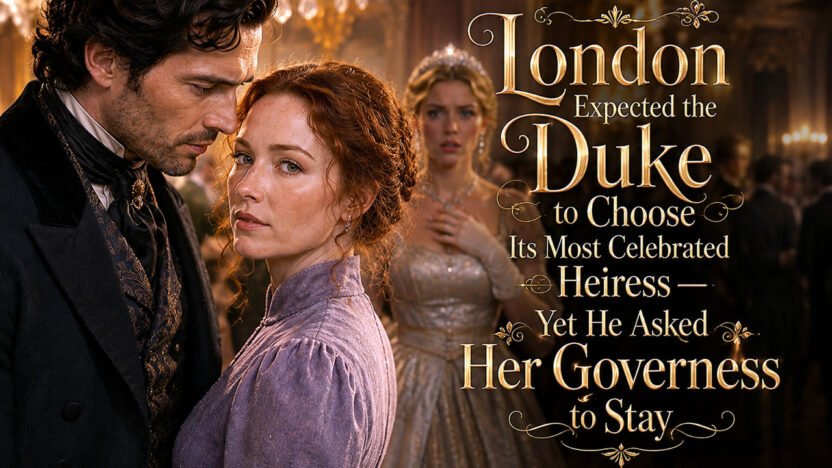
“Translate this for me,” Arthur whispered beneath the crash of thunder.
The scent of rain and old leather wrapped around them in the dim alcove. He paused, waiting for the slight, consenting tilt of her chin before his knuckles brushed the silver locket at her throat. Discovery here meant her instant dismissal and his absolute ruin. Yet as Eleanor leaned into his warmth, the quiet danger remained: could a duke truly forsake his duty?
Their impossible choice began weeks earlier, over a single misplaced book.
The carriage wheels crunched against the gravel of the Sterling estate, sealing Arthur Pendelton’s fate with the finality of a closing vault. As the Duke of Harrington, he had learned long ago that his life belonged not to himself, but to the dukedom. His older brother’s tragic death had seen to that, leaving Arthur with a heavy title, a grieving mother, and an inescapable duty to secure the line.
Now, at thirty-six, that duty had led him to the sprawling country manor of Lady Arabella Sterling. She was the season’s celebrated heiress, a vision of flawless blonde ringlets and perfectly fashionable silk gowns. A match between them would merge two powerful lineages and satisfy the Dowager Duchess of Harrington’s exacting standards. It was a transaction. Arthur understood this. He accepted it. Yet, as the footman opened the carriage door to the chaotic cheer of the house party, Arthur instinctively turned the heavy gold signet ring on his finger, feeling the familiar, suffocating weight of his own existence.
Inside the grand hall, the air was thick with the scent of hot wax, hothouse flowers, and aristocratic ambition. Lady Arabella greeted him with a breathy, rapid flutter of sentences that lacked any true substance, her laughter bright and hollow. Arthur offered his most practiced, formal smile. He spoke in the brief, commanding tones expected of a duke, giving nothing of his true self away. He was a title first, a man second. To blur the lines was a dereliction of duty.
Two floors above the glittering assembly, Miss Eleanor Vance occupied a different world entirely.
Dressed in an austere, high-necked gown of faded lavender wool, Eleanor sat at a small desk in the schoolroom, meticulously updating a leather-bound ledger. Every shilling was recorded. Every penny saved brought her closer to her ultimate desire: an independent school of her own. She touched the worn silver locket at her throat, the only remaining tie to her late father. His sudden death had left her at the mercy of cruel relatives, teaching her a brutal lesson. To depend on anyone else, especially a man of higher station, was to guarantee her own ruin.
Eleanor closed the ledger with a quiet snap. She was thirty-one, a gentlewoman by birth, but a governess by necessity. Downstairs, she was invisible furniture. Up here, she was the sovereign of her own small, fiercely protected life.
“Miss Vance,” her young pupil, Arabella’s little sister, called out from the window. “The Duke has arrived. He looks very tall. And very severe.”
“Dukes often practice severity, Jane,” Eleanor replied, her voice soft but clipped. “It saves them the trouble of having to be interesting. Now, return to your history lesson.”
Eleanor lifted her chin in quiet defiance of the grand estate around her. She did not care about the Duke of Harrington or his impending engagement. She cared only about securing a volume of Homer’s Iliad from the master library to prepare tomorrow’s Greek translation.
By the second evening of the house party, Arthur’s legendary self-control was fraying. The endless string of lavish dinners, hunting plans, and Lady Arabella’s vapid observations about the weather had left him intellectually starved and deeply exhausted. He required sanctuary.
Slipping away from the drawing-room while the guests were distracted by a terribly out-of-tune pianoforte performance, Arthur sought the one place in any country house that the ton reliably ignored.
The library was a vast, labyrinthine room, smelling of old parchment, dust, and beeswax. Arthur released a deep, quiet sigh as he sank into a worn leather armchair in the farthest alcove. For a moment, he closed his hazel eyes, allowing his rigid posture to finally soften. Here, he was not the prize of the season. He was merely a tired man.
A soft rustle of fabric broke the silence.
Arthur opened his eyes. Standing three aisles away, perched precariously on a rolling wooden ladder, was a woman in a gray-lavender dress. She had an untamable mass of auburn hair rigidly pinned back, and she was currently scowling at a high shelf.
Assuming her to be a maid dusting the upper volumes, Arthur cleared his throat. “I believe the treatises on agriculture are on the lower shelf, if you are attempting to clean them.”
Eleanor froze. She looked down, her amber eyes narrowing as they landed on the imposing figure in the armchair. She recognized the Duke of Harrington instantly, though in the dim light, he looked less like an untouchable aristocrat and more like a weary traveler seeking refuge.
“I am not cleaning, Your Grace,” Eleanor said, her tone meticulously respectful but carrying an unmistakable edge of dry wit. “I am attempting to locate the 1714 translation of the Iliad. Though, given the chaotic arrangement of this section, I suspect the librarian has chosen to organize the Greeks by the color of their bindings rather than their historical significance.”
Arthur raised a dark brow. It was highly irregular for a household employee to speak to him with such articulate, rapid precision, let alone to possess an opinion on Greek translations.
He stood, stepping out of the shadows. “You are Lady Arabella’s governess.”
“I am Miss Vance, yes.” Eleanor did not descend the ladder. She merely looked down at him, her chin lifted, refusing to be intimidated by his height or his title.
“And what use does a governess have for Homer?” Arthur asked, moving closer to the bookshelves. He wasn’t mocking her; his voice had dropped its public formality, replaced by a genuine, philosophical curiosity.
“I might ask what use a Duke has for hiding in the dark,” Eleanor countered smoothly, before catching herself. She touched her silver locket, a nervous habit. “Forgive me. The text is for my pupil’s advanced studies.”
Arthur looked at the shelf she was inspecting. He reached up easily, pulling down a heavy, faded blue volume that had been pushed too far back. He held it out to her.
Eleanor descended the ladder, her sensible shoes making no sound on the carpet. When she stepped into the alcove’s light, Arthur noticed the faint, unexpected scent of lavender soap and old parchment that clung to her. It smelled remarkably like the warm, intellectual sanctuary he had been desperately craving.
She reached for the book. Her fingers, small and ink-stained, brushed against the fine wool of his sleeve, a purely accidental contact. Yet, Arthur felt a strange, sudden stillness settle in his chest.
“You will find,” Arthur said quietly, his gaze locked on her intelligent amber eyes, “that this particular translator took far too many liberties with the concept of duty. He writes of Achilles as if obligation is a cage, rather than a choice.”
Eleanor paused, her hands gripping the heavy book. The Duke was supposed to be a cold, empty vessel of aristocratic duty. He was not supposed to harbor philosophical grievances about free will.
“Perhaps,” Eleanor replied, her voice dropping to a near whisper, “obligation is a cage, Your Grace. Especially for those who are never permitted the luxury of a choice.”
She saw the slight tightening of his jaw, the flash of something raw and deeply exhausted in his eyes. In that fleeting second, the invisible governess saw exactly what the rest of the glittering society upstairs missed: the Duke of Harrington was a prisoner of his own life.
And Arthur, looking down at the fierce, brilliant woman clutching a Greek epic to her chest, realized she was the first person in years who had spoken to him as an equal.
Eleanor offered a perfectly executed, albeit shallow, curtsy. “Thank you for the assistance, Your Grace. I shall leave you to your solitude.”
“Wait,” Arthur said, the command entirely absent from his voice. He rubbed the bridge of his nose, a gesture of quiet surrender. “The translation of Book Six is particularly flawed. Leave it on the desk by the window tomorrow evening. I will correct the margins for your pupil.”
Eleanor looked at him, recognizing the thinly veiled excuse for what it was. A task. A promise. A reason for their paths to cross again in this quiet room.
“As you wish, Your Grace,” she murmured.
She turned and slipped into the shadows, leaving Arthur alone once more. But as he sat back in the leather chair, the library no longer felt empty. He listened to the faint sound of her retreating footsteps, turning the gold signet ring on his finger, acutely aware that the silence of the estate had finally been broken.
PARTE 2
The relentless drumming of rain against the library windows became their silent chaperone. Over the next three days, the sprawling Sterling estate was confined indoors by a fierce autumn storm, forcing the house party into a claustrophobic cycle of parlor games, idle gossip, and stifling proximity. For Arthur, the hours spent in the grand drawing-room with Lady Arabella were an exercise in sheer endurance. She complained endlessly about the damp hem of her gowns, the impossibility of a proper hunt, and the dreary nature of the countryside, her breathy voice grating against his already frayed nerves.
His only reprieve was the library. And the quiet, precise notes left in the margins of the Iliad.
True to his word, Arthur had corrected the translation that first evening. When he returned the following night, seeking the quiet sanctuary of the alcove, he found that Miss Vance had not merely accepted his corrections; she had challenged them in a neat, elegant script. Beside his assertion that Hector fought out of unyielding duty, she had written: Or perhaps he fought because the alternative was watching the people he loved burn. Fear of loss is a powerful substitute for obligation, Your Grace.
Arthur had smiled—a genuine, rare expression that softened the harsh lines of his face. He had written back. She had replied. The debate continued in the margins for two days, a secret, intellectual dance hidden between the leather bindings, before it finally spilled into the hushed air of the library itself.
It was late afternoon, the room cast in the dim, gray light of the storm. Eleanor sat at the large oak table, entirely absorbed in a stack of philosophical essays. She looked paler than usual, her amber eyes shadowed with a fatigue she was trying desperately to hide. Arthur stood by the window, watching her with a quiet, intense observation that would have scandalized the ton, had anyone been perceptive enough to notice.
He noticed the way she tapped her index finger against her thigh when she was dissecting a difficult passage. He noticed how she subconsciously touched her silver locket whenever the heavy oak door out in the corridor creaked, as if preparing to shrink back into her invisible armor. Most of all, he noticed that she had not attended the servants’ midday meal.
Arthur turned his heavy gold signet ring around his finger, a sudden, fierce protectiveness rising in his chest. It was a strange, unsettling sensation, entirely divorced from the hollow, inherited duty he felt toward his family name. This was a specific, acute desire to care for a woman who stubbornly refused to be cared for by anyone.
Without a word, he left the library. When he returned ten minutes later, he did not ring for a servant. He carried a small silver tray himself, holding a steaming porcelain teapot and two delicate cups.
Eleanor looked up, startled, as he set the tray gently onto the edge of her desk.
“Your Grace,” she said, her voice tight with immediate apprehension. She instinctively straightened her spine, slipping seamlessly back into the role of the deferential employee. “You should not be carrying trays. There are footmen for that.”
“The footmen are currently occupied with Lady Arabella’s demands for drier firewood and more perfectly tuned instruments,” Arthur replied, his tone perfectly even, though a hint of dry irony colored the words. He poured the tea, the rich, bergamot scent of Earl Grey mixing with the comforting smell of old leather and damp wool. “Besides, I observed that you have skipped your meals twice in the last two days, Miss Vance. One cannot wage a proper war in the margins of Homer on an empty stomach.”
Eleanor stared at the steaming cup he pushed toward her. It was a simple, domestic gesture, yet it struck a profound, terrifying chord within her chest. No one in this grand house—or any house she had lived in since her father died—had noticed whether she ate or starved. She was the governess. Her physical comfort was utterly irrelevant to the machinery of the aristocratic world.
To accept the tea was to accept his care, and that felt far more dangerous than debating ancient literature.
“I was merely occupied with my pupil’s lesson plans,” she murmured, her fierce pride warring with her genuine hunger.
“Drink the tea, Eleanor,” he said quietly.
It was the first time he had used her given name. The sound of it, spoken in his deep, slightly raspy voice, sent a sudden rush of heat through her chest. She looked up, fully intending to correct his improper familiarity, but the reprimand died in her throat. The cynical, imposing Duke of Harrington was gone. In his place was a man looking at her with such clear, unvarnished understanding that she felt entirely exposed.
She picked up the cup. Her small, ink-stained hands trembled slightly, betraying the calm facade she fought so hard to maintain. The tea was warm, sharp, and exactly what she needed.
Arthur took his own cup and leaned against the edge of the heavy desk, closing the physical distance between them in a way that felt deliberate, yet entirely unthreatening. The rain battered the glass, sealing them in their own private, shadowed world, far removed from the expectations waiting downstairs.
“You disagree with my assessment of Hector,” Arthur stated softly, bringing the conversation back to the safe, intellectual ground they had established.
Eleanor took a slow breath, letting the familiar rhythm of academic debate steady her racing pulse. “I believe you view the world through the lens of your own experience, Your Grace. You see duty as the only driving force of a man’s life because it is the only force you permit yourself to acknowledge.”
Arthur rubbed the bridge of his nose, the gesture stripped of all his usual aristocratic pretense. “Duty is not a choice I make, Miss Vance. It is the air I am forced to breathe.” He looked down at the dark liquid in his cup, his profile stark against the gray window light. “My older brother was the heir. He was brilliant, vibrant, the very sun around which my entire family orbited. I was the spare, perfectly content to exist in my shadows and my books.”
Eleanor remained completely still, recognizing the profound rarity of what he was doing. The cold, untouchable duke was bleeding out a private grief, offering it to her without expectation of pity.
“When he died,” Arthur continued, his voice dropping to a harsh, quiet whisper, “the title fell to me. The expectations, the estates, the legacy. I had to bury the man I was to become the duke they required. There is no freedom in that kind of survival. Only obligation. I am a title first, and a man second.”
The raw vulnerability in his confession resonated deep within Eleanor’s own hidden wounds. She understood the crushing weight of sudden loss, the brutal way the world demanded you become someone else just to endure it.
“When my father passed,” Eleanor said, her voice soft, offering her own truth in exchange for his, “he left me with a brilliant mind, a heart full of grief, and an entirely empty purse. The relatives who took me in made it abundantly clear that my presence was a burden they resented. I learned very quickly that to rely on anyone else is to invite humiliation.”
She reached up, her fingers grazing the worn silver locket. “I became a governess because I would rather be invisible and employed than visible and indebted. I am saving every wage I earn for a school of my own. I want a door I can lock, a roof that belongs to me, and a life where I never have to wait for someone else to decide my fate.”
Arthur looked at her, his hazel eyes completely devoid of the cynicism that usually shielded them. He did not offer empty platitudes or aristocratic pity. He simply saw her. He saw the fierce, protective independence that masked her profound fear of being discarded.
“You are the strongest person in this house, Eleanor,” he said quietly.
The absolute sincerity of his words caused a tight, painful ache in her throat. It was exactly what she had starved for during all her years of servitude—to be truly seen and respected as an absolute equal.
She stood up abruptly, overwhelmed by the sudden, terrifying urge to close the remaining distance between them and rest her head against his chest. It was a foolish, ruinous impulse, one that would destroy everything she had worked for.
“I must return these volumes to the upper gallery,” she said, her voice slightly breathless as she turned toward a precarious stack of heavy encyclopedias resting on a nearby wooden stool.
Her haste made her clumsy. As she reached for the towering stack, her woolen sleeve caught the edge of a thick leather binding. The heavy books shifted, tilting dangerously backward toward her.
Before they could fall, Arthur moved.
He stepped into her space with fluid, protective speed. His large hand cupped her elbow, his grip firm but incredibly gentle, pulling her out of the path of the collapsing books. The heavy volumes crashed to the carpet with a dull thud, sending up a small cloud of dust, but Eleanor barely heard the noise.
All she could feel was the warmth of his hand radiating through the wool of her sleeve.
They were standing agonizingly close. The scent of rain, old paper, and his subtle soap enveloped her entirely. She could feel the steady, reassuring heat of his body, the slight, uneven change in his breathing as he looked down at her. His hand remained on her elbow for a breath too long, his thumb resting against the inside of her joint in a gesture that was entirely proper in its mechanics, yet devastatingly intimate in its execution.
Eleanor did not pull away. She had the clear opportunity to step back, to reestablish the boundaries of their stations, but she chose to stay. The silence stretched between them, thick with the unspoken realization of how easily she had let him protect her, and how much she wanted him to do it again.
Arthur looked from her parted lips to her amber eyes, his own gaze darkening with a banked, heavy desire. He slowly released her elbow, letting his hand fall to his side, deliberately giving her the space and autonomy she so desperately needed.
“Translate this for me,” Arthur murmured, his voice a low, rough vibration in the quiet room.
Eleanor’s breath hitched. She knew he was not asking about the Greek texts scattered on the table. It was their private language, evolving in real time. He was asking her to explain the sudden, undeniable pull between them. He was asking her to admit that they had crossed an invisible line, that they were no longer just a duke and a governess passing time in the shadows.
“I cannot,” Eleanor whispered, her heart hammering wildly against her ribs. She took a deliberate step back, preserving her dignity even as her emotional defenses crumbled entirely. “Some things, Your Grace, are far too dangerous to read aloud.”
Arthur did not push her. He simply nodded, accepting her boundary, though the profound shift in the air remained absolute.
As Eleanor quickly gathered her ledgers and fled the library, the bitter truth settled over them both. This was no longer a matter of intellectual curiosity or polite rebellion against societal norms. The cold, dutiful duke and the fiercely independent governess had begun to trust one another. And in a world governed by rigid class divides and unbreakable obligations, that unexpected trust was the most dangerous thing they could possibly share.
PARTE 3
The relentless rain of the fourth day brought an unexpected, heavy carriage up the sweeping gravel drive of the Sterling estate. The Dowager Duchess of Harrington had arrived. With her ivory-handled cane striking the marble floors and her piercing hazel eyes—eyes that mirrored Arthur’s exactly—she brought the full, crushing weight of the Harrington legacy directly into the drawing-room. Her arrival was not a polite social call; it was a deadline. The impending engagement to Lady Arabella, which Arthur had successfully delayed with vague pleasantries, was now to be formalized. The announcement was expected at the grand ball in two days.
Arthur stood by the grand fireplace, listening to his mother finalize the guest list with Lady Arabella’s mother. The two matriarchs spoke of the union not as a marriage, but as a merger of empires. Arabella sat nearby, inspecting a silk ribbon, entirely unbothered by the fact that her future husband had barely spoken three words to her all afternoon. Arthur turned the heavy gold signet ring on his finger, twisting it until the metal dug painfully into his skin. The walls of the grand house were closing in, the air growing impossibly thin beneath the suffocating demands of duty.
Two floors above, Eleanor felt the distinct shift in the atmosphere of the estate. The servants’ corridors hummed with frantic energy and whispered gossip about the Dowager Duchess’s arrival and the impending midnight toast. Eleanor sat in the schoolroom, her ledger open before her, but the columns of numbers blurred beneath her gaze. She pressed her ink-stained fingers against her temples, fighting the cold, leaden ache expanding in her chest. She had spent her entire life mastering the art of invisibility, shielding her pride behind the strict rules of her employment. Yet, the thought of the Duke formally binding his life to another woman caused a sharp, physical pain she could not neatly categorize in her ledgers.
She closed the book with a definitive snap. She was Miss Vance, the governess. She had a savings box hidden beneath her bed and a dream of a school in Yorkshire. She did not have the luxury of a broken heart, especially over a man who belonged to the peerage. Desperate to reclaim her fiercely guarded independence, Eleanor waited until the house settled into the quiet hours of the evening. She slipped down the servants’ stairs, seeking the only sanctuary that offered her peace. She needed the scent of old paper and the quiet rhythm of academic study to anchor her fraying nerves.
The library was entirely dark, save for the faint, flickering glow of a single lamp in the furthest alcove. Eleanor’s footsteps slowed as she approached the heavy oak tables. She expected to find the room empty, but as she rounded the towering bookshelves, she stopped abruptly. Arthur was sitting in the worn leather armchair, his long legs stretched out toward the meager fire, his cravat loosened, and his formal jacket discarded over the back of the chair. It was a shocking breach of aristocratic decorum, revealing a profound, unguarded exhaustion that immediately bypassed all of Eleanor’s carefully constructed defenses.
He did not look like the untouchable Duke of Harrington. He looked like a man who had been fighting a quiet, losing war against his own existence. Eleanor knew she should retreat. The rules of her station demanded that she turn around and return to the shadows of the servants’ quarters. But her feet remained firmly planted on the woven carpet. When Arthur finally lifted his head, the raw relief that washed over his sharp features at the sight of her shattered any remaining illusion that they were merely passing acquaintances.
“I thought the storm might keep you away tonight,” Arthur said, his voice a low, raspy murmur that seemed to vibrate in the quiet room. He did not stand, offering her a rare, informal intimacy that felt far more dangerous than any spoken confession.
“The storm upstairs is far more daunting than the one outside, Your Grace,” Eleanor replied softly, moving cautiously into the alcove. She did not reach for a book. She simply stood near the edge of the heavy desk, allowing the warmth of the small fire to chase the damp chill from her woolen gown. “I understand congratulations will soon be in order.”
Arthur flinched, the slight movement barely visible, but Eleanor saw it. He rubbed the bridge of his nose, closing his eyes against the flickering light. “Do not congratulate a man on the locking of his own cell, Eleanor. It is entirely cruel, and I know you are not a cruel woman.”
The use of her given name, spoken with such heavy resignation, pulled at the deepest, most vulnerable parts of her soul. She watched as he leaned forward, pouring hot water from a small brass kettle into the teapot resting on the low table. The familiar, comforting scent of bergamot and black tea filled the space between them. It was their shared ritual, a quiet domesticity that belonged to no one else in the sprawling estate.
Arthur stood and offered her the delicate porcelain cup. Eleanor reached for it, her eyes fixed on the dark liquid rather than his face. But as her fingers closed around the saucer, Arthur did not immediately let go. His large, warm hand remained over hers, his thumb resting gently against the side of her wrist. The contact was deliberate, lingering for a breathless, agonizing second too long. Eleanor’s pulse hammered wildly against her skin, the heat of his touch radiating straight through her practical wool sleeves, melting the ice of her rigid self-control.
She looked up, her breath catching in her throat. The distance between them had vanished. They were standing so close that she could see the subtle flecks of gold hidden in his dark hazel eyes, could feel the slight, uneven warmth of his breath against the crown of her head. The heavy silence of the library was suddenly deafening, amplifying the dangerous, undeniable truth of what they were doing. This was no longer a debate over classical texts. This was a profound, quiet surrender.
A violent crash of thunder rattled the tall glass windows, sending a sharp, cold draft sweeping through the alcove. Without thinking, Arthur stepped even closer, his broad shoulders physically shielding her from the sudden chill. The scent of rain and old leather wrapped around them, isolating them in a fragile, shadowed world that belonged entirely to them.
“Translate this for me,” Arthur whispered beneath the crash of thunder.
He was not speaking of Homer. He was speaking of the desperate, impossible longing vibrating in the space between their bodies. He paused, his hand hovering in the air between them, offering her the absolute freedom to step away, to protect her hard-won independence and flee back to the safety of her station. He waited, his chest rising and falling heavily, demanding nothing, yet offering everything.
Eleanor did not step back. Slowly, deliberately, she tilted her chin upward, her amber eyes softening with a brave, terrifying consent. She was granting him access to the grief and the brilliance she had hidden away from the world for so long.
Arthur let out a ragged breath. He closed the final fraction of distance, his knuckles gently brushing the worn silver locket resting against her throat. The back of his hand rested against her bare collarbone. The gesture shattered every rule of Victorian etiquette, crossing a boundary that promised instant dismissal for her and monumental scandal for him. Yet, as his fingers traced the cool metal of the locket, the touch was infinitely more intimate than a kiss. He was touching her past, her sorrow, and the fierce pride that kept her alive.
“Why do you hide your brilliance in the shadows?” Arthur asked, his voice breaking as his thumb softly stroked the edge of the silver pendant, his knuckles warm against her skin. “Why do you let them treat you as if you are invisible, when you are the most vivid, extraordinary thing I have ever known?”
Eleanor leaned into his warmth, her eyes slipping shut as a single, treacherous tear escaped her lashes. For the first time in her adult life, she felt entirely seen, completely understood, and perfectly safe. Her hands hovered over the lapels of his discarded jacket, aching to hold him, to claim the fierce, protective care he was offering. The emotional hunger that had starved them both for years was finally being answered in the quiet dark of the library.
But the cruel reality of their world rarely allowed such sanctuary to endure.
The heavy double doors at the far end of the library groaned open. The sharp, commanding voice of the Dowager Duchess echoed through the cavernous room, demanding to know where her son had disappeared to, accompanied by the heavy, authoritative tap of her ivory cane against the floorboards.
The sound was a physical blow. The illusion of their safety shattered instantly. Discovery here meant Eleanor’s total ruin; she would be cast out without a character reference, her dreams of a school destroyed, her dignity ground into the dirt by the very people who demanded Arthur’s loyalty.
Arthur froze, his jaw clenching with a helpless, violent fury. He looked down at Eleanor, his hand dropping from her locket as if he had been burned. The agony of realization washed over his features. By stepping into the light to care for her, he had dragged her into the direct path of his family’s destructive expectations. To protect her, he had to leave her.
“Go,” Arthur whispered, his voice harsh with suppressed panic and absolute despair. He stepped back, instantly reassembling the cold, impenetrable armor of the Duke of Harrington. “Through the servants’ door in the gallery. Do not let them see you.”
Eleanor did not argue. The fierce independence that had kept her alive snapped back into place, a cold, necessary shield against the devastating loss she felt. She turned and slipped quietly into the shadows of the book stacks, a ghost retreating into the walls of the grand estate. As she hurried up the narrow servant stairs, her hands shaking and her heart bruised beyond measure, the truth settled heavily upon her shoulders. She had survived poverty, grief, and humiliation. But she was not entirely sure she could survive the quiet agony of loving a man who belonged to a world that would never accept her.
PARTE 4
The morning sun offered no warmth to the Sterling estate, merely a harsh, unforgiving light that exposed the grand house for what it truly was: a gilded cage preparing for a spectacle. The storm had finally broken, leaving behind a crisp, biting chill. Inside, the corridors hummed with a frantic, suffocating energy. Servants rushed past with armfuls of white roses and lengths of silver ribbon, transforming the ballroom for the evening’s grand gala. Tonight, at the stroke of midnight, the Duke of Harrington was expected to raise his glass and formally bind his legacy to Lady Arabella.
Arthur stood by the drawing-room window, staring out at the damp, manicured lawns, his posture as rigid as the glass panes. His mother, the Dowager Duchess, sat near the fire, dictating the precise timing of the evening’s announcements to Lady Sterling. They spoke of Arthur as if he were a prized stallion, a necessary component in an elaborate financial transaction. He did not argue. He did not raise his voice. He simply turned the heavy gold signet ring on his finger, his jaw clenched so tightly it ached.
Since the agonizing interruption in the library the night before, Arthur had not spoken to Eleanor. He had convinced himself that distance was the only honorable shield he could offer her. If his mother or Lady Sterling suspected even a fraction of the profound, shattering truth he harbored for the governess, Eleanor’s reputation would be decimated before nightfall. She would be dismissed, destitute, and destroyed by the very society Arthur was sworn to uphold. He believed that by playing the cold, dutiful duke, he was protecting the woman he loved. He planned to quietly dismantle the engagement negotiations the following week, away from the prying eyes of the house party. He thought he was being wise. He did not realize he was being a coward.
Two floors above, the silence of the schoolroom was absolute and terrifying. Eleanor sat perfectly still at her small wooden desk, her hands folded neatly over her ledger. The faint scent of lavender soap still clung to her skin, a cruel reminder of the warmth she had almost allowed herself to claim. She had not slept. Every time she closed her eyes, she felt the ghost of Arthur’s knuckles brushing against her silver locket, heard the raw, desperate break in his voice asking why she hid her brilliance.
But daylight had brought the crushing weight of reality. Through the open door of the corridor, Eleanor had spent the morning listening to the maids gossiping about the Dowager’s demands and the spectacular emerald necklace the Duke was rumored to present to Lady Arabella at midnight. The machinery of the aristocracy was in full motion, an unstoppable force that crushed anything in its path.
Eleanor pressed her fingers to her lips, suppressing a quiet, jagged breath. She had misinterpreted his silence. When Arthur had stepped away from her in the library, his face masked in cold aristocratic detachment, she had assumed the worst. She believed that when faced with the terrifying wrath of his mother and the monumental expectations of his title, he had chosen his duty over her. He had chosen the safety of his world over the ruinous risk of hers.
Her false belief, the armor she had worn since her father’s death, hardened into an impenetrable shell around her heart. To depend on a man of higher station was to guarantee her own humiliation. She would not be the discarded secret, a fleeting intellectual amusement left behind while he pledged his life to a woman of consequence. Her pride, fierce and protective, demanded action.
Moving with a deliberate, mechanical precision, Eleanor pulled a worn leather valise from beneath her narrow bed. She began to pack her meager belongings. A few woolen dresses, a sensible pair of shoes, her father’s notes, and the small wooden box containing the wages she had saved for her independent school. She folded her gray-lavender gown, her hands trembling only slightly as she smoothed the practical fabric. The dream of Yorkshire, of a quiet life she controlled entirely, was the only lifeline she had left. She would secure a carriage to the village inn before the midnight toast, slipping away under the cover of the ball’s chaotic revelry. It was the only way to preserve her dignity.
Before she closed the valise, Eleanor returned to her desk. She drew a fresh sheet of parchment and dipped her pen into the inkwell. She wrote a brief, formal letter of resignation addressed to Lord and Lady Sterling, citing an urgent family matter that required her immediate departure.
But there was a second letter.
She pulled a smaller, thicker piece of paper from her drawer, her hand hovering over the page. She did not write of anger or betrayal. She wrote of profound, agonizing clarity. She thanked him for the quiet hours in the library, for the tea, and for the brief, beautiful illusion that a duke and a governess might speak as equals. She told him that she could not bear to witness him lock the cell he had so desperately wished to escape, and that she was choosing her own freedom before it could be taken from her.
In the late afternoon, while the house was consumed with the final preparations for the ball and the guests were resting in their chambers, Eleanor slipped down the servants’ stairs. The library was empty, the hearth cold and swept clean. The heavy scent of old paper and leather immediately constricted her throat, bringing the sting of unshed tears to her amber eyes. She walked to the alcove, running her fingers lightly over the back of the worn leather armchair. She placed her folded note squarely in the center of the desk, right atop the volume of Homer they had debated so fiercely. She did not look back as she walked out the door.
By ten o’clock that evening, the Sterling ballroom was a blinding display of wealth and power. Hundreds of wax candles illuminated the swirling silks and glittering jewels of the ton. An orchestra played a sweeping waltz, the music soaring above the clatter of crystal glasses and hollow laughter.
Arthur stood at the edge of the dance floor, dressed in severe, impeccable evening clothes. Lady Arabella was at his side, her hand resting lightly on his arm as she accepted compliments from passing aristocrats. She was radiant, entirely absorbed in her own triumph. Arthur felt nothing but a cold, expanding void in his chest.
He scanned the periphery of the room, his hazel eyes searching the shadows near the pillars, desperately hoping to catch a glimpse of muted gray wool. He knew Eleanor was not required to attend, but the sheer, physical ache of her absence was becoming unbearable. Every piece of music, every polite nod he offered, felt like a betrayal of the truth he had discovered in the quiet dark of the library. He was surviving, just as he had since his brother died, but he was not living.
“Arthur,” the Dowager Duchess said, appearing suddenly at his left side, her cane striking the polished floor. “The Duke of Wellington is asking for your opinion on the agricultural reforms. And do try to look slightly more engaged. In less than two hours, you will secure the future of this family.”
Arthur looked at his mother. For the first time in his life, the commanding tone of her voice did not inspire obedience. It inspired absolute, blinding clarity. He saw the endless years stretching before him—a life composed of polite conversations, strategic alliances, and a profound, echoing loneliness. He would be the perfect Duke of Harrington, and he would die completely hollow inside.
“Excuse me,” Arthur murmured abruptly, stepping away from his mother and Lady Arabella without waiting for a reply.
He ignored the startled murmurs of the guests as he strode out of the ballroom. The heavy, perfumed air of the gala fell away as he navigated the long, empty corridors toward the west wing. He needed the quiet. He needed to figure out how to dismantle this trap before midnight.
When Arthur opened the doors to the library, the absolute stillness of the room felt like a physical blow. The moonlight spilled across the woven carpet, illuminating the empty leather armchair. He walked slowly toward the alcove, seeking the comforting scent of lavender and old parchment.
Instead, he found the note.
The small, neatly folded parchment rested on the heavy desk, pale and stark in the moonlight. Arthur’s heart stopped. He recognized her elegant, precise handwriting immediately. His large hands actually trembled as he broke the simple wax seal.
He read the words twice, the blood rushing in his ears, drowning out the faint sound of the orchestra playing far away.
You view duty as a cage, Your Grace, yet you have chosen to turn the key yourself. I cannot stay and watch you surrender the brilliant, feeling man I have come to know to the shadows of an inherited title. I am choosing my own freedom. Do not look for me.
Arthur stared at the paper, the devastating truth crashing over him with the force of a physical blow. He had not protected her. His silence, his cowardice disguised as duty, had broken her heart. He had made her feel invisible all over again. He had forced her to flee into the night, abandoning the small security she had built, simply because he was too afraid to stand against the expectations of his world.
He crushed the letter in his fist, his breathing ragged and shallow. The elaborate facade of the Duke of Harrington, constructed over years of grief and obligation, shattered completely in the quiet dark of the library.
He looked at the grand clock ticking on the mantle. It was half past eleven. The midnight toast was imminent. The entire aristocracy of England was waiting in the ballroom to witness him claim his designated prize.
Arthur turned his gold signet ring around his finger one last time. Then, with a sudden, violent motion, he pulled it off entirely, dropping the heavy symbol of his absolute compliance onto the desk beside the volume of Homer. He did not care about the scandal. He did not care about the legacy. He only cared about the woman currently riding away in the dark.
Arthur turned on his heel and broke into a sprint.
PARTE 5
The hired carriage smelled of damp straw and wet wool, a cold, jolting reality that rattled Eleanor’s bones with every turn of the heavy wheels. Outside, the autumn storm had returned with a vengeance, lashing rain against the thin glass of the windows as the vehicle crept down the long, winding drive of the Sterling estate. She sat rigidly on the narrow leather seat, her small valise clutched tightly in her lap like a shield. She had done it. She had preserved her dignity. She had secured her independence.
Yet, as the grand, illuminated silhouette of the manor faded into the darkness behind her, Eleanor felt no triumph. She felt only a profound, devastating emptiness. She touched the worn silver locket at her throat, the metal cold against her skin, and closed her eyes. She imagined the ballroom, the glittering lights, the crystal glasses raised in a midnight toast. She imagined Arthur, standing tall and impenetrable, binding himself to a woman who would never understand the beautiful, weary soul hidden beneath his aristocratic armor. The thought was a physical agony, a sharp, twisting ache in her chest that made it difficult to draw a full breath. She had survived a lifetime of being invisible, but she knew, with terrifying certainty, that she would never survive the memory of being seen by him.
Back at the manor, the grand clock in the hallway began to chime the quarter hour before midnight. Arthur did not hear it. He was moving with a desperate, reckless speed that defied every rule of composure he had ever been taught. He tore through the servants’ corridors, bypassing the grand staircase entirely, his severe evening jacket abandoned somewhere near the library doors. The few maids he passed pressed themselves against the flocked wallpaper, their eyes wide with shock as the normally impenetrable Duke of Harrington sprinted past them, his pristine cravat hanging loose, his dark hair falling into his eyes.
He burst through the heavy oak doors of the kitchen and out into the freezing, torrential downpour of the stable yard. The cold hit him like a physical blow, instantly soaking his fine linen shirt, but he welcomed the harsh, biting reality of the storm. It was the first time in years he felt entirely, undeniably awake. He had spent his life suffocating in the stifling warmth of drawing-rooms, making choices designed to please ghosts and protect a legacy he had never asked for. Tonight, he was choosing the rain. He was choosing the woman who had made him remember what it meant to breathe.
“Saddle the black gelding,” Arthur shouted over the roar of the wind, startling the drowsy stable master who had been dozing near a lantern.
The older man scrambled to his feet, stammering about the weather and the lack of a proper riding coat, but Arthur did not wait. He grabbed a bridle from the wall, his hands working with frantic efficiency. He did not bother with a saddle. He vaulted onto the horse’s bare back, his powerful thighs gripping the animal’s sides, and spurred the gelding out into the pitch-black night.
The gravel drive was a treacherous ribbon of mud and deep puddles, but Arthur rode with a blind, terrifying focus. The icy rain plastered his shirt to his skin and stung his eyes, but all he could see was the small, neatly folded parchment on the library desk. I am choosing my own freedom. Do not look for me. She believed he lacked the courage to step out of his cage. She believed he had chosen the crushing weight of his title over the quiet, brilliant sanctuary of her heart. He pushed the horse faster, the rhythmic thud of hooves fighting against the howling wind. He had to reach her before the carriage turned onto the main London road. If he lost her tonight, he knew with absolute certainty he would lose the only true piece of his soul he had left.
Inside the carriage, Eleanor jumped as the vehicle suddenly swerved, the wheels sliding precariously in the deep mud before grinding to a violent, jarring halt. The driver shouted something unintelligible over the wind, followed by the terrifying sound of a restless horse stamping the ground directly outside her window. Eleanor’s heart hammered against her ribs. She pulled her woolen cloak tighter around her shoulders, her mind racing with thoughts of highwaymen, her fingers instinctively curling around the handle of her valise.
The carriage door was wrenched open, the wind howling violently into the small cabin.
Eleanor gasped, shrinking back against the leather seat. But it was not a highwayman illuminated by the flickering carriage lantern. It was Arthur.
He was entirely drenched, his dark hair plastered to his forehead, his fine linen shirt soaked through and clinging to his broad chest. He was breathing heavily, his chest heaving, his hands gripping the wooden frame of the door as if it were the only thing keeping him tethered to the earth. The aristocratic facade, the cold, impenetrable Duke of Harrington, was completely gone. In his place was a wild, desperate man, stripped of everything but the raw, unfiltered truth in his hazel eyes.
“You left,” Arthur said, his voice a harsh, raspy shout over the sound of the rain.
Eleanor stared at him, her entire body trembling, unable to comprehend the impossible sight before her. “Your Grace—what are you doing here? The engagement toast—the Dowager Duchess—”
“I left the ring on the desk,” Arthur interrupted, his voice dropping, carrying a fierce, unwavering intensity that cut straight through the noise of the storm. He stepped closer, the rain dripping from his jaw, refusing to enter the carriage but refusing to let her close the door. “I took it off, Eleanor. I left the ring, I left the ballroom, and I left the cage. I do not care about the toast. I do not care about the scandal. I only care that you are currently sitting in a freezing carriage, running away from me because I was too much of a coward to speak when it mattered.”
Eleanor’s breath hitched, a painful, desperate sound. She gripped her valise so tightly her knuckles turned white, terrified to believe the words he was saying, terrified that this was a cruel illusion born of her own grief. “You have a duty to your family name. You cannot simply walk away from a dukedom for a governess. They will ruin you, Arthur. They will humiliate us both.”
“Let them try,” Arthur replied, his jaw hardening with a protective, unyielding resolve. He reached out, his large, rain-soaked hand gently covering her small, trembling fingers, loosening her white-knuckled grip on the valise. The sudden, intense warmth of his touch sent a shockwave straight to her heart. “I have spent my entire life trying to be the man they required. I am done. I do not want the legacy if it means a lifetime of empty rooms and polite conversations. I want the quiet. I want the fire in the library. I want you.”
Eleanor shook her head, tears finally spilling over her lashes, mixing with the damp chill of the air. “I cannot be a Duchess, Arthur. I will not survive in their world. I will not be a bird in a gilded cage, waiting for society to deem me worthy. I have fought too hard for my independence to surrender it now.”
“I am not asking you to surrender your independence, Eleanor,” Arthur said softly, his thumb tracing the delicate line of her wrist, sending a fierce, undeniable heat radiating up her arm. “And I am not asking you to step into my world. I am asking if I might be permitted to step into yours.”
He paused, letting the magnitude of his choice settle between them. He was not rescuing her with his wealth; he was asking for a partnership. He looked at her, his hazel eyes burning with an emotion so profound and entirely specific to her that it shattered the last of her protective armor.
“I knew I loved you,” Arthur whispered, the words carrying the weight of an absolute vow, “when I watched you tap your index finger against your thigh while fiercely dissecting the flaws in a Greek translation. I knew it when I watched from the window as you defended your young pupil’s right to play in the mud during a rainstorm, refusing to let them be stifled by ridiculous rules of decorum.”
He reached up, his wet fingers gently brushing the silver locket at her throat, waiting for her slight, consenting tilt of the chin before letting his hand rest against her warm cheek. “But mostly, Eleanor, I knew it because you made a cold, isolated man realize he had been starving for a true home his entire life. You are my equal in every way that matters. I will fund your school in Yorkshire. I will build it with you, not for you. We will read Homer, we will drink Earl Grey, and we will let the ton rot in their own superficiality. But I cannot do it without you.”
Eleanor looked into his eyes, seeing the complete, beautiful vulnerability he had entrusted to her. The false belief that had governed her life—that dependence meant ruin—finally dissolved. She realized that accepting his love did not erase her strength; it simply meant she no longer had to carry the weight of the world alone. She saw the man she admired, the man who listened to her, the man who had ridden through a storm, throwing away an empire simply to hold her hand.
“Translate this for me,” Eleanor whispered, her voice trembling with a radiant, overwhelming joy.
Arthur’s eyes darkened with profound relief and fierce desire. He did not hesitate. He leaned into the carriage, bringing his face inches from hers. He paused for one agonizing, breathless second, giving her the final choice. Eleanor closed the distance, her small hands rising to grip the wet fabric of his shirt, pulling him down to her.
The kiss was a desperate, breathless collision of relief and absolute surrender. It tasted of rain, tears, and the fierce, undeniable heat of two guarded souls finally finding their safe harbor. Arthur’s large hand cupped the back of her head, his fingers tangling in her pinned auburn hair, anchoring her to him as if she were the only solid thing in a crumbling world. There was no hesitation, no holding back. It was a kiss that shattered the boundaries of class and duty, a profound, physical vow that they belonged to one another, entirely and irrevocably. Eleanor poured years of hidden passion and silent longing into the embrace, matching his intensity, proving that her heart was as fierce and unyielding as his own.
When they finally broke apart, both of them breathing heavily, Arthur rested his wet forehead against hers. He kept his eyes closed, a soft, genuine smile touching his lips. “I believe the translation,” he murmured, his voice a low, raspy vibration against her skin, “is that we are going to Yorkshire.”
Three years later, the heavy autumn rain lashed against the tall glass windows of the Vance-Pendelton Academy for Young Women. The storm outside was fierce, but inside the sprawling, wood-paneled library, the air was perfectly warm and profoundly peaceful.
Eleanor sat at a large oak desk, bathed in the soft, golden light of the afternoon sun that occasionally broke through the clouds. She was no longer wearing austere, faded gray wool, but a beautiful, rich gown of deep forest green silk. Her auburn hair was still pinned up, but softer now, with stray curls framing her face. She was tapping her index finger rhythmically against her thigh, her amber eyes narrowed in intense concentration as she reviewed the architectural plans for the new dormitory wing.
The door to the library opened with a soft click. Arthur stepped into the room, his tall frame cutting a striking figure in a casual, tailored waistcoat. The severe, exhausted Duke of Harrington was a distant memory. The man who walked toward her possessed a relaxed, easy grace, his hazel eyes bright with a quiet, enduring contentment. He carried a small silver tray, the familiar, comforting scent of bergamot and black tea preceding him.
He set the tray gently on the corner of the desk, mindful of the sprawling blueprints. Eleanor looked up, a warm, instinctual smile spreading across her face at the sight of him. The silver locket still rested at her throat, but it was no longer a shield protecting her grief; it was simply a cherished memory, resting above a heart that was entirely full.
Arthur poured the Earl Grey, handing her a delicate porcelain cup. As she took it, his fingers lingered over hers, a deliberate, intimate caress that still made her pulse skip, even after three years of marriage. The scandal of their union had rocked London, furious letters had been exchanged, and the Dowager Duchess had threatened ruin. But in the quiet hills of Yorkshire, surrounded by a school that empowered young women to command their own destinies, none of the ton’s outrage mattered. They had built an empire of their own design.
Arthur moved behind her chair, his hands coming to rest warmly on her shoulders. He leaned down, pressing a soft, lingering kiss to the crown of her head.
“The structural supports for the new library look sound,” Arthur murmured, his voice a low, comforting rumble near her ear. “Though I expect you will still insist on climbing the highest ladders yourself to arrange the Greek texts.”
Eleanor leaned back into his solid warmth, closing her eyes as a profound sense of safety washed over her. She reached up, resting her hand over his where it gripped her shoulder. “Naturally, my love. After all, someone must ensure the translations are accurate. I cannot leave such important matters to a man who believes duty is a cage.”
Arthur let out a low, rich chuckle, the sound vibrating through her chest. He turned his hand, threading his fingers perfectly through hers. “I stand corrected, Mrs. Pendelton,” he whispered, looking out at the rain washing over the sturdy stone walls of the home they had built together. “Duty is not a cage at all. It is a privilege, when you finally find the one soul worth serving.”