The heavy oak clock in the corner of the room ticked with the rhythmic, merciless precision of an executioner’s drum. Lady Clara Ashford sat perfectly still on the edge of a dark leather chair, her gloved hands folded so tightly in her lap that her knuckles ached beneath the faded silk. She did not look at the towering bookshelves that lined the walls. She did not look at the priceless tapestries that swallowed the faint afternoon light. She kept her eyes fixed on the massive mahogany doors at the far end of the study, waiting for the monster to walk through them.
Julian Vance, the Duke of Blackwood, was not a man who granted favors. He was a man who collected debts, destroyed rivals, and possessed a reputation so ruthless that London society had long ago crowned him the Iron Duke. He was wealth and power incarnate, answering to no one but the Crown itself.
And as of yesterday evening, he held her brother’s life in his hands.
Clara swallowed, her throat dry and thick with terror. Somewhere beneath her ribs, her heart battered against her corset. She was only twenty-two years old, yet she felt as though she had spent a lifetime carrying the weight of her family’s ruin entirely alone. Her father had left them with nothing but a dying name and overwhelming debts. But Thomas, her foolish, desperate, twenty-year-old brother, had taken their misfortune and turned it into a catastrophe.
He had forged a massive debt note. Worse, he had forged a signature that directly implicated a member of the royal court. It was not merely a financial crime; it was treason. The penalty for forgery was the gallows, and the evidence had somehow found its way into the impenetrable vaults of the Duke of Blackwood.
Clara had no money to offer. She had no political influence to leverage. The only thing she possessed was herself.
She had spent the grueling carriage ride to the Blackwood estate rehearsing the desperate words she would speak. She would beg. She would throw herself at the Duke’s mercy. If he demanded a lifetime of unpaid labor in his country estates, she would accept. If he demanded public humiliation, she would lower her head. If he demanded her utter ruin, she would yield without a single tear. There was no price too high, no degradation too deep, to keep the hangman’s noose away from Thomas’s neck.
But as the minutes bled into hours in the silent, suffocating study, Clara’s fierce courage began to fray. Men like the Duke of Blackwood did not trade in mercy. They traded in leverage. What could a ruined Earl’s daughter possibly offer a man who already owned half of England?
A shadow crossed the narrow sliver of light beneath the mahogany doors.
Clara stopped breathing.
The heavy brass handle turned with a sharp, metallic click that echoed through the cavernous room like a gunshot. The doors swung open.
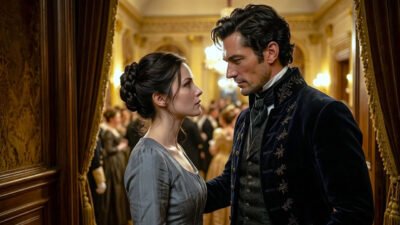
He did not look like a monster. That was the most terrifying realization of all. The man who stepped into the room was tall, with broad shoulders tailored flawlessly into a severe charcoal coat. His dark hair was meticulously swept back, and his striking, aristocratic face was completely devoid of emotion. But it was his eyes that pinned her to the chair—cold, calculating, and piercingly intelligent.
He did not offer a greeting. He did not bow.
He simply walked behind his immense desk, picked up a familiar folded piece of parchment, and let it drop onto the polished wood between them.
“I believe,” the Duke’s voice was low, smooth, and terribly quiet, “you are here to negotiate a life, Lady Clara.”
Clara stood, her knees trembling beneath the heavy fabric of her skirt, and prepared to offer the devil everything she had left.
The parchment lay upon the polished mahogany desk like a physical manifestation of a death sentence. Clara stared at it, her chest tightening so severely she thought her ribs might splinter beneath her faded silk bodice. It was Thomas’s reckless, clumsy handwriting, attempting to mirror the sweeping, arrogant signature of a royal courtier. A forged debt of ten thousand pounds. A sum so astronomical she could not even comprehend it, let alone repay it. The sight of it made the room tilt dangerously beneath her feet.
She lifted her chin, forcing herself to meet the Duke of Blackwood’s gaze. He was watching her with an unnerving stillness, his dark eyes entirely unreadable. He had not gloated. He had not shouted. He had simply presented the instrument of her family’s utter destruction and waited for her to shatter.
“I will not insult your intelligence by denying what it is, Your Grace,” Clara said. Her voice trembled, just once, before she forced the sound into a steady, iron line. “My brother is a fool. He is desperate, and he is young, but he is not malicious. I am here to offer whatever restitution you demand in exchange for his life, and for his freedom.”
Julian Vance did not immediately reply. He leaned back in his heavy leather chair, steepling his long, aristocratic fingers together. The silence in the cavernous study stretched, heavy and suffocating. He was analyzing her, stripping away the faded velvet of her gown, the desperate pride in her rigid posture, down to the bare, terrified nerve beneath.
“Restitution,” the Duke repeated, the word rolling off his tongue in a low, resonant drawl that seemed to vibrate in the floorboards. “Do you even comprehend the magnitude of what your brother has done, Lady Clara? This is not a gambling debt to be quietly settled in a gentleman’s club. This is a forgery implicating the Crown. It is treason. If I hand this paper to the magistrate, Thomas Ashford will swing from the gallows before the month is out. What possible restitution could a ruined Earl’s daughter offer for a life?”
Clara swallowed the sharp, metallic taste of fear in her mouth. She had rehearsed this moment a thousand times in the rattling carriage, yet under the crushing weight of his presence, her prepared speeches felt absurd.
“I will sign myself over to your household,” she said, her voice rising in volume as panic clawed at her throat. “I will work in your scullery. I will manage your accounts. I will go to debtor’s prison in his stead. Take the last of the Ashford properties in the north—they are heavily mortgaged, but the land is fertile. Take everything we have left. Strip us of our name. But please, Your Grace, I am begging you. Do not take my brother’s life.”
A muscle feathered along Julian’s sharp jawline. He stood, his sudden movement making Clara flinch backward. He was a massive man, broad-shouldered and imposing, moving with the predatory grace of a creature entirely comfortable in the dark. He walked around the edge of the immense desk, closing the distance between them until he stood only a few feet away. The faint, clean scent of sandalwood and cold autumn air washed over her.
“I have two hundred servants across my estates, Lady Clara. I do not need another maid,” he said softly, looking down at her. “I have more land than I could traverse in a lifetime. I do not want your mortgaged dirt. And sending a woman to prison in place of a guilty man does absolutely nothing to amuse me.”
Clara felt the last remnants of her hope turn to ash. Her hands clenched into fists at her sides. “Then what? Why did you agree to see me? If I have absolutely nothing of value to you, why not send the magistrate to my door this morning? Why let me stand here and humiliate myself?”
“Because you are wrong,” Julian said. “You do possess something of value.”
Clara blinked, genuinely confused. She looked down at her worn gloves, her mended hem. “I have nothing.”
“You have a title,” Julian corrected, his voice entirely devoid of sentiment. “You are Lady Clara Ashford, daughter of an Earl, born of a bloodline that predates the Tudors. You are remarkably well-educated, you possess a sterling reputation despite your father’s financial incompetence, and, most importantly, you are in a position of complete and utter desperation.”
Clara stared up at him, her heart hammering a frantic rhythm against her breastbone. “I do not understand.”
“My uncle, the late Duke, was a spiteful man with a fondness for legally binding inconveniences,” Julian explained, turning his back to her to pace slowly toward the crackling fireplace. “He left a codicil in his will regarding the northern mining territories—the most profitable lands I possess. The codicil stipulates that if I am not wed to a woman of noble birth by my thirty-first birthday, those territories revert to the Crown.”
He turned back to face her, the firelight catching the sharp planes of his face, casting half of it in impenetrable shadow.
“My birthday is in three weeks,” he said. “I require a Duchess.”
Clara stopped breathing. The study seemed to spin, the towering bookshelves blurring into streaks of brown and gold. She opened her mouth, but no sound came out. She must have misheard him. The Iron Duke, the most formidable bachelor in London, a man who swatted away the daughters of Dukes and Marquesses with ruthless indifference, was speaking to her of marriage.
“You are mocking me,” she finally whispered, her voice cracking. “You are playing a cruel game to punish me.”
“I do not play games, Lady Clara. They are a waste of my time.” Julian walked back to the desk. He did not look at the forged note. He opened a heavy leather folio and produced a second, much thicker document. It was bound in red ribbon, the heavy vellum covered in dense, elegant legal script.
“This is a marriage contract,” Julian said, his tone as casual as if he were discussing the purchase of a horse. “The terms are straightforward. You will become my wife. You will bear my name, manage my households, and act as my hostess when society requires it. In exchange, I will settle all of your father’s outstanding debts. I will secure a naval commission for your brother, sending him far away from London where he cannot forge any more documents. And this,” he tapped a single finger against Thomas’s forged note, “will be burned in that fireplace the moment the ink dries on our marriage registry.”
Clara stared at the thick contract. A cold, horrifying realization washed over her.
He already had the contract drawn up.
Before she had even arrived. Before she had even begged. The Duke of Blackwood had known exactly what he was going to do. He had sat in this silent room like a spider, waiting for her to walk willingly into his web, driven by a desperation he had fully anticipated.
“You planned this,” she breathed, staring at the perfectly straight edges of the parchment. “You acquired Thomas’s debt specifically to trap me.”
Julian’s expression did not change. His eyes remained as cold and hard as obsidian. “I acquired the debt because it was a useful piece of leverage. I am a pragmatic man. I need a wife who understands duty, who is not crippled by sentimental delusions, and who will never demand my heart, because she knows this union is a business arrangement. Your situation makes you the perfect candidate. You will comply, because you have no other choice.”
He was right. That was the most agonizing part of it all. He was entirely, brutally right.
Clara looked from the marriage contract to the forged note, and then up to the face of the man who was calmly holding her brother’s life hostage. She thought of Thomas, foolish, laughing Thomas, with his entire life ahead of him. She thought of the gallows. She thought of the cold, terrifying reality of binding her body, her name, and her future to a man who viewed her as nothing more than a strategic asset.
She would be a Duchess in name, but a prisoner in truth. She would belong to the Iron Duke, a man who clearly possessed no heart to give, and who would demand absolute obedience in return for his protection.
“And if I refuse?” she asked, though the word felt hollow even as she spoke it.
Julian leaned forward, resting his knuckles on the desk. He was so close she could see the faint pulse beating at the base of his throat, the only sign that he was a living, breathing man and not a statue carved from stone.
“If you refuse, you may walk out of those doors right now,” he said quietly. “I will not stop you. But I will send this forgery to the magistrate before your carriage reaches the end of my driveway. The choice is entirely yours, Clara.”
It was the first time he had used her given name. The sound of it on his lips felt dangerously intimate, a dark promise of the ownership he was demanding.
She looked at the quill resting in its silver inkwell. It looked heavier than a broadsword. She reached out with a trembling, gloved hand. Her fingers brushed the cold silver, her heart screaming in protest, her mind echoing with the finality of what she was about to do. She drew the quill from the ink, the black droplet hovering over the heavy parchment.
She did not look up at him. She couldn’t. If she looked into his eyes again, she might break.
With a quick, sharp motion, Clara Ashford signed away the rest of her life.
Julian reached down and pulled the contract from beneath her trembling hand. As he did, his warm knuckles grazed the chilled skin of her wrist. The brief, unexpected friction sent a sharp jolt of heat racing up her arm, a sudden, alarming spark in the freezing atmosphere of the room.
The Duke looked down at her signature, a faint, imperceptible shift softening the hard line of his mouth.
“Welcome to Blackwood, Your Grace,” he murmured.
The first week of their marriage was defined by a suffocating, echoing silence.
Clara had traded the crumbling, drafty halls of the Ashford estate for the sprawling, suffocating opulence of the Duke of Blackwood’s London townhouse. It was a fortress of marble and velvet, heavily staffed and terrifyingly quiet. The marriage ceremony itself had been a swift, brutal affair, witnessed only by a magistrate and Julian’s solicitor. There had been no flowers, no music, and no wedding breakfast. There was only the scratch of a pen on the registry, sealing her fate.
Since that morning, they had existed in a state of cold war. They took their meals at opposite ends of a vast dining table, separated by twenty feet of polished oak and silver candelabras. Julian was unfailingly polite, asking after her comfort in a voice so detached it made her skin ache. He treated her not as a wife, but as an acquisition—a delicate, expensive vase he had purchased and placed carefully on a shelf.
Clara refused to break. She masked her terror with impeccable posture and icy courtesy, determined to prove that while he had bought her name, he had not broken her spirit.
She threw herself into the duties of a Duchess with a fierce, quiet desperation. If she was to be a prisoner, she would be the master of her gilded cage. It was this determination that led her to the estate’s morning room on her fifth day in residence, a stack of heavy, leather-bound household ledgers spread across the desk before her.
She was tracing a line of ink with her finger, her brow furrowed in concentration, when the heavy tread of boots sounded in the corridor. The door swung open, and Julian stepped into the room.
He stopped when he saw her. He was dressed for riding, his dark hair slightly windblown, the severe cut of his coat emphasizing the sheer, intimidating breadth of his shoulders.
“I was told you requested Mr. Hopkins, the steward,” Julian said, his gaze dropping to the open ledgers. “Is there a problem with the household accounts?”
“There is,” Clara said, keeping her voice perfectly level as she sat back in her chair. “Though Mr. Hopkins seemed entirely unwilling to explain it to me. He suggested that I concern myself with the floral arrangements and leave the mathematics to him.”
A dangerous, quiet stillness settled over Julian. “Did he.”
“He did,” Clara confirmed, lifting her chin. “I informed him that while I may be new to this house, I am not new to addition. And according to these ledgers, nearly four hundred pounds a month is bleeding from the northern estate revenues into an unnamed, untraceable account. If Mr. Hopkins is embezzling from you, Your Grace, he is doing it with shocking incompetence.”
Julian stared at her for a long, heavy moment. Clara braced herself, expecting the cold reprimand, the reminder that she was merely a purchased bride who had overstepped her bounds.
Instead, a faint, genuine glimmer of amusement warmed the harsh lines of his face. He walked slowly across the room, stopping just beside her chair. He leaned over, placing one large, gloved hand on the desk, entirely invading her space. The scent of fresh air, leather, and sandalwood wrapped around her, making her breath catch in her throat.
“Mr. Hopkins is not embezzling, Clara,” Julian murmured, his voice rumbling near her ear. He reached out and tapped a long finger against the column of missing numbers. “Those funds are diverted before they reach the main household accounts.”
“Diverted where?” she asked, struggling to keep her voice steady while he stood so close.
“To the widows and orphans of the men who work the northern coal mines,” Julian replied smoothly. “Mining is a dangerous trade. When a man dies in my mines, his family loses their income. I provide full pensions, housing, and medical care for the families left behind, as well as an orphanage in the village for children who have lost both parents.”
Clara turned her head to look at him, her eyes wide with shock. Her face was only inches from his. “You provide pensions? For all of them?”
“I do.”
“But… no one in society knows this,” she whispered, her mind reeling. “The ton calls you the Iron Duke. They say you care for nothing but profit and power. They say you are ruthless.”
Julian straightened, his expression hardening slightly as he looked down at her. “Let them say it. A monster is rarely asked for favors, Clara. If society believed I possessed a soft heart, I would be bled dry by every gambling lord and bankrupt baron in London. I prefer to be feared. It is far more efficient.”
He held her gaze for a moment longer, a strange, intense vulnerability flickering in his dark eyes before he masked it behind his usual indifference. “I will speak to Mr. Hopkins. He will never speak to you with condescension again. You are the Duchess of Blackwood. See that you remind them of it.”
He turned and strode from the room, leaving Clara sitting in stunned silence. She looked back down at the ledger, her chest tightening with an unfamiliar, painful emotion. The man she had married was not the monster she had feared. Beneath his armor of ice and cruelty, he was hiding a fiercely protective heart.
Two nights later, Clara was forced to wear her new title like a suit of armor.
The Earl of Carmichael’s ball was the event of the season, and it marked Clara’s first public appearance since the sudden, scandalous marriage. The ballroom was a sea of glittering jewels, suffocating perfume, and vibrant silk. The moment Julian and Clara were announced at the top of the sweeping marble staircase, the music seemed to falter. The collective gaze of three hundred aristocrats turned toward them.
The whispers began immediately, hissing through the room like dry leaves over stone.
Clara stood frozen at the top of the stairs, her heart hammering against her ribs. She knew exactly what they were saying. They knew her father was ruined. They knew this marriage made no sense. They were calling her a beggar, a woman sold to the highest bidder to save her family from the gutter.
A wave of humiliation washed over her, so intense she felt physically ill. She took a tiny, involuntary step backward, wanting nothing more than to flee into the night.
Suddenly, a large, warm hand settled firmly against the small of her back.
“Keep your head up,” Julian murmured, his voice a low, steady rumble just behind her ear. “You are my wife. There is not a single person in this room who breathes the same air as you.”
He did not offer her his arm. Instead, he shifted his hand from her back to her waist, a deeply possessive, intimate gesture that sent a shockwave of heat straight through her corset. He guided her down the stairs, moving with the predatory confidence of a king descending among his subjects.
As they stepped onto the ballroom floor, Lady Sefton, a notorious gossip with a vicious tongue, stepped purposefully into their path.
“Your Grace,” Lady Sefton purred, her eyes raking over Clara’s new, exquisite gown with barely concealed disdain. “What a tremendous surprise. We were all quite shocked by the suddenness of your nuptials. One hears such terrible rumors about the Ashford family finances. I suppose we must applaud Lady Clara for securing such a… practical arrangement.”
Clara felt the blood drain from her face. She opened her mouth to defend herself, but Julian moved first.
He did not raise his voice. He did not even blink. He simply looked down at Lady Sefton with a gaze so terrifyingly cold that the older woman actually recoiled.
“My wife’s name is Clara,” Julian said, his voice dropping to a silken, deadly whisper that carried to every eavesdropper within ten feet. “And if I ever hear a single word spoken against her, or her family, by anyone in this room, I will make it my personal mission to see that their family name is erased from polite society entirely. Do I make myself perfectly clear, Lady Sefton?”
The silence that followed was absolute. Lady Sefton turned a ghastly shade of white, stammering a terrified apology before retreating quickly into the crowd.
Julian turned to Clara, his jaw tight, the dangerous fire still burning in his dark eyes. Without asking permission, he pulled her into his arms as the orchestra nervously struck up a waltz.
They moved across the floor together. Clara was trembling, her hand clutching his broad shoulder, her mind spinning from the sheer, overwhelming force of his protection. He had not just shielded her; he had threatened the entire aristocracy for her.
“You did not have to do that,” she breathed, looking up at his sharp profile.
Julian looked down at her, his grip tightening imperceptibly on her waist. The physical tension between them, previously locked beneath their cold war, suddenly flared to life, heavy and intoxicating. “I protect what is mine, Clara.”
The carriage ride back to the estate was wrapped in a thick, vibrating silence. The air inside the dark cabin felt entirely too small, charged with the lingering heat of the ballroom and the terrifying realization that Clara was no longer afraid of him. She was entirely, hopelessly captivated by him.
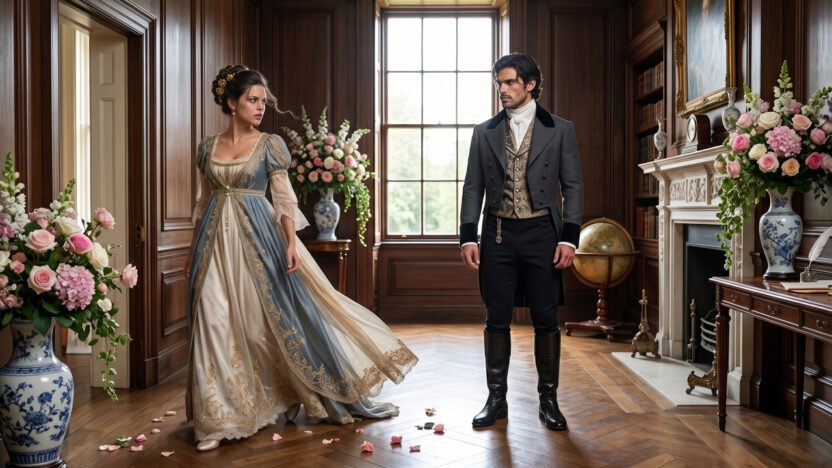
When they arrived at the townhouse, the silence followed them into the dimly lit library. Julian walked to a side table to pour two glasses of brandy, the crystal clinking softly in the quiet room. Clara stood by the dying fire, her shawl slipping from her shoulders, her skin still humming from where he had touched her during the waltz.
Julian handed her a glass. His fingers brushed hers. Neither of them pulled away.
“You were brave tonight,” he said softly, his voice stripped of its usual armor.
“I was terrified,” she confessed, her voice barely a whisper. She looked up into his eyes, seeing the exhaustion and the quiet, desperate longing he was trying so hard to hide. “But I was not afraid when I was with you.”
Julian inhaled sharply. The glass in his hand trembled. He set it down on the mantelpiece, his eyes never leaving hers. Slowly, as if fighting his own instincts, he reached out. His knuckles brushed against her cheek, a touch so incredibly gentle it broke Clara’s heart.
She leaned into his hand, a small, involuntary sigh escaping her lips. Julian’s gaze dropped to her mouth. The space between them vanished. He leaned in, the heat of his breath washing over her lips, the world narrowing to this single, breathless point of inevitability.
The library door crashed open.
Julian snapped backward, his body instantly shifting from a lover to a shield as he placed himself between Clara and the doorway.
The butler stood on the threshold, his face pale, his breath coming in ragged gasps.
“Forgive me, Your Grace,” the servant stammered, looking terrified to have interrupted them. “But there is a gentleman demanding to see you in the foyer. He says it is a matter of life and death.”
Julian’s posture went rigid. “Who is it?”
“Lord Hastings, Your Grace.”
Clara felt the blood freeze in her veins. Lord Hastings. The political rival. The man who had originally coerced Thomas into forging the debt note. The man who had started this entire nightmare.
Julian turned his head slightly, meeting Clara’s terrified gaze over his shoulder. The fragile, beautiful intimacy they had just built shattered against the cold, hard floor, replaced instantly by the terrifying reality of the war that was about to begin.
The foyer of the Blackwood townhouse was a masterpiece of intimidating architecture, designed to make visitors feel small. Lord Hastings stood in the center of the black-and-white marble floor, refusing to look diminished. He was a slender, sharp-featured man with the calculating eyes of a viper and the relaxed posture of a man holding a winning hand.
Julian stood on the bottom step of the grand staircase, looking down at him. Clara lingered in the shadows of the landing above, her heart hammering against her ribs, straining to hear every word.
“It is a bold choice, Hastings,” Julian said, his voice deadly soft. “Demanding entry to my home at midnight.”
“I apologize for the late hour, Blackwood,” Hastings replied smoothly, removing his gloves finger by finger. “But I have just returned from the continent, and I was shocked—truly shocked—to hear of your sudden marriage to Lady Clara Ashford. A beautiful woman, certainly. But a surprising choice for the Iron Duke.”
“State your business,” Julian demanded, entirely ignoring the pleasantries.
Hastings smiled, a thin, cruel expression. “I understand you recently acquired a certain… document. A promissory note bearing an unfortunate signature. Forged by Thomas Ashford.”
Clara gripped the mahogany banister so tightly her knuckles turned white.
“I have no idea what you are speaking of,” Julian said, his face a mask of bored indifference.
“Come now, Julian. We both know you have it,” Hastings continued, stepping closer to the stairs. “I was the one who initially held the boy’s gambling debts. I was the one who pressured him. I watched him panic, and I watched him forge the note. Unfortunately, my agent was careless, and the document slipped into your hands before I could utilize it.”
“Then you are admitting to extortion,” Julian observed coldly.
“I am admitting to political strategy,” Hastings countered. “The document you hold is the key to ruining the Prime Minister’s current coalition, which you know perfectly well. I want it back. And if you do not surrender it to me by tomorrow evening, I will take what I know directly to the magistrate. I will swear out a statement that I witnessed Thomas Ashford forge the signature. Your wife’s brother will hang, and your new, shiny marriage will be buried in the scandal.”
Clara stopped breathing. The floor seemed to drop out from beneath her. Thomas was not safe. The marriage contract, her sacrifice, Julian’s protection—none of it mattered if Hastings testified.
“If you attempt to testify against Thomas Ashford,” Julian said, his voice dropping to a terrifying, absolute calm, “you will find that my lawyers will bury you in so much counter-litigation regarding your extortion practices that you will be fighting for your own freedom, not his.”
“Perhaps,” Hastings conceded with a shrug. “But the boy will still hang while we fight in court. Are you truly willing to risk your new bride’s sanity on a legal gamble? Give me the note, Blackwood. You step down from the committee voting on the railway expansion, you give me the document, and the boy lives.”
Hastings turned and walked toward the door. “Tomorrow evening. Do not test me, Julian. I have nothing to lose.”
The heavy door snapped shut.
Clara stumbled backward, unable to support her own weight. She sank onto the top stair, burying her face in her hands. A strangled sob tore free from her throat. It had all been for nothing.
She heard the heavy tread of Julian’s boots on the stairs. He knelt beside her, his large frame blocking out the dim light of the chandelier. He reached for her, his large hands pulling hers gently away from her face.
“Look at me,” he commanded, his voice tight.
She shook her head, tears spilling over her lashes. “He is going to kill him. Hastings is going to kill him, and you cannot stop it without destroying your own political standing.”
“Clara. Look at me.” The raw desperation in his voice finally pierced through her panic.
She looked up. Julian’s dark eyes were blazing with a fierce, absolute resolve. He framed her face with his hands, his thumbs gently wiping away her tears.
“He will not touch your brother,” Julian said, every word a vow. “I will give him the note. I will resign from the committee. I will give him whatever he asks for. Hastings will get his railway, and Thomas will live.”
Clara stared at him, stunned into silence. The railway committee was Julian’s life’s work. It was the source of his political power in Parliament. Stepping down would be a massive public defeat, a humiliation the Iron Duke had never suffered.
“You cannot,” she whispered, her voice trembling. “The committee… it is your legacy. If you yield to him, he will own you. You cannot sacrifice your position for my family.”
“I would sacrifice the entire Parliament,” Julian said fiercely, his voice dropping to a harsh, ragged whisper. “I would burn the House of Lords to the ground before I let you shed another tear, Clara. The committee means nothing. The power means nothing. Do you not understand that yet?”
He pulled her against his chest, holding her so tightly she could barely breathe. She buried her face in his shoulder, the heavy wool of his coat scratching against her cheek. The truth of his words hit her with the force of a physical blow. He wasn’t doing this because of a contract. He wasn’t doing it out of duty.
He was doing it because he loved her.
The realization tore through her remaining defenses, leaving her utterly exposed. She loved him. She loved this terrifying, beautiful, damaged man who had bought her to save her, and who was now willing to destroy his own empire to keep her safe.
She lifted her head, framing his face with her trembling hands. Julian went entirely still, his breath catching in his throat as he looked into her eyes. The cold war was over. The boundaries between them were gone.
Clara leaned in and pressed her lips to his.
Julian groaned, a sound of profound surrender, and pulled her down against him on the cold marble stairs. The kiss was not gentle. It was a collision, desperate and urgent, fueled by the terror of the night and the crushing weight of their unspoken feelings. His mouth was hot and demanding, his hands tangling in her hair as she opened to him completely.
He carried her to the master suite. There were no words spoken, only the frantic discarding of silk and linen in the darkness. When Julian finally took her to his bed, his touch was a revelation—reverent, trembling, and overwhelmingly tender. He worshipped her with a desperation that broke her heart, and Clara gave herself to him not as a duty, but as a freely chosen surrender.
When Clara woke the next morning, the space beside her was empty. The sheets were cold.
A profound sense of unease settled in her stomach. She wrapped a heavy velvet robe around herself and walked out into the corridor. The house was entirely silent, the kind of silence that usually followed a disaster.
She made her way down to Julian’s study, hoping to find him preparing for the meeting with Hastings. The door was ajar.
She pushed it open. The room was empty.
Julian’s desk, usually meticulously organized, was in disarray. Stacks of paper were scattered across the polished wood, the heavy iron safe behind the desk left hanging open.
Clara frowned, walking behind the desk to begin organizing the papers. Her hand brushed against a leather folio that had been left open. Beneath a stack of railway proposals lay a piece of folded parchment.
Clara froze. It was not Thomas’s forged note.
It was a letter, addressed to Julian, dated nearly a year ago.
Clara knew she should not read it, but the signature at the bottom caught her eye. It was from Lord Hastings.
Her heart began to pound a slow, sickening rhythm as she pulled the letter free and began to read.
Blackwood,
Your agents are as persistent as you are. I concede the point. You have correctly identified that I hold the young Ashford boy’s gambling debts. I find it fascinating that the great Iron Duke has taken such a sudden, intense interest in the ruined Earl’s son. Or perhaps, it is not the son you are interested in protecting? If you wish to acquire the debt before the boy does something foolish—like forgery, which I am currently encouraging him to do—it will cost you dearly. But I assume, given your obvious obsession with the sister, price is of no object.
Clara stopped reading. The paper trembled violently in her hands.
The date. The date was a year old.
Julian had known. He had known about Hastings pushing Thomas toward forgery for a year. He had known, and he had let it happen. He had waited until Thomas actually committed the crime, waited until the trap was perfectly set, and then he had swooped in to buy the debt, not to save Thomas, but to ensure that Clara had no choice but to marry him.
He had orchestrated her ruin.
The beautiful, devastating intimacy they had shared just hours ago curdled into something monstrous. She had given him her heart, believing he was sacrificing everything to protect her from a threat. But he was the threat. He had built the cage, locked her inside, and convinced her to thank him for it.
The study door clicked open.
Clara turned around. Julian stood in the doorway, still wearing his riding clothes, looking exhausted but deeply relieved. He held a small, sealed envelope in his hand.
“I have settled it with Hastings,” Julian said, his voice softer, unguarded as he stepped into the room. “The note is destroyed. Thomas is entirely safe.”
He stopped. The words died in his throat as he looked at her face, and then down to the crumpled letter trembling in her fist.
The silence that filled the room was not the quiet of a cold war. It was the devastating silence of total destruction.
The silence stretched, thick and suffocating, as Julian’s gaze fell from Clara’s pale face to the crumpled letter trembling in her hand. The soft, unguarded expression he had worn only moments before vanished. In its place, the cold, impenetrable mask of the Iron Duke descended with terrifying speed, freezing the very air between them.
“You have been reading my private correspondence,” he said, his voice dropping to a smooth, dangerous calm.
Clara stepped out from behind the desk. Her legs felt like lead, but her anger—a blinding, protective fury—kept her upright. “You knew,” she whispered, her voice shaking with a devastating mixture of heartbreak and rage. “You knew Hastings was pushing Thomas into forgery a year ago. You could have stopped it. You could have warned my father. You could have warned me.”
Julian did not move. He stood perfectly still in the doorway, his jaw locked, his broad shoulders rigidly set. “I am not your family’s keeper, Clara. I am not responsible for your brother’s weak character.”
“Do not speak of his character!” she cried, the sound echoing sharply in the cavernous room. “You let him fall! You watched him walk into a trap, and you waited until the jaws snapped shut so you could collect the prize. You orchestrated my ruin just to force me into a contract.”
She threw the letter onto the desk. It slid across the polished wood, stopping inches from Julian’s gloved hand.
“Tell me I am wrong,” she demanded, her voice cracking on the final word. She was begging him to deny it. She wanted, with every fiber of her being, for him to offer an explanation that would mend the shattered pieces of her heart.
Julian looked at the letter, and then back at her. Inside his chest, a violent war was raging. He wanted to tell her the truth. He wanted to confess that he had watched her from afar for a year, captivated by her fierce devotion to her ruined family, terrified by the knowledge that a woman of her warmth and light would never willingly choose a man as hollowed out as he was. When Hastings’s plot had emerged, Julian had seized it not out of malice, but out of a desperate, pathetic need to bind her to him before she was lost to someone else.
But the words would not come. The old, deep-seated fear of rejection—the absolute certainty that if he revealed his pathetic, desperate heart, she would only look at him with pity or disgust—paralyzed him. He had never learned how to ask for love. He only knew how to command, how to conquer, and how to buy.
“I required a wife,” Julian said slowly, his voice deadened of all emotion. “Your situation made you the most logical candidate. I utilized the leverage available to me to secure my estate. It was a matter of strategy.”
The words struck Clara like physical blows. She took a step back, wrapping her arms around her waist as if trying to hold herself together. The beautiful, tender lover who had worshipped her in the dark the night before had been an illusion. This was the reality. She was a strategy. A pawn moved across a board.
“You are a monster,” she whispered, her voice devoid of tears, hollowed out by absolute betrayal.
Julian flinched, the movement so slight it was almost imperceptible, but Clara did not see it. She walked toward the door, giving him a wide berth as if his very proximity might burn her.
“I will fulfill the terms of the contract, Your Grace,” she said, pausing at the threshold without looking back at him. “I will manage this house. I will wear your name. But I will not share your bed again. And you will never have my heart.”
She walked out into the corridor, leaving Julian standing alone in the ruins of the only thing he had ever truly wanted.
The next forty-eight hours were a descent into a freezing, agonizing purgatory. Clara moved through the grand townhouse like a ghost, her face pale, her interactions with the staff perfectly polite and entirely devoid of warmth. She moved her belongings into a guest chamber in the opposite wing of the house. Julian did not attempt to stop her. He withdrew into his study, drowning himself in ledgers and political correspondence, radiating a cold, dangerous energy that kept even the boldest servants at bay.
The silence between them was no longer a battle of wills; it was a graveyard.
It was on the afternoon of the third day that the fragile, frozen world they had built finally shattered.
Clara was in the morning room, staring blankly at the rain lashing against the tall glass windows, when the sound of frantic shouting echoed from the foyer. She rushed into the hall just as Julian emerged from his study, moving with terrifying speed.
The butler was standing by the front doors, trembling violently as he handed Julian a piece of torn, muddy parchment.
Julian snatched the note. As his eyes scanned the jagged handwriting, the remaining color drained from his face. The cold, indifferent mask he wore for the world cracked completely, replaced by a look of sheer, murderous fury.
“Saddle my horse,” Julian roared, his voice echoing off the marble walls with a terrifying volume that made Clara jump. “Bring my pistols. Send a rider to the magistrate and tell him to meet me at the abandoned warehouses by the eastern docks. Now!”
The servants scattered instantly. Julian turned, his dark coat sweeping around him, and strode toward the armory.
Clara ran down the stairs, her heart hammering against her ribs. “Julian! What has happened? What was that note?”
He stopped, turning to look at her. For a fraction of a second, the iron wall between them dropped, and she saw the raw, desperate panic in his eyes. But just as quickly, he shut her out.
“It is a political matter,” he said sharply, turning away to retrieve a heavy wooden box from the hall table. He snapped it open, pulling out two gleaming flintlock pistols. “Return to your rooms, Clara. Lock the doors. Do not let anyone inside until I return.”
“You are lying to me,” she demanded, grabbing his sleeve as he shoved the pistols into his belt. “Tell me what is happening!”
“I said return to your rooms!” he shouted, shaking her hand off with a harsh, desperate movement. He did not wait for her to argue. He turned and strode out the heavy front doors into the pouring rain, leaping onto the back of his massive black stallion before the groom had even finished tightening the girth.
Clara watched him gallop wildly down the street, disappearing into the gray mist. Her breathing was fast and shallow. She turned back to the foyer. The muddy piece of parchment Julian had discarded lay crumpled on the marble floor.
She lunged for it, her hands shaking so violently she could barely smooth out the creases.
The handwriting belonged to Lord Hastings.
Blackwood,
You truly believed you could force me out of Parliament and walk away without consequence? You stripped me of my committee, so I have taken something of yours. The Ashford boy is with me at the eastern docks. He was remarkably easy to lure away from his naval lodgings. If you want him to live, you will come alone. If you bring the magistrate, or if you do not arrive by nightfall, I will slit the boy’s throat and drop him into the Thames. We will see how your new Duchess looks at you then.
Clara pressed a hand to her mouth to stifle a scream.
Hastings had Thomas. He had taken him in retaliation for Julian forcing him off the railway committee.
But Julian had just told the butler to send for the magistrate. He knew the magistrate wouldn’t arrive in time to prevent Hastings from acting. Julian had ridden out alone, heavily armed, riding straight into a deadly trap to buy enough time for the law to arrive.
She stared at the note, the ink running slightly where the rain had touched it.
You are a monster, she had told him.
I utilized the leverage available to me as a matter of strategy, he had replied.
But this was no strategy. A calculating, emotionless man would have let the boy die. A monster would have stayed in his fortress and let his political rival hang himself with a murder charge. Instead, Julian Vance, the ruthless Iron Duke, had ridden out alone into a violent storm, risking his life, his title, and his entire empire to face a madman.
He had not done it for leverage. He had not done it for duty. He had done it because he could not bear the thought of her shedding another tear. His silence was a desperate shield, but his actions were an undeniable confession.
Clara dropped the note, a fierce, terrifying resolve hardening in her chest. The fear that had ruled her since the day she discovered Thomas’s forgery evaporated, replaced by an absolute, unyielding courage. She turned to the terrified butler.
“Have my carriage brought around immediately,” she commanded, her voice ringing out with the absolute authority of a Duchess. “And find me a pistol.”
The rain was a solid, freezing sheet, turning the cobblestone streets of the eastern docks into a treacherous, muddy slick. Clara’s carriage rattled violently as it careened through the narrow, twisting alleys near the river. The stench of salt, rotting wood, and stagnant water seeped through the velvet curtains. She sat rigidly on the edge of the leather seat, one hand gripping the heavy iron handle of the carriage door, the other wrapped tightly around the cold, unfamiliar grip of a small flintlock pistol she had demanded from the estate armory.
“Wait here,” she ordered the driver as the carriage slid to a halt near the edge of a towering, dilapidated warehouse complex. The river rushed aggressively against the pylons below, black and violent in the storm.
She did not wait for the footman. She pushed the door open and stepped out into the deluge. The wind tore at her heavy cloak, instantly soaking her hair and chilling her to the bone. She moved carefully through the shadows, slipping between rusted shipping crates, guided by the faint, flickering light of a lantern glowing deep within the largest warehouse.
As she crept closer to a broken side window, the sound of shouting cut through the roar of the rain.
“Drop it, Blackwood! Drop it or I put a bullet through his skull right now!”
Clara pressed her back against the damp wood of the warehouse wall, edging toward the shattered glass. She peered inside.
The interior was vast and shadowy, illuminated only by a few lanterns swinging wildly from the rafters. In the center of the massive room, Lord Hastings stood behind Thomas. The boy’s face was bruised and pale with terror, his hands bound tightly behind his back. Hastings had a pistol pressed directly against Thomas’s temple.
Ten paces away stood Julian.
He was entirely soaked, his dark coat clinging heavily to his broad shoulders. He held one pistol aimed steadily at Hastings’s chest, but his face was rigid with suppressed panic. He was completely exposed, with no cover between him and the madman holding his wife’s brother hostage.
“You have lost your mind, Hastings,” Julian yelled over the sound of the rain hammering on the tin roof. “The magistrate is already on his way. My men surround this building. If you pull that trigger, you will not live long enough to watch him fall.”
“I do not care!” Hastings screamed, his composure entirely gone, replaced by a frantic, feverish desperation. “You ruined me! You stripped my family of our influence. You took the railway. If I am going to swing, I am taking your shiny new family down with me!”
Hastings tightened his grip on Thomas. The boy whimpered, his eyes squeezing shut.
Julian’s jaw locked. He looked at Thomas, the boy who had caused him nothing but trouble, the boy whose foolishness had forced Clara into his arms. And then, slowly, agonizingly, Julian lowered his weapon.
“Let him go,” Julian commanded, his voice carrying a dark, absolute authority. He tossed his pistol onto the wet wooden floorboards. It clattered loudly in the silence. He raised his empty hands, standing entirely defenseless. “Take me. You want to hurt the Duke of Blackwood? Do it. Let the boy walk out that door, and you and I will settle this.”
Clara’s breath hitched in her throat. The man who claimed he had no heart, the man who insisted he only moved for strategy, was offering his own life to save a reckless twenty-year-old simply because she loved him.
Hastings laughed, a sharp, hysterical sound. “Oh, how poetic. The Iron Duke, sacrificing himself for love. How pathetic.” He shifted his aim, moving the pistol away from Thomas’s head and pointing it directly at Julian’s chest.
Clara did not think. She did not hesitate.
She stepped out from the shadows of the broken window, raised her arm, and screamed.
“Hastings!”
Hastings flinched, his head snapping toward the sound of her voice just as Julian moved. The Duke lunged forward with terrifying speed, tackling Hastings to the ground. The pistol discharged with a deafening crack, the bullet tearing into the wooden rafters above.
Clara scrambled through the broken side door, the heavy pistol shaking in her hands. The two men were locked in a vicious struggle on the floor. Hastings was desperate, clawing wildly at Julian’s face, but he was no match for the Duke’s sheer size and furious strength. Julian pinned Hastings down, delivering a brutal, decisive blow that left the older man unconscious on the floorboards.
Silence crashed back into the warehouse, broken only by the sound of the rain and ragged breathing.
Julian rose slowly to his feet. He looked down at Hastings, then turned sharply toward Thomas, pulling a knife from his boot to slash the thick ropes binding the boy’s wrists. Thomas collapsed forward, gasping for air.
Then, Julian turned and saw Clara.
He froze. He stared at the pistol in her trembling hands, then at her soaked, shivering form. The absolute terror that crossed his face was more profound than anything he had shown while staring down Hastings’s barrel.
He crossed the room in three massive strides, ignoring the pistol entirely, and pulled her into a crushing embrace.
“You foolish, beautiful idiot,” he breathed fiercely against her wet hair, his large hands shaking as they held her tight against his chest. “Why are you here? I told you to lock the doors.”
“You went to die,” Clara sobbed, dropping the pistol and wrapping her arms around his waist, clinging to him as if he might disappear. “You threw your weapon away. You were going to let him shoot you.”
“I was not going to let him shoot me,” Julian murmured, burying his face in the crook of her neck. “But I could not let him hurt your brother. I could not survive watching you look at me if I let your family die.”
He pulled back just enough to look at her face. The iron mask was gone, shattered entirely, leaving behind a man who was raw, vulnerable, and completely desperate.
“I lied to you,” Julian confessed, his voice rough and broken. He reached up, cupping her face with his cold, wet hands, his thumbs tracing the line of her cheekbones. “I did not buy the debt for leverage. I did not force the contract for my estate.”
Clara stared up at him, her heart pounding. “Then why?”
Julian closed his eyes for a fraction of a second, the admission tearing its way out of his chest. “Because I have loved you for a year, Clara. Because I watched you at every society event, carrying the weight of your family’s ruin with more grace and fire than any woman in London. Because I am a coward who did not know how to approach you, knowing you would never look twice at a man as ruined and cold as I am.”
He opened his eyes, the dark depths shining with an unshed, profound emotion. “When Hastings cornered Thomas, I panicked. I used the forgery to force you to marry me because it was the only way I knew how to keep you. It was monstrous. It was cruel. And when you told me I would never have your heart, I knew I deserved it. But I could not let Hastings take the boy. I could not let him take the only family you had left.”
Clara looked at the terrifying, powerful Duke of Blackwood. He was not a monster. He was a man who had built a fortress to protect himself from the world, and who had just torn it all down for her.
She reached up, tangling her fingers in the wet hair at the nape of his neck, and pulled him down.
She kissed him, pouring every ounce of her forgiveness, her relief, and her love into the touch. Julian groaned, pulling her flush against him, kissing her back with a desperate, starving intensity, completely ignoring the rain, the cold, and the unconscious man on the floor beside them.
Two months later, the Blackwood estate in the north was bathed in the warm, golden light of late summer.
Clara sat at the heavy oak desk in the morning room, the window thrown wide open to catch the fragrant breeze rolling off the moors. She was casually reviewing the household ledgers—not as a prisoner ensuring her survival, but as a true partner managing an empire.
The heavy door opened, and Julian walked in. The severe, unapproachable Iron Duke was nowhere to be seen. He wore no coat, his sleeves rolled up to the elbows, a smudge of dirt on his jaw from inspecting the new stables. The lines of tension that had once deeply etched his face were gone, replaced by a quiet, steady peace.
He walked up behind her chair, leaning down to press a soft, lingering kiss to the bare skin of her shoulder.
“Thomas writes that his naval commission is progressing well,” Julian murmured, his voice a low, warm rumble against her skin. “He says the captain is strict, but fair. He has not caused any trouble in six weeks.”
“A true miracle,” Clara smiled, leaning back against Julian’s chest. “Though I suspect knowing his brother-in-law will hunt him down if he misbehaves is a strong deterrent.”
Julian chuckled, a rich, genuine sound that still made Clara’s heart flutter every time she heard it. He stepped around the chair, offering her his hand.
“Come,” he said softly, his dark eyes entirely entirely focused on her. “The ledgers can wait. I want to show you the new gardens.”
Clara placed her hand in his. His fingers curled warmly around hers, pulling her up and into his arms. There were no contracts between them now. There was no debt, no coercion, and no fear. The marriage that had begun with a desperate plea for a life had given them both exactly what they had secretly been begging for: a life worth living, together.
That concludes the story of Lady Clara and the Iron Duke. It is a beautiful, powerful reminder that sometimes the most impenetrable walls we build around ourselves are not designed to keep the world out. Often, they are constructed because we are entirely terrified of letting anyone in. Julian Vance possessed all the wealth and political power a man could ever desire in England, yet he was completely paralyzed by the fear of his own vulnerability. He built a fortress of cold indifference to hide a heart that was desperate to love, resorting to a ruthless, unforgivable strategy simply because he did not know how to ask a woman for her true affection.
Clara, on the other hand, had to learn a very different, but equally difficult lesson. She had to discover that true strength does not always mean carrying the crushing weight of the world on your own shoulders. Sometimes, the bravest thing a person can do is step out of the dark and allow someone else to share their heaviest burdens. Their journey from a desperate, fear-driven bargain to a freely chosen, passionate partnership proves that true love always requires the courage to tear down our deepest defenses.
I am so curious to hear what you thought of Julian’s desperate strategy to win the woman he loved. Do you believe his actions were justified given his ultimate desire to protect her and her family? Or was his method of forcing the marriage contract simply too cruel a gamble, even for a man known as the Iron Duke? I would love to hear your perspective on their complex relationship. Please share your thoughts in the comments below. I always look forward to reading how you interpret these deeply flawed, fiercely passionate characters.
If you enjoyed Clara and Julian’s journey today, please take a brief moment to like this video and subscribe to the channel. Your continued, gentle support truly helps bring more of these captivating historical romance stories to life every single week. Thank you so much for spending your time with me, and for listening to their story. Until next time, take care, and may your own love stories be just as deeply earned and fiercely fought for.