The companion played a melody no one recognized—but the duke turned pale when he heard it, because it was the song his missing mother had composed for him.
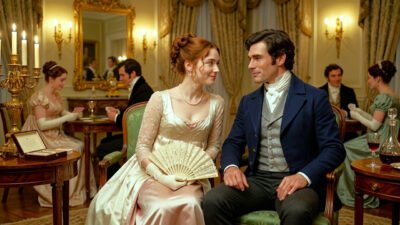
The hum of conversation in the Danvers’ Mayfair drawing room was precisely the sort of polite, meaningless noise Miss Phoebe Vance had learned to endure with quiet grace. As the paid companion to the formidable Dowager Countess of Danvers, Phoebe’s role was to be entirely present yet perfectly invisible. She sat in a straight-backed chair near the alcove, her hands folded in the lap of her modest gray silk gown, watching the glittering assembly of London society with a mild, observant eye. The room was stifling with the heat of hundreds of wax candles and the heavy scent of hothouse flowers, but Phoebe remained perfectly still, a calm island in a sea of swirling silk and calculated ambition.
Across the room, standing with the rigid posture of a man who wore his title like a suit of armor, was Robert Sterling, the seventh Duke of Ravenscar. Phoebe had only seen him from a distance, but his reputation preceded him. He was known to be a man of impeccable manners, vast wealth, and profound, unyielding coldness. Watching him now as he listened to the endless chatter of a young debutante, Phoebe thought he looked less cold than weary. There was a tension in his jaw, a guarded darkness in his dark eyes that suggested a man who held the world at a calculated distance not out of arrogance, but out of necessity.
The conversation in the room suddenly faltered, hitting one of those inexplicable, awkward lulls that hostesses dreaded above all things. Lady Danvers, seated near the fireplace with her silver-tipped cane, caught Phoebe’s eye and gave a sharp, imperious flick of her wrist toward the pianoforte. It was a silent command Phoebe knew well: play something pleasant, something mindless, and cover the silence.
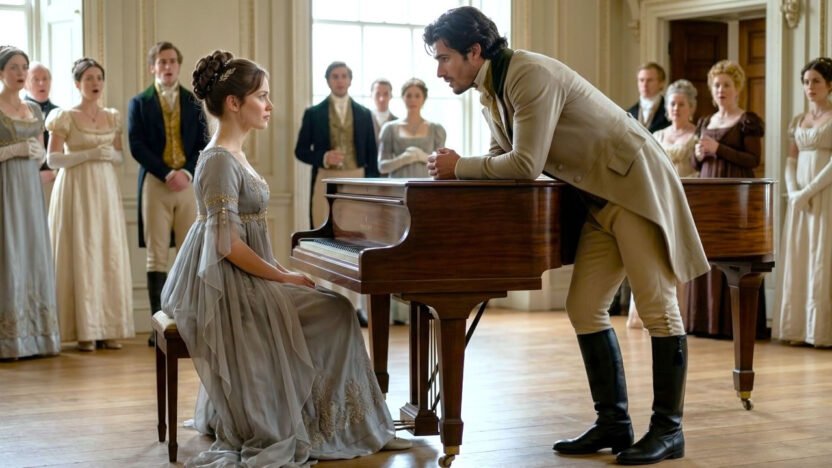
Phoebe rose without a word and crossed the room to the gleaming instrument. She seated herself, adjusted the cuffs of her sleeves, and rested her fingers on the keys. She had intended to play a light, cheerful country dance, something perfectly suited to the shallow atmosphere of the room. But as her hands settled, a different melody rose in her mind. It was a piece that had never been printed, a quiet, melancholic lullaby taught to her years ago by an eccentric, reclusive older woman in her Yorkshire village. Mrs. Ellis had called it a song for a rainy afternoon, though her eyes had always held a deep, unresolved sorrow when she played it. Without entirely meaning to, Phoebe pressed the keys, and the haunting, beautiful chords drifted through the drawing room.
It was a gentle song, full of quiet longing and a tender, aching sort of love. Phoebe lost herself in the music for a moment, letting the familiar notes ground her, remembering the small cottage in the north and the woman who had treated her not as a servant, but as a cherished friend.
She did not see the Duke of Ravenscar freeze. She did not see the color drain from his face, nor the way his hands clenched into tight fists at his sides.
Robert had spent twenty-three years building a fortress around his heart, sealing away the memory of the mother who had walked out of Ravenscar House when he was eight years old and never returned. His father had locked the music room, burned the compositions, and raised his son to believe that emotion was a weakness that destroyed families. Yet here, in the middle of a crowded, trivial Mayfair gathering, the fortress shattered in an instant. The melody was unmistakable. It was the lullaby his mother used to play for him in the quiet hours before dawn, a song she had composed just for him. He had not heard it in over two decades.
Driven by a force entirely beyond his control, Robert abandoned the debutante mid-sentence. He ignored the startled looks of the guests and the sudden, rippling silence that followed his abrupt movement. He walked straight across the drawing room, his gaze fixed entirely on the woman at the pianoforte.
Phoebe sensed the shift in the room’s atmosphere before she saw him. The polite murmurs had died away, replaced by a strained, breathless quiet. She looked up from the keys and found the Duke of Ravenscar towering over the instrument, his chest rising and falling with shallow, uneven breaths. His dark eyes, usually so impassive, were blazing with a raw, agonizing intensity that made Phoebe’s heart give a sudden, erratic jolt.
He did not offer a bow. He did not observe a single rule of polite introduction. He leaned forward, placing one large, gloved hand flat against the polished wood of the piano. Where did you learn that melody? he asked, his voice low and tight, carrying a dangerous edge of desperation.
Phoebe’s hands went still on the keys. A lesser woman might have shrunk back from the sheer force of his presence, intimidated by his title and the naked emotion in his face. But Phoebe simply looked up at him, her spine straight, meeting his intense gaze with a calm, steady dignity. She saw the tremor in his hand, the defensive set of his shoulders, and recognized the look of a man who was fighting a desperate battle against a long-buried grief.
It is an unprinted composition, Your Grace, Phoebe said softly, her voice steady and clear in the quiet room. I learned it many years ago, from a lady in Yorkshire.
Robert stared at her, his mind reeling. A lady in Yorkshire. The words felt like a physical blow. Tell me her name, he demanded, stripping away the last remnants of aristocratic detachment.
Phoebe hesitated, protective of her late mentor’s privacy, but the profound sorrow in the duke’s eyes answered a question she had carried for years. She remembered Mrs. Ellis speaking of a son she had been forced to leave behind, a boy she had loved more than life itself. Looking at the proud, broken man before her, Phoebe knew the truth.
She went by the name of Mrs. Ellis, Phoebe replied quietly, holding his gaze with gentle understanding. She was a dear friend to me. She lived in quiet peace, Your Grace, and she played this song every day.
Robert closed his eyes, a shudder running through his rigid frame. The words settled over him, bringing with them a rush of agonizing relief and a profound, aching sorrow. She had lived. She had found peace. And this quiet, self-possessed woman with the steady eyes had been with her. When he opened his eyes again, the harshness was gone, replaced by a vulnerability that left him entirely exposed. For a long, breathless moment, the duke and the companion simply looked at one another, tethered together by a forgotten melody and the shared ghost of a woman they had both loved, while the rest of London society watched in stunned, uncomprehending silence.
The morning light in Lady Danvers’s sitting room was unforgiving, illuminating the dust motes dancing in the air and the deep frown etched into the Dowager Countess’s face. Phoebe sat near the window, her head bowed over a piece of intricate embroidery, though her needle had barely moved in the last half hour. The house was still ringing with the scandal of the previous evening. Lady Danvers had spent the entirety of breakfast dissecting the Duke of Ravenscar’s inexplicable breach of etiquette, declaring it either a symptom of a disordered mind or an insulting commentary on the quality of her gathering. Phoebe had listened in silence, keeping the truth of that charged encounter locked safely within her own chest.
When the heavy oak doors of the morning room opened and the butler announced His Grace, the Duke of Ravenscar, the silence that fell over the room was absolute.
Robert entered with the effortless authority of a man born to command the space he occupied. He was impeccably dressed in dark superfine wool and a crisp white cravat, his aristocratic features arranged into a mask of polite indifference. To anyone else, he appeared exactly as the formidable duke society knew him to be. But as he bowed over Lady Danvers’s hand, Phoebe caught the slight tightness around his mouth and the immediate, searching sweep of his dark eyes. When his gaze found her sitting quietly by the window, a brief, undeniable flash of relief softened the severe lines of his face.
“Your Grace,” Lady Danvers said, recovering her voice and gesturing toward a chair with her silver-tipped cane. “To what do we owe this highly unexpected honor? I had not thought my modest musical entertainments were to your taste.”
“On the contrary, madam,” Robert replied, taking the offered seat with fluid grace. His voice was a rich, low baritone, perfectly measured. “It is precisely the music that brings me here this morning. I must beg your forgiveness for my abruptness yesterday evening. I was quite taken off guard by the final piece Miss Vance played. It is a melody I have a profound interest in acquiring.”
Lady Danvers narrowed her eyes, assessing him. “A melody? You crossed my drawing room as though the house were aflame for a country tune?”
“It is a matter of historical preservation, Lady Danvers,” Robert said smoothly, though his eyes shifted once more to Phoebe, holding her gaze with a silent plea for understanding. “I am currently compiling a catalog of certain rare musical manuscripts. I recognized the piece Miss Vance played as one I believed lost. If you would permit it, I should very much like to ask her a few questions regarding its origin.”
Lady Danvers sniffed, clearly suspecting a grander mystery but unable to deny a duke in her own morning room. With a wave of her hand, she granted permission, though she leaned forward in her chair, signaling that she intended to hear every word.
Robert turned his full attention to Phoebe. The physical distance between them was entirely proper, yet the intensity of his focus made the space feel suddenly intimate. “Miss Vance. You mentioned last night that the composer, a Mrs. Ellis, lived in Yorkshire.”
“She did, Your Grace,” Phoebe answered softly. She set her embroidery aside and met his gaze squarely. She understood exactly what he was risking by coming here, exposing his private grief to the sharp eyes of her employer. She felt a fierce, protective instinct rise within her to guard his mother’s memory as carefully as he clearly wished to. “She lived in a small, quiet cottage near the edge of the moors. She was a woman of solitary habits, but she possessed a brilliant mind and a deeply generous spirit.”
Robert’s hands rested on the arms of his chair. His knuckles were white. “Was she… was she content there?”
The vulnerability beneath the formal question made Phoebe’s heart ache. She ignored the warning look Lady Danvers shot her for speaking too familiarly and leaned forward slightly, her voice gentle and unwavering. “She found peace, Your Grace. She cultivated a beautiful garden, she read extensively, and she taught me how to understand music not merely as a performance, but as a language. She was well-loved by the few who had the privilege of truly knowing her.”
Robert swallowed hard, the sharp line of his throat working. The father who had raised him had painted his mother as a selfish, bitter woman who had fled her duties out of spite. To hear her described with such warmth and reverence by this quiet, perceptive woman felt like cool water on a decades-old burn.
“And the lullaby,” Robert asked, his voice dropping a fraction, becoming a private exchange despite the older woman sitting mere feet away. “Why did she write it?”
Phoebe did not look away from him. “She told me it was composed for a boy who was very far away. A child she carried in her heart every day of her life. She played it when the house was quiet, to remind herself that love does not cease simply because distance requires it.”
Robert went perfectly still. The mask of the Duke of Ravenscar slipped entirely, leaving behind a man stripped of his armor, staring at the woman who had just handed him the absolution he had not known he was starving for. For twenty-three years, he had believed his mother’s departure meant he was unlovable. With a few honest, fearless words, Phoebe had rewritten the defining tragedy of his life.
He drew a long, slow breath, forcibly gathering his composure before the emotion could overwhelm him in front of Lady Danvers. When he spoke again, the rawness was hidden, but the profound gratitude in his eyes was fixed entirely on Phoebe.
“I am deeply indebted to you, Miss Vance, for sharing this history,” Robert said. He turned back to the Dowager Countess, shifting the conversation back to the polite, transactional realm of society. “Lady Danvers, I find myself in need of a favor. My younger sister, Lady Rosalind, has recently taken it upon herself to organize the Ravenscar musical library. We have uncovered several fragmented scores that resemble the piece Miss Vance played. Rosalind is passionate, but lacks the specific ear to decipher them.”
Lady Danvers sat up straighter, sensing an opportunity for social leverage. “Indeed, Your Grace?”
“Indeed. I would consider it a tremendous personal favor if you would allow Miss Vance to call at Ravenscar House two afternoons a week to assist my sister in cataloging and completing these fragments. It would be a great service to my family.”
It was a masterful maneuver. By framing the request around his sister and elevating it to a matter of formal aristocratic assistance, Robert had made it impossible for Lady Danvers to refuse without appearing ungracious. Furthermore, it provided a perfectly respectable reason for Phoebe to enter his home.
Lady Danvers considered the request, tapping her cane against the carpet. A companion assisting a duke’s sister was highly irregular, but the social cachet of having her household so publicly favored by Ravenscar was undeniable. “Well,” she said finally, a note of satisfaction in her voice. “We are always eager to be of service to Lady Rosalind. Assuming it does not interfere with her duties to me, I have no objection.”
“You are exceedingly generous, madam,” Robert said, rising from his chair.
He turned to Phoebe one last time to offer a formal bow. The respectful inclination of his head was the sort of gesture usually reserved for women of high birth, not impoverished companions. “I look forward to welcoming you to Ravenscar House, Miss Vance. My sister will be delighted.”
“Thank you, Your Grace,” Phoebe replied, a faint, genuine smile touching her lips. “I shall look forward to the work.”
As the duke was shown out, the morning room felt suddenly empty, devoid of the electric, vibrating energy he carried with him. Phoebe picked up her embroidery once more, her hands trembling just slightly. She knew the boundaries of her world perfectly well, and she knew the danger of looking too closely at a man who resided so far above her station. But as she pulled the silken thread through the linen, she realized that Robert Sterling had not looked at her as a companion, nor as a servant. He had looked at her as an equal, and for the first time in years, Phoebe felt entirely, terrifyingly seen.
Ravenscar House was a formidable fortress of pale stone and dark mahogany, a residence seemingly designed to intimidate rather than welcome. When Phoebe arrived on Tuesday afternoon, she braced herself for an atmosphere of oppressive aristocratic formality. Instead, she was shown into a sunlit parlor by a surprisingly warm young woman with Robert’s dark hair and a quick, intelligent smile. Lady Rosalind Sterling did not treat Phoebe with the cool condescension typical of a duke’s sister toward a paid companion. She greeted her with genuine enthusiasm, immediately offering tea and leading her down a long corridor toward the music room.
The music room itself was magnificent, though it carried the distinct, heavy chill of a space that had been closed off from the rest of the world for a very long time. Dust covers had only recently been removed from the furniture, and at the center of the vast room stood a beautiful, albeit slightly neglected, grand pianoforte. Stacks of yellowed sheet music were spread across a large mahogany table, the scattered fragments of a life abruptly interrupted.
Robert joined them shortly after the tea tray arrived. He was dressed less formally than he had been at Lady Danvers’s home, having abandoned his severe tailored coat for a more comfortable dark blue riding jacket that softened the rigid lines of his shoulders. His presence immediately shifted the energy in the room. He offered a polite greeting to his sister, but his eyes settled on Phoebe, holding her gaze with a quiet intensity that made her breath catch slightly in her throat.
For the first hour, the three of them worked at the large table, carefully sorting the delicate manuscripts. Rosalind was bright and eager, asking Phoebe questions about musical theory that Phoebe answered with a natural, unpretentious authority. Robert listened to them in relative silence, observing Phoebe with a steady, unreadable expression. Eventually, Rosalind was called away by the housekeeper to consult on a pressing matter regarding a dinner menu, leaving Robert and Phoebe alone in the cavernous room.
“I have been trying to make sense of this particular passage all morning,” Robert said, stepping closer to the table and picking up a page covered in hurried, chaotic ink marks. “It appears completely irrational.”
Phoebe moved to stand beside him. The scent of sandalwood and clean linen wrapped around her, and she was suddenly acutely aware of his height, the sheer physical presence of the man standing inches away. She looked down at the page and recognized the frantic, brilliant shorthand immediately.
“It is not irrational, Your Grace,” Phoebe said, a faint smile touching her lips. “It is simply impatient. She often heard the entire melody in her head long before her hand could write it down. She used a shorthand of her own invention for the bridge of a song so she would not lose the rhythm of the chorus.”
Robert looked at her, his dark eyes wide with a mixture of awe and profound curiosity. “You can read this?”
“I can,” Phoebe said. She gestured toward the pianoforte. “If you will allow me, it is much easier to explain at the instrument.”
They crossed the room together. Phoebe took her seat on the wide bench, and after a moment’s hesitation, Robert sat down beside her. It was an astonishing breach of propriety. Dukes did not share piano benches with impoverished companions. Yet, as he settled next to her, his thigh a mere inch from the silk of her skirt, neither of them made a move to increase the distance.
Phoebe arranged the fragmented manuscript on the stand and placed her hands over the keys. She began to play, slowing the tempo so Robert could hear how the chaotic ink marks translated into a complex, soaring bridge. When she reached a particularly difficult transition, she paused, her hands hovering over the ivory. “Here, she crosses the left hand over, which she always did when she was feeling particularly rebellious.”
To her complete surprise, Robert laughed. It was a rich, deep sound, startling in its warmth, as though he had not used it in years. The sound sent an involuntary shiver down Phoebe’s spine. She looked up and found him watching her, the severe, unreadable mask entirely gone. In its place was a man of extraordinary charm and quiet vulnerability, disarmed by her dry wit and unvarnished honesty.
For Robert, the moment felt dangerously perfect. He was a man expected by his family to marry Lady Honoria Westfall, a woman of impeccable lineage who spoke only in polite, meaningless platitudes. Yet, sitting here with Phoebe Vance, sharing a piano bench and piecing together the broken fragments of his past, he felt a profound sense of rightness. Phoebe did not look at his title or his wealth; she saw the grief he carried and met it with intellect, capability, and a quiet, fierce respect. He realized, with a sudden tightening of his chest, that he had never felt so entirely seen by another human being.
Their hands brushed over the keys as Robert reached out to turn the page of the manuscript. The brief contact was electric, a sudden jolt of heat that caused them both to freeze. Phoebe looked up, her gaze locking with his. The air between them thickened, heavy with unspoken understandings and a sudden, undeniable attraction.
Robert slowly withdrew his hand, though he did not look away from her. The silence in the room stretched, no longer awkward, but vibrating with intense romantic tension.
“My father locked the door to this room the day she left,” Robert said, his voice dropping to a raw, quiet whisper. “He forbade any instrument to be played in Ravenscar House. He said that music was an indulgence, a weakness that distracted a family from its duty. This estate has been entirely silent for twenty-three years.”
Phoebe felt the weight of his confession settling over her, understanding the terrible, cold isolation he had endured as a child. She looked at the proud, lonely man beside her, and the protective instinct she had felt in Lady Danvers’s morning room bloomed into something far deeper and infinitely more dangerous.
She did not offer him pity, for she knew he would hate it. Instead, she turned her eyes back to the manuscript, straightened her spine, and gently, with deliberate grace, began to play the opening chords of his mother’s composition.
The music swelled, rich and vibrant, filling the dusty corners of the vast room, chasing away the shadows of his father’s rigid cruelty. Robert closed his eyes, listening to the melody as it breathed life back into the silenced estate, and realized he was falling unequivocally in love with the woman at his side.
The storm broke over Mayfair with sudden, violent intensity just as Phoebe was preparing to return to Lady Danvers’s townhouse. The sky bruised a deep, heavy purple, and rain began to lash against the tall windows of Ravenscar House in thick, driving sheets. With her carriage delayed and Lady Rosalind called upstairs to attend to a minor domestic crisis regarding a flooded gallery, Phoebe found herself sequestered with the duke in his private library.
It was a magnificent, enveloping room, lined from floor to ceiling with leather-bound volumes that carried the comforting scent of old paper and beeswax. A fire had been quickly laid in the great marble hearth to ward off the sudden damp chill of the afternoon. As the storm raged outside, rattling the windowpanes, the library felt like a quiet, impregnable sanctuary.
Phoebe poured tea from the silver service that had been brought in, her hands remarkably steady despite the acute awareness of being entirely alone with Robert. He was standing by the window, watching the deluge with a pensive expression, his tall frame silhouetted against the gray light. The strict aristocratic distance that usually defined him seemed to have been washed away by the rain and the intimate quiet of the room.
“It is a strange thing,” Robert said softly, turning away from the window and coming to sit in the leather armchair opposite hers. “To realize that the walls you have spent your entire life reinforcing are built on a foundation of lies.”
He accepted the teacup she offered, but he did not drink. Instead, he looked at her, the dark depths of his eyes completely unguarded. “My father taught me that my mother left because she found her family a burden. He taught me that attachment was a weakness that ultimately ended in humiliation. I spent the last twenty-three years ensuring I would never care deeply enough about anyone to feel the agony of being left behind again. I believed I was protecting the estate. I was merely hiding.”
Phoebe set her own cup down, moved profoundly by the raw honesty in his voice. She knew the immense courage it took for a man of his station, raised in absolute authority, to admit to such a deep, fundamental terror.
“Fear is a very effective architect, Your Grace,” Phoebe said gently. The firelight caught the gold threads in her modest dress, casting a warm glow over her calm features. “It builds walls that keep the pain out, but it also starves the people living inside them. I know something of that.”
Robert leaned forward, the tea forgotten. “What do you fear, Phoebe?”
It was the first time he had used her given name. The sound of it on his lips sent a sudden, dizzying warmth rushing through her blood. She looked down at her hands, interlaced tightly in her lap, and allowed herself to voice the dread she usually kept locked safely away.
“I fear being nothing more than a convenience,” she admitted, her voice quiet but entirely steady. “When my father died, I became a problem to be solved by distant relatives, and then a paid accessory to Lady Danvers. I fear living my entire life at the whim of others, dictated to by their schedules, their moods, their charity. I fear losing the only thing I truly own, which is my independence and my self-respect.”
Robert reached out across the small space separating them. He did not ask permission; he simply covered her tightly clasped hands with his own. His palm was warm, strong, and deeply reassuring. The physical contact dissolved the last remaining barriers of rank and propriety between them.
“You possess more strength and dignity than anyone I have ever known,” Robert said, his voice dropping to a rough whisper. “You could never be invisible to me.”
Phoebe looked up, and the breath caught in her throat. He was leaning closer, the imposing Duke of Ravenscar entirely surrendered to the pull between them. Driven by a longing she could no longer deny, Phoebe did not pull away.
When his lips met hers, it was not the hesitant, polite brush of a formal courtship. It was a kiss of profound, aching necessity. Robert’s hand slid from hers to cup the curve of her jaw, his thumb tracing her cheekbone as he drew her nearer. Phoebe closed her eyes and yielded to the warmth of him, her hands rising to rest against the solid, reassuring breadth of his chest. The kiss deepened, tender and desperate, speaking of years of shared loneliness and the sudden, miraculous discovery of a true equal. For a fleeting, breathless moment, the world outside the library ceased to exist.
Then, the heavy brass clock on the mantel chimed the hour, a sharp, metallic sound that sliced through the quiet room.
The sound shattered the fragile illusion of their sanctuary. Reality, harsh and uncompromising, rushed back in. Phoebe tore herself away, her breath coming in ragged gasps. She stood up so quickly her teacup rattled against its saucer.
“Miss Vance—Phoebe—” Robert stood up, reaching for her, his eyes dark with immediate regret at her distress.
“No,” Phoebe whispered, taking a desperate step backward. Her heart was pounding violently against her ribs. The taste of him was still on her lips, but a cold, terrible clarity had washed over her. She was a paid companion. He was a peer of the realm, expected to marry an heiress. If she allowed this to continue, she would become exactly what she feared most: a secret, a disposable diversion hidden in the shadows of a great house.
She straightened her spine, forcing herself to look at him, though it felt as if she were tearing her own heart in two. “I apologize, Your Grace. That was an unforgivable lapse in judgment. I forgot myself.”
“Phoebe, do not apologize,” Robert said fiercely, closing the distance between them, though he forced himself not to touch her. “There is nothing to forgive. You must know what I feel—”
“I know the reality of the world we live in,” Phoebe interrupted, her voice trembling but resolute. “I am Lady Danvers’s companion. You are the Duke of Ravenscar. If this continues, it will destroy my reputation and bring a scandal upon your family that you have spent your life avoiding. I will not be a hidden indulgence, Your Grace. I cannot afford to lose my self-respect, for it is the only thing I have.”
Robert froze, the truth of her words striking him with the force of a physical blow. He saw the fierce, unyielding pride in her eyes and knew she was right. To offer her an ambiguous affection was an insult to the very dignity he admired in her.
“We must maintain a strict, professional distance,” Phoebe continued, gathering her damp shawl with shaking hands. “For the sake of the music, and for the sake of your mother’s memory, I will finish the transcriptions. But you must give me your word, as a gentleman, that we will not cross this boundary again.”
Robert looked at her, his jaw tight, his heart aching with the sudden, sharp realization of what it would cost to let her walk away. But he saw the fear beneath her resolute expression, and he could not bear to be the cause of it. Slowly, agonizingly, the Duke of Ravenscar offered a stiff, formal bow.
“You have my word, Miss Vance,” he said, his voice entirely hollow.
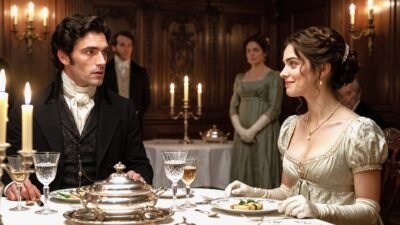
The Hanover Square Rooms were ablaze with the light of a thousand wax tapers, the air heavy with the scent of expensive perfumes and the suffocating weight of aristocratic expectation. It was the premier musical event of the Season, a gathering that demanded the presence of everyone who mattered in London society. Phoebe sat in the very last row of the gilded chairs, grouped with the other paid companions and poor relations, effectively invisible against the damask wallpaper. She kept her eyes fixed firmly on the empty stage, fighting the overwhelming urge to look toward the front of the hall.
Three rows from the orchestra, Robert Sterling was seated in the very center of social scrutiny. To his right sat his formidable aunt, the Duchess of Cleves, who had taken it upon herself to steer the Ravenscar dynasty back toward impeccable propriety. To his left sat Lady Honoria Westfall.
Lady Honoria was, by every metric of the ton, the perfect prospective bride. She was beautifully dressed in pale blue silk, her blonde hair flawlessly arranged, her pedigree unblemished. As the musicians tuned their instruments, she leaned toward Robert, tapping her closed fan lightly against his sleeve.
“I do hope they play something lively this evening, Your Grace,” Honoria murmured, offering him a practiced, flawless smile. “I find these heavy German symphonies so dreadfully taxing. Don’t you agree? Music should be pleasant, I think. It shouldn’t require one to think too deeply.”
Robert looked at her, his jaw tightening. A week ago, he might have found her shallow commentary harmless, if tiresome. Now, the words felt like a physical weight pressing against his chest. He thought of the library at Ravenscar House, the smell of rain and old paper, and the fiercely intelligent woman who had taught him that music was the very language of the soul. He thought of Phoebe’s hands on the keys, translating the chaotic grief of his mother’s shorthand into a soaring, triumphant bridge.
“I believe, Lady Honoria, that the best music requires us to feel precisely what we spend our lives trying to ignore,” Robert replied, his voice flat and perfectly polite.
Honoria blinked, clearly confused by the response, before offering a light, uncomprehending laugh. “How very profound, Your Grace. Though I must say, I prefer a good country dance.”
Robert turned his head, his gaze sweeping over the sea of velvet and silk until it found the shadows at the back of the room. Even across the crowded hall, he found her instantly. Phoebe sat perfectly still in her modest dark gown, her hands folded in her lap, her profile illuminated by a single sconce. The distance between them was only a matter of yards, but it was measured in centuries of impenetrable social law.
Since the afternoon in the library, they had kept their word. They had maintained a strict, agonizingly professional distance during her visits to Ravenscar House. But the forced separation had not extinguished the fire between them; it had only drawn the air from the room, leaving Robert feeling as though he were slowly suffocating.
His aunt leaned in, her voice dropping to a sharp, discreet whisper meant only for his ears. “You are staring again, Robert. And people are beginning to notice.”
Robert did not immediately look away from the back of the hall. “I am merely observing the room, Aunt.”
“You are observing Lady Danvers’s companion,” the Duchess corrected coldly. “I have heard the whispers, Robert. You have been inviting that young woman to Ravenscar House under the guise of assisting Rosalind. It is a thin excuse, and society is not blind. It is one thing to have a discreet dalliance, though even that is beneath you. But to parade a dependent before the very people expecting the announcement of your betrothal to Lady Honoria is an insult to the Westfall family, and a danger to your own name.”
“Miss Vance is a woman of exceptional character,” Robert said, his voice dangerously low. “There is no dalliance.”
“Then there is foolishness,” his aunt countered ruthlessly. “You are the Duke of Ravenscar. You do not marry for sentiment, and you certainly do not marry the daughter of a country doctor. You have a duty to secure the line with a woman of appropriate standing. Do not repeat your father’s mistakes by allowing misplaced passions to destroy the order of this family.”
The words struck the very center of Robert’s deepest fear, but for the first time in his life, the fear did not make him seek the safety of control. Looking at Honoria’s beautiful, vacant face, Robert experienced a sudden, chilling moment of absolute clarity. If he married this woman, his home would remain a tomb. He would become exactly what his father had been: a cold, detached man ruling over a silent house, trapped in a loveless marriage, slowly freezing to death behind a wall of ducal pride.
At the back of the hall, Phoebe heard the whispers. The companions sitting on either side of her were gossiping behind their fans, their voices hushed but painfully clear.
“They say the announcement will be in the Times by Thursday,” a woman in a plum-colored dress murmured. “The Duke and Lady Honoria. A perfect match. The families have been in negotiations for weeks.”
Phoebe kept her eyes on the orchestra, her expression entirely neutral, though a cold, hollow ache was spreading through her chest. She had known this was coming. She had told herself in the library that Robert belonged to a world she could never enter. But knowing the truth and watching it unfold before her were two entirely different agonies.
She allowed herself one fleeting glance toward the front of the room. Robert’s dark head was inclined toward Lady Honoria. To the rest of the world, it was the portrait of a perfect aristocratic courtship. Phoebe felt the last fragile thread of her hope snap. She could not do this. She could not remain in London, sitting in the margins of society, watching the man she loved marry a woman who would never understand the depths of his heart. She refused to become a tragic, unspoken regret, haunting the edges of his life while he fulfilled his dynastic obligations.
That night, returning to the suffocating quiet of her small room beneath the eaves of Lady Danvers’s townhouse, Phoebe did not light the fire. She sat at her small, scarred writing desk, pulled a sheet of plain paper toward her, and unstoppered her inkwell.
Her hand did not tremble. The tears that burned in her throat were swallowed down, replaced by the fierce, protective pride that had kept her alive since her father’s death. She wrote in clear, steady script.
She thanked the Duke of Ravenscar and Lady Rosalind for their kindness. She formally resigned her position in assisting with the musical transcriptions, citing a pressing need to seek a governess position she had been offered in the north of Scotland. She wished His Grace every happiness in his upcoming endeavors.
It was polite, it was final, and it was devastating.
Phoebe folded the paper, dripped a single drop of plain wax to seal it, and pressed it flat. Tomorrow, the letter would be delivered to Ravenscar House. And tomorrow, Phoebe Vance would begin the work of erasing herself from Robert Sterling’s life forever.
The plain, uncrested letter arrived at Ravenscar House precisely at ten o’clock the following morning. Robert broke the simple wax seal standing in the foyer, not bothering to retreat to his study. As his eyes scanned the neat, steady handwriting, the air in his lungs seemed to vanish.
She was leaving. A governess position in Scotland.
The polite, formal words felt like a knife dragging against his ribs. She was removing herself from his world, withdrawing her light, her music, and her quiet, unyielding strength, all to spare him the scandal of associating with her. A sudden, violent panic gripped him, far stronger than the deeply ingrained terror of societal disapproval. The fortress of duty and pride he had spent his life maintaining suddenly appeared to him not as a sanctuary, but as a tomb.
He did not call for his carriage. He strode out of the house, crossing the distance to Lady Danvers’s Mayfair residence on foot, his mind racing.
He found her not in the townhouse, but walking alone in the private, iron-gated garden square across the street. She was wearing a plain woolen cloak against the morning chill, her head bowed as she walked along the crushed gravel path beneath the ancient, spreading oaks. She looked small against the vast, gray backdrop of the London morning, but there was an unmistakable rigidity in her spine.
“Phoebe.”
She stopped abruptly. When she turned to face him, her eyes widened in shock, but she quickly masked it, her expression hardening into a look of polite detachment that tore at his heart.
“Your Grace,” Phoebe said, her voice dropping to a formal, measured tone. She glanced nervously toward the windows of the surrounding townhouses. “You should not be here. If you are seen speaking to me alone in the square—”
“I received your letter,” Robert interrupted, closing the distance between them until he was standing only an arm’s length away. The gravel crunched beneath his boots. “Scotland, Phoebe? A governess position at the edge of the world? You cannot do this.”
“I have already sent my acceptance,” she replied, keeping her gaze fixed on the lapel of his dark coat. She refused to look into his eyes, terrified that if she saw the tenderness there, her resolve would shatter. “It is a respectable position, and it will afford me the independence I require.”
“I can give you independence,” Robert said desperately, his voice raw. The words tumbled out before he could measure them against his own pride. “You do not need to freeze in a Scottish nursery. Stay in London. I will secure a house for you, provide an allowance, anything you need. You would never have to answer to Lady Danvers or anyone else ever again. I can protect you.”
Phoebe flinched as though he had struck her. She finally looked up, and the polite detachment in her eyes had been replaced by a fierce, blazing devastation.
“Protect me?” she repeated, the words trembling with a sudden, sharp anger. “By making me your kept woman, Your Grace? By hiding me away in a quiet house where you might visit me when it does not interfere with your duties to Lady Honoria?”
“No,” Robert said quickly, reaching for her. “Phoebe, you know my heart—”
“I know the reality of your station!” Phoebe stepped back, pulling her cloak tighter around her shoulders, refusing to let him touch her. Her breath came in shallow, ragged gasps, but she held her ground. “You ask me to give up my respectability so that you might preserve yours. You ask me to live in the shadows so that you may stand in the light. I told you, Robert, my self-respect is the only thing I own. I will not surrender it to become a duke’s secret.”
The truth of her words hit him with staggering force. He stood frozen on the gravel path, the desperate offer he had just made echoing in his own ears. He had thought he was offering her safety, but she had seen it for exactly what it was: cowardice. He was trying to have the love he so desperately craved without sacrificing the safety of his pride.
“I love you,” Robert said, the confession tearing out of him, ragged and undeniable. “I love you, and the thought of you leaving is tearing me apart.”
Tears finally spilled over Phoebe’s lashes, tracking silently down her pale cheeks, but her voice did not waver. “And I love you. More than I ever thought it possible to love another soul. But if your love requires me to hide, then it is not enough to build a life upon.”
She did not wait for him to answer. She turned her back on the Duke of Ravenscar and walked away, her footsteps fading down the long, empty path.
Robert stood alone in the center of the garden square, the morning wind biting through his coat. He watched her go, the agonizing pain of her absence already taking root in his chest. But beneath the pain, a sudden, blinding clarity began to rise. He thought of his father, clutching his pride in a silent, empty house. And he thought of Phoebe, choosing poverty and exile rather than compromising her soul.
If he let her walk away, he would be safe. He would marry Honoria, he would secure the line, and society would applaud him. And he would be dead inside for the rest of his natural life.
Robert turned on his heel and strode out of the garden square, his jaw set, his pace relentless. He no longer cared about the whispers of the ton, or the expectations of his aunt, or the heavy, suffocating legacy of his title. He knew exactly what he had to do.
The final grand assembly of the London Season was a spectacle of silk, diamonds, and ruthless calculation. Beneath the towering crystal chandeliers of the premier ballroom, the ton gathered to witness the culmination of the year’s social maneuvering. For weeks, the singular point of anticipation had been the imminent betrothal of the Duke of Ravenscar to Lady Honoria Westfall. Tonight was the night the announcement was universally expected.
Phoebe sat in the gallery overlooking the dance floor, her hands folded rigidly in her lap. Her trunk was already packed and waiting in the narrow hall of Lady Danvers’s townhouse. Her coach for Scotland departed at dawn. She had been commanded to attend this final event by her employer, an agonizing duty she had no power to refuse. She kept her gaze fixed on the intricate woodwork of her fan, determined not to look down at the dais where Robert sat flanked by his formidable aunt and the radiant Lady Honoria.
The orchestra concluded a lively waltz, and a expectant hush fell over the vast room. The Duchess of Cleves gave a sharp, satisfied nod toward her nephew, signaling that the moment had arrived. The master of ceremonies stepped forward, tapping his staff against the polished floor to command absolute silence.
Robert stood. He was dressed in impeccable evening formalwear, the very picture of aristocratic power. But as he stepped to the edge of the dais, Phoebe, unable to stop herself from looking at him one last time, saw that the rigid, cold mask he had worn for decades was entirely gone. In its place was a man of staggering calm and absolute conviction.
He did not offer his hand to Lady Honoria. Instead, he signaled the orchestra leader, who stepped forward holding a beautifully bound folio of sheet music.
“My lords, ladies, and esteemed guests,” Robert’s voice rang out, rich and effortless, carrying to the very back of the gallery. “You expect an announcement from the House of Ravenscar tonight, and you shall have it. But it is not the announcement you have been led to anticipate.”
A ripple of confused murmurs washed through the crowd. Lady Honoria’s smile faltered, and the Duchess of Cleves stiffened in her chair.
“For twenty-three years, the music of Ravenscar House was silenced,” Robert continued, his gaze slowly sweeping the room. “My family allowed pride and fear to bury the legacy of a brilliant woman—my mother. Tonight, I am honored to announce the formal publication of her life’s work, restored and completed from her private manuscripts.”
The murmurs grew louder, shocked by the public mention of the scandalous former duchess. Robert ignored them, his voice rising with unwavering authority.
“But I cannot claim the credit for this restoration,” he said, turning his head and lifting his eyes directly to the shadows of the gallery. “This legacy was saved by the extraordinary talent, the brilliant intellect, and the unyielding integrity of one woman. A woman who taught me that true honor does not hide behind stone walls, and that a life without music—and without love—is no life at all.”
The entire assembly turned, following the duke’s gaze. Phoebe’s breath stopped. Her heart pounded a frantic rhythm against her ribs as the crowd parted beneath her.
Robert stepped down from the dais. He did not look at his furious aunt, nor the stunned Lady Honoria. He walked straight through the center of the ballroom, ascending the curved staircase to the gallery. The silence in the room was absolute, heavy with the shock of a thousand watching eyes.
He stopped directly in front of Phoebe. In full view of the most powerful families in England, the imposing, unapproachable Duke of Ravenscar offered a deep, sweeping bow, entirely shedding his aristocratic armor.
When he straightened, he looked only at her. “I once asked you to compromise your dignity because I was too much of a coward to risk my own,” Robert said, his voice entirely steady, meant for her but heard by everyone. “I was wrong, Phoebe. You are the finest, bravest woman I have ever known. I will not hide you in the shadows. I want you in the light, where you belong.”
He stripped off his white evening glove and held out his bare hand to her. “I lay my pride, my title, and my heart at your feet. I ask you, before the whole of the world, to do me the greatest honor a man could ever hope for. Be my equal. Be my wife. Be my Duchess.”
Phoebe stared at his outstretched hand, tears spilling hot and fast over her lashes. The terror of the watching crowd, the fear of her own inadequacy, the rigid boundaries of her world—all of it dissolved in the warmth of his dark, desperate eyes. He had done it. He had torn down the walls of his fortress, choosing her over everything he had been raised to protect.
With a trembling breath and a sudden, radiant smile, Phoebe placed her hand in his.
“Yes,” she whispered, her voice carrying the fierce, joyful strength of a woman finally stepping into the light. “Yes, Robert. I will.”
He pulled her to him, kissing the back of her hand with a reverence that sent a shockwave of collective gasps through the ton. Then, tucking her hand firmly into the crook of his arm, he turned and led his future Duchess down the stairs, walking through the parted sea of London society with his head held high, leaving the ghosts of his past behind them forever.
Six months later, the heavy, oppressive silence of Ravenscar House was only a memory. The tall windows of the music room were thrown wide open to the crisp autumn air, letting the golden afternoon light spill across the polished mahogany floors. The room was alive with the sound of laughter and the warm hum of conversation, filled with a diverse gathering of prominent peers, gifted scholars, and young musicians from the academy Robert and Phoebe had just established in London.
At the center of the room, seated side-by-side on the wide bench of the grand pianoforte, were the Duke and Duchess of Ravenscar.
Phoebe wore a gown of rich, deep emerald, her face glowing with a quiet, profound contentment. Robert sat close beside her, the severe lines of his face permanently softened by a joy he no longer felt the need to hide. He turned the page of the bound folio resting on the music stand—the published, completed works of his mother.
“Are you ready, Your Grace?” Phoebe asked, her eyes sparkling with the dry, affectionate wit he loved so dearly.
“Only if you lead the tempo, my love,” Robert murmured, leaning in to press a brief, tender kiss to her temple. “I have always trusted your hands far more than my own.”
Together, they placed their hands over the ivory keys. They did not play a mournful solo, nor a chaotic, frantic bridge. They played the lullaby. But as their hands moved in perfect synchronization, the music transformed. It was no longer a monument to a mother’s lonely grief, nor the echo of a son’s profound abandonment. Played as an equal, harmonious duet, the melody soared through the bright room—a joyous, triumphant celebration of a love that had defied the world, and a beautiful, enduring promise of the life they would share together.
Played as an equal, harmonious duet, the melody soared through the bright room—a joyous, triumphant celebration of a love that had defied the world, and a beautiful, enduring promise of the life they would share together.
If you enjoyed Phoebe and Robert’s story, please like this video, subscribe to the channel, and tell us in the comments: Would you have chosen love, even if society demanded sacrifice?