
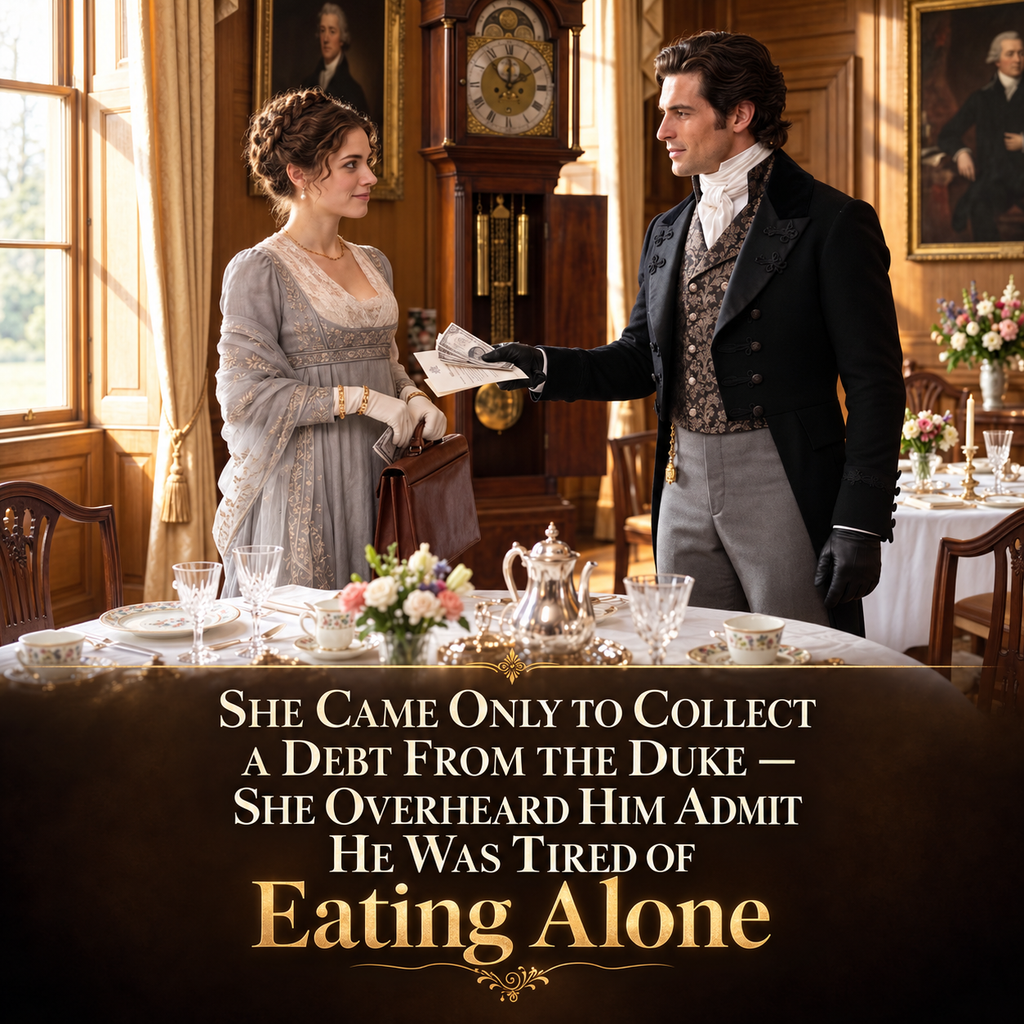
Hester Calloway traveled to Carrowby Hall with an unpaid account in her bag, a box of clockmaker’s tools, and every intention of returning swiftly to her workshop. Inside the vast estate, the Duke of Carrowby kept most of his rooms shuttered and sat down each evening to a dining table set for one. What began as a firm demand for payment soon led to a contract to restore a silent musical clock and conversations that stretched well beyond the work. The nobleman who spoke with strict authority about household debts lost his stiffness whenever Hester offered her dry observations. Yet the repair had a fixed end, and he held fast to a private vow of denial until an overheard admission changed what that great house meant to them both.
On the morning of Tuesday, the second of September, Hester stood in the chilly entrance hall of Carrowby Hall with her leather folio tucked beneath one arm and her wooden tool chest resting by her boots. Dust motes hung in the narrow strips of sunlight that slipped past the shuttered windows, and the doors to the adjoining parlors remained closed beneath white linen covers. Mrs. Dunmore, the housekeeper, clasped her hands at her waist and offered a polite, practiced refusal. His Grace does not receive callers, Miss Calloway, the older woman said, glancing toward the quiet staircase. The house has kept a very plain routine since the late Duke’s passing. Hester adjusted her grip on the folio and met Mrs. Dunmore’s eyes without heat. I did not come to pay a call, Mrs. Dunmore. I came to collect a debt. Before the housekeeper could reply, a tall butler in a well-brushed black coat stepped forward from the passage leading to the dining room.
The butler’s gaze fell to the brass nameplate fastened to the lid of Hester’s chest, and recognition flickered across his composed face. You are from Calloway and Daughter of Kirkby Wend, he said. I am Mr. Quill. Was it your father who delivered the tall musical clock in the dining room two winters ago? It was, Hester said, and I was his partner before his death in January. Josiah Calloway built the movement, and I cut the pin barrel and set the chimes. That clock has stood silent since the spring, Mr. Quill remarked, looking toward Mrs. Dunmore with quiet intent. The late Duke left the balance unsettled, Hester added, drawing the folded bill partway from her leather case so both servants could see the neat ledger hand. I have appointments arranged by mark at my shop, and I am prepared to wait in the hall as long as necessary, but I must have an answer from His Grace today.
Mrs. Dunmore studied the firm set of Hester’s shoulders and the clean, practical cuffs of her gray wool gown. After a brief exchange of glances with the butler, the housekeeper inclined her head. Wait here a moment, Miss Calloway, she said. Mr. Quill will inquire whether His Grace can spare a few minutes before his noon accounts. Quill turned back down the wainscoted passage with measured steps, leaving Hester beside a marble table that held no flowers and a pair of unlit lamps. She looked once toward the closed double doors at the far end of the hall, where not a single tick or chime disturbed the stillness, and loosened the brass clasp of her folio so the papers would be ready in her hand. Within three minutes, Quill returned and stepped aside to motion her forward. His Grace will see you in the dining room, Miss Calloway.
Hester carried her folio and tool chest down the passage and stepped into a dining room large enough to hold two dozen guests with ease. The long mahogany table stretched beneath twin chandeliers wrapped in holland bags, yet only a single place was being laid at the far end with a white cloth, one silver fork, and one porcelain plate. Against the paneled wall opposite the windows stood her father’s eight-foot musical clock in its walnut case, the brass pendulum motionless behind the glass door. Rowland Sedgwick, the fifth Duke of Carrowby, stood near the hearth with a ledger open on a side table. At thirty-six, he wore a plain dark coat without ornament, and his dark hair was brushed back from a face marked by weary concentration. You have come from Kirkby Wend, Miss Calloway, he said, stepping forward as Quill closed the door behind her and moved to the sideboard. Tell me what my house owes your workshop.
Hester approached the end of the long table and laid three papers upon the polished wood without flourish. Your late father purchased this musical clock for three hundred and eighty pounds, Your Grace, she said. He paid one hundred pounds upon delivery, as shown on this receipt, and signed the order below it. The remaining balance of two hundred and eighty pounds was never discharged. Rowland picked up the papers, examining his father’s broad signature and the clear itemization in Josiah Calloway’s hand. He did not challenge the figures or ask her to soften her tone. Instead, a look of genuine regret crossed his features as he set the sheet down. This bill was buried among the unconciliated accounts my father left behind fifteen months ago, Rowland said. The fault belongs entirely to the administration of this house, Miss Calloway, and I apologize for the delay you have suffered. I accept full responsibility for the balance.
Hester felt the tight knot between her shoulders loosen slightly at his plain honesty. I appreciate your directness, Your Grace, she said. I have a metal and component supplier in Leeds whose account of two hundred pounds falls due on the fourth of October. If I do not settle it on time, I lose my credit terms and must refuse winter commissions that require brass stock. Rowland walked to the portable writing desk on the side table, unlocked a cash box, and counted out bank notes with practiced care. I have eighty pounds available in the household commercial account today, he said, returning to place the notes beside her folio. Our Michaelmas rents arrive between the twenty-fourth and the twenty-seventh of this month. I will sign a written acknowledgment for the remaining two hundred pounds, payable to you here on the twenty-ninth of September, which will leave you time to pay your Leeds representative before the fourth.
Hester counted the eighty pounds, wrote out a partial receipt in clear ink, and watched him sign the promissory note for the balance. That arrangement satisfies my books, Your Grace, she said, drying the papers before tucking them away. As she closed her folio, her gaze drifted back to the silent walnut case against the wall. Mr. Quill mentioned that the clock stopped in the spring. Rowland glanced at the tall dial with a faint, dry grimace. It stopped in May, he said, and I cannot say I mourned the silence. The musical cylinder plays The Roast Beef of Old England at noon and six, and the tune never aided my digestion. Hester looked from the single plate on the vast table to the silent brass face and kept her voice entirely level. The instrument was never to blame for your cook’s choices, Your Grace.
For a second the room was completely still, and then Rowland let out a short, genuine laugh that startled them both. Even Quill, standing near the sideboard with a water carafe, looked up in surprise before schooling his expression. Rowland’s dark eyes warmed as he studied Hester with sudden personal interest. No one in this house has defended the furniture to my face before, Miss Calloway, he said. Since you built half of it, tell me whether the movement can be restored. Hester walked to the case, unlocked the waist door with her own key, and peered inside at the brass plates and the pin barrel. The oil has gummed on the arbors, two bushings are worn, and a lifting lever on the musical train is out of adjustment, she said, straightening up. It will require cleaning, new bushings, reassembly, and several days of observation to regulate the strike.
Rowland stepped closer to the clock, looking past the brass wheels to the woman examining them. How long would the work require, and what is your fee? It will take from tomorrow until the twenty-ninth of September, Hester replied, keeping the new proposal separate from the old debt. My fee is twenty pounds, ten upon engagement and ten upon delivery. That sum will also cover my room at the Heron Inn in the village while my shop in Kirkby Wend operates by appointment, and I will reopen full time on the thirtieth. Rowland returned to the cash box at once and brought back ten pounds along with a fresh sheet for the repair contract. My coachman will bring the cabriolet to the Heron each morning to carry you and your tools, he said, handing her the notes as they signed the agreement. Hester placed the ten pounds in a separate pocket of her case, knowing she would return to Carrowby Hall the next morning with work to do.

On Wednesday morning, the third of September, Hester spread a clean canvas cloth over a worktable near the dining room windows and laid out her screwdrivers, tweezers, and brass brushes. In the adjoining morning room, the door stood open so Mrs. Dunmore could mend table linens within earshot while Hester worked inside the tall walnut case. When Rowland entered the dining room with a bundle of estate letters in his hand, Hester was reaching into the narrow waist of the clock to unhook the heavy brass pendulum bob. Your Grace, she said without looking back, if your hands are free for a moment, I need someone to steady the pendulum rod while I release the suspension spring at the top. Rowland set his letters on the sideboard at once and stepped beside her. Tell me where to hold it, Miss Calloway.
She guided his fingers to the flat brass shaft just above the gleaming bob, and he gripped the metal with such stiff, military solemnity that his knuckles turned white and his shoulders locked. Hester looked down from her low wooden stool and hid a faint smile as she loosened the upper screw. You may breathe, Your Grace, she remarked, lifting the small steel spring clear of its slit. The brass will not take offense if your chest moves. Rowland let out a breath he had clearly been holding and glanced sideways at her with a sheepish curve to his mouth. I was afraid a sudden movement might bend something vital, he admitted, lowering the heavy pendulum carefully onto the padded cloth at her signal. In truth, I have looked at this clock every day for two years, and I do not know what that thin strip of steel in your hand actually does.
Hester appreciated a client who asked an honest question instead of pretending to master a trade in five minutes. She held out the suspension spring on her palm so he could see its delicate flexibility. It bears the weight of the pendulum while allowing it to swing with almost no friction, she explained, pointing to the tiny brass blocks at either end. If this strip is twisted by even a hair, the clock limps like a horse with a stone in its shoe. Rowland leaned down to examine the part, remaining beside the worktable even after his task with the pendulum was finished. And the music? he asked, nodding toward the pinned brass cylinder resting on the cloth. Why did the tune begin to drag before it gave up altogether?
The lifting lever was bent, Hester said, picking up her brass brush, though I suspect someone in this room glared at the mechanism until its spirits sank. The melody is not so terrible when the hammers strike in proper time. It is relentless, Rowland countered, folding his arms as he lingered by her table. Every afternoon at six, just as the soup grew cold, it marched through the same pompous phrase as if announcing a regiment of boiled beef. How can you know the phrase is pompous if you never listened to it? Hester asked, raising her eyebrows. Because the third measure repeats the same high note three times before dropping like a stone, he replied promptly. Hester hummed two crisp notes under her breath to test his claim, stopped mid-bar as she realized he knew the entire arrangement by heart, and laughed aloud with him when he caught her in the act. You have memorized it, Your Grace, she said, shaking her head as she reached for her oil vial, and yet neither of them moved to end the conversation.
By seven o’clock that evening, the autumn light had faded behind the tall windows, and Quill entered to light the candles at the far end of the mahogany table. Rowland sat down in his solitary armchair as the butler placed a tureen of broth and a covered dish before him, while twenty feet away Hester wiped her brass tools with a chamois rag. As he lifted his spoon, Rowland noticed that he was watching the steady movement of her hands and searching his mind for a subject that would keep her from snapping the lid of her chest shut. When Quill uncovered a porcelain dish of stewed pears in spiced syrup near the sideboard, Rowland looked across the polished expanse of wood toward her worktable. Does your workshop approve of cooked fruit, Miss Calloway, or is that another offense of my kitchen?
Hester paused with a small file in her fingers and glanced at the steaming dish. A good pear has enough character when it is firm and fresh from the branch, Your Grace, she said, setting the file neatly in its slot. Stewing it in cloves only hides the fact that the gardener picked it too late or too early. A crisp pear is practically a turnip with ambition, Rowland replied, resting his forearm beside his plate as the distance of the long table seemed to shrink between them. When I was ten, the orchard wall at Carrowby collapsed after a storm, and the cook served us poached pears for nineteen days straight to save the windfalls. To this day, I cannot trust a raw one. Hester laughed and closed the inner tray of her box. My father once traded a pocket watch repair for two bushels of hard winter pears from a farmer in Leyburn, she told him. We kept them in the cold cellar until Christmas, and every time we bit into one, the sound was loud enough to drown out the shop chimes.
Rowland smiled, looking at the abundant dishes surrounding his single plate and then at the woman standing beside her packed chest. There is far more here than one person can manage, Miss Calloway, he said, gesturing toward the table. Let Quill set a place for you before you drive back to the village. Thank you, Your Grace, Hester replied without awkwardness, lifting her leather folio, but I ordered my supper at the Heron before I left this morning, and Mrs. Yates keeps the mutton hot for my return. Rowland inclined his head at once, accepting her boundary without pressing her. Then I will not make an enemy of Mrs. Yates, he said, rising from his chair as Quill stepped to the door to summon the cabriolet. As Hester walked into the hall, Rowland realized he was already looking forward to her return in the morning and deliberately saving a question about the chime hammers so he would have a reason to join her table before noon.
On Friday evening, the fifth of September, a light rain tapped against the dining room panes as Hester finished cleaning the brass gear train. She washed her hands in a basin Mrs. Dunmore had provided, bade Rowland and the housekeeper good evening, and walked out to the entrance hall to wait for the coachman to bring the cabriolet around to the steps. As she checked her cloak pockets near the front door, she realized she had left her small box of pivot broaches on the corner of the worktable in the anteroom just off the dining hall. Turning back down the quiet passage, she stepped into the unlit anteroom and reached for the cedar box. The heavy door between the anteroom and the dining room stood ajar by a few inches, and Quill’s quiet voice carried clearly through the opening.
Sir Thomas and Lady Wetherby sent word from the priory this afternoon, Your Grace, the butler was saying as silver clinked softly against porcelain. They inquired whether you might invite a few neighbors to dine next week now that the autumn quarter has begun. A small company would bring warmth to the room. There was a pause, followed by the soft scrape of Rowland’s chair against the floorboards. When he spoke, the dry composure Hester had heard all week was gone, replaced by a low, unguarded fatigue. I am tired of eating alone, Quill. Hester’s hand stilled on the lid of her cedar box, her breath catching at the plain sorrow in his voice. For fifteen months I have sat at the end of this table listening to the house creak, Rowland continued quietly, and there are evenings when the silence weighs more than the ledgers.
Then let me lay six places on Tuesday, Your Grace, Quill replied gently. No, Rowland said, his tone firming with the strict discipline that governed his days. My father filled all twenty-four chairs twice a week while tradesmen in York and Kirkby Wend waited years for their money. Every dish on that mahogany cost someone else their livelihood. I will not fill that table again while there are still people waiting to be paid. Hester did not linger by the crack in the door to pry further into his private thoughts. She lifted her small box of broaches carefully so the brass hinges made no sound, stepped back into the corridor, and walked out to the waiting cabriolet under the rain. Yet as the carriage rolled down the gravel drive toward the Heron Inn, she could no longer see the Duke’s austere routine as coldness or pride; she saw a solitary man punishing himself at an empty table for debts he had not made.
When Monday evening, the eighth of September, arrived, the rain had cleared, and Hester remained at her worktable as seven o’clock struck on the hall watch. She had spent the afternoon fitting new brass bushings into the movement plates, and two pinions still needed testing before she could leave them for the night. When Quill entered with the dinner trays and set Rowland’s single place at the head of the table, Hester did not pack her tools. Instead, she untied a clean linen napkin from her basket, revealing a small loaf of crusty brown bread and a wedge of Wensleydale cheese she had bought at the inn. Your Grace, she said, stepping away from her workbench with the bundle in her hands, I have another hour of adjustment on the striking train tonight. Rather than sitting on my work stool in the corner with my bread, may I take a chair at the table while I eat?
Rowland looked up from unfolding his napkin, surprise and unmistakable pleasure brightening his face as he rose to his feet. You are very welcome at the table, Miss Calloway, he said at once, pulling out the chair immediately to his right. And please let Quill bring you a plate from the sideboard so you need not dine on dry bread. I brought my own supper so I would not add to the household accounts, Hester replied, choosing a chair three places down from him—close enough for easy conversation, yet far enough to mark that she had come on her own terms. Quill brought a clean plate, a knife, and a glass of water without being asked, setting them before her while Rowland resumed his seat. You are a remarkably stubborn woman about your independence, Miss Calloway, Rowland remarked, though his voice held warmth rather than rebuke. I am a clockmaker who keeps her books balanced, Your Grace, she answered, cutting a neat slice of her bread.
As the first course was cleared, Rowland glanced at the fruit stand on the sideboard and spoke quietly to the butler. A moment later, Quill set a small silver dish beside Hester’s elbow containing two firm, uncooked autumn pears with the stems intact. Hester looked from the fresh fruit to Rowland, who was attempting to look entirely occupied with his wineglass. I believe we established on Wednesday that stewing ruins their character, he said evenly. Hester felt a sudden, disarming rush of warmth in her chest at the realization that he had remembered a passing remark from five days earlier and arranged the kitchen order to suit her taste. Careful, Your Grace, she said, picking up the pear with a crooked smile. If you indulge my opinions on fruit, I may begin criticizing the wallpaper next. If it keeps you from eating on that wretched wooden stool in the corner, you may condemn the curtains as well, he replied.
She sliced the crisp pear and relaxed back against the upholstered chair, the careful distance between them dissolving into easy companionship. Watching you guard your ledger reminds me of the winter I tried to teach my father to play piquet by the kitchen fire, Hester said, laughing softly at the memory. Josiah could calculate gear ratios for a planetarium in his head, yet whenever I dealt the cards, he ignored the suits entirely and tried to multiply the pips to see if they matched the week’s brass invoice. Rowland leaned forward, resting his arm on the table with genuine curiosity. I have not touched a pack of cards since I left Oxford, he said. Is piquet the game where one declares sequences before playing? We have a pack in the morning room drawer if you are willing to risk a pupil who will not multiply the spades.
When the dishes were cleared and the clock repairs were set aside for the evening, Quill brought the leather card box and two candlesticks to the space between their chairs. Hester dealt twelve cards to each of them and explained the scoring of the carte blanche and the point, only to frown three minutes later when she laid down a sequence of four diamonds and claimed fourteen points instead of four. Rowland studied the cards on the mahogany, looked up at her composed face, and raised one eyebrow. Unless Kirkby Wend uses a very generous arithmetic, Miss Calloway, a quart counts for four until you reach five cards. Hester stared at the diamonds, realized she had conflated two rules in her haste to instruct him, and burst out laughing at her own mistake. My father would have demanded a recount of the entire shop inventory if he saw that blunder, she admitted, gathering the tricks. You have won the first hand fairly, Your Grace, and I ought to let your coachman take me back to the inn before I lose my tools. The clock can wait until morning, Rowland said, holding the pack out to her with a quiet, hopeful directness in his eyes. Stay another half hour and play the second hand with me. Hester looked at the cards in his hand, felt no wish at all to return to her empty room at the Heron, and reached across the wood to take the deck.
That Monday evening became the pattern for the remainder of the week. On Wednesday and again on Friday, Hester brought her small loaf wrapped in linen, yet each night she chose a chair one place closer to the head of the table until only the corner of the mahogany separated them. Their conversations stretched seamlessly from one supper to the next, picking up unfinished debates about parish roads, village choir masters, and the temperamental chimneys of North Riding houses as if no hours had passed between meals. By Friday night, as Hester stood in the hall tying her bonnet strings for the drive back to the Heron, she realized that she looked forward to seven o’clock far more than a temporary contractor had any business doing. Rowland walked her to the doors and paused with his hand on the brass latch. Will you bring the cards back on Monday, Miss Calloway, so we may settle the rubber? he asked, though beneath the light question lay the unspoken awareness that the twenty-ninth of September was drawing closer, and neither of them knew what reason could keep her at his table once the clock was whole.

On the afternoon of Saturday, the twentieth of September, the cleaned brass movement stood reassembled on Hester’s worktable, gleaming in the pale autumn light that crossed the dining room. Before lifting the heavy mechanism back onto its seatboard inside the tall walnut case, Hester leaned into the upper hood with a tallow candle to inspect the wooden brackets for warpage. As the flame warmed the dark timber behind the dial frame, a line of neat, angled lettering carved with a small chisel caught her eye. She held the candle closer and traced the shallow grooves with her fingertips. Your Grace, she called softly over her shoulder, if you have a moment from your correspondence, there is something inside the hood you have never seen.
Rowland rose from the side table where he had been reviewing autumn lease agreements and stepped beside her stool. Hester tilted the candle so the light fell squarely across the inner backboard. My father sometimes left his mark inside the cases of his finest longcase clocks, she said, her voice warming with quiet affection as she read the words aloud. May this clock keep good company at a full table. It has no legal bearing on the bill of sale, of course, she added quickly, looking up at him, only Josiah Calloway’s wish for the house that received his work. Rowland leaned into the scent of beeswax and aged walnut, studying the steady hand of the man who had waited in vain to be paid for that blessing. He carved it cleanly, Rowland said softly. What sort of man was he at his own table?
He was a terrible storyteller who believed he was a great wit, Hester said, a fond smile curving her mouth as she lowered the candle. Every Sunday over boiled mutton, he would begin an account of some famous watchmaker in London, forget the man’s name halfway through the gravy, and invent three new details that contradicted the week before. If I corrected him, he would tap his knife against his glass and tell me that a daughter who could file a verge escapement ought to show more mercy to an old man’s memory. Yet he never once let a meal pass in silence, even when brass was scarce and the coal bill was high. Rowland rested his hand lightly against the side of the walnut case, his expression softening into a rare, unguarded nostalgia. Before my mother died and the gaming tables in London took hold of him, my father used to bring two spaniels into the breakfast room every frosty morning, Rowland said. He would slip them pieces of buttered toast under the cloth whenever Quill turned his back, and then blame me with a completely solemn face when the butter dish was empty. He was generous in small, foolish ways before his generosity outran his purse and turned into neglect of everyone who depended on him.
Hester looked at his profile in the warm glow of the candle, moved by the quiet honesty that allowed him to speak of his father with both sorrow and tenderness. They stood close beside the open case for a moment, neither of them hurrying to break the stillness. Then Hester set the candlestick on the worktable and reached for the brass winding crank. I will have the movement seated in the case before dusk, she said, and the next eight days will require fine regulation of the strike and the musical train. I will need to work late on Thursday evening to test the night silencing lever after the six o’clock chime. She paused, looking directly into his dark eyes without the shield of her ledger or her tools. Will you be here for supper on Thursday? Rowland’s face lit with an immediate, boyish pleasure that smoothed the lines from his forehead. I have no engagement in the county that could keep me away, Miss Calloway, he answered. Tell Mrs. Dunmore what you would like the cook to prepare, and I will have Quill set the places at seven.
During the week that followed, the tall clock ticked with steady authority against the dining room wall while the estate rents began arriving in Mr. Fenn’s office. By noon on Monday, the twenty-ninth of September, the autumn sun shone brightly across the polished mahogany table, and Hester’s wooden chest stood packed and latched beside her chair. Not a single brass wheel or steel screw remained on the canvas cloth. Rowland stood near the hearth with Mr. Fenn, his estate steward, while Mr. Quill waited by the sideboard. Fenn opened a leather bank book upon the table and counted out two hundred pounds in crisp notes drawn from the Michaelmas rents collected four days earlier. Here is the balance of the late Duke’s account, Miss Calloway, Fenn said politely, sliding the stack toward her alongside a second small pile of ten pounds from the household purse for the completion of your restoration contract.
Hester counted both sums with her customary care, dipped the quill into the inkstand, and signed the full discharge of the two-hundred-and-eighty-pound debt at the bottom of the original bill. She then signed the separate receipt for her twenty-pound repair fee and tucked the notes safely into her leather folio. With that two hundred pounds in hand, her account with the Leeds metal supplier would be settled well before the fourth of October, and her workshop was completely secure. Just as she blotted the second sheet, the minute hand of the tall walnut clock reached twelve. Inside the case, the lifting lever rose without a hitch, the warning wheel spun softly, and twelve clear, resonant strokes sounded through the dining room, followed at once by the bright, sprightly hammers playing The Roast Beef of Old England in brisk, unhurried time.
Across the room, Rowland did not look at the dial; he looked immediately at Hester’s face to catch her reaction. Hester listened to the last brass pin release its hammer, turned toward him with a dry twinkle in her eyes, and inclined her head. If your digestion suffers today, Your Grace, you will have to take it up with the butcher, she said. The musical train is within half a beat of perfection. It is almost cheerful enough to make me forgive the tune, Rowland replied, though the smile faded from his eyes a moment later as his gaze fell to the latched tool chest by her boots. I will pack the canvas cloth tonight and return to Kirkby Wend in the morning, Hester added, keeping her voice steady as the reality of their finished business settled over the room. My shop reopens for regular hours tomorrow. Before Rowland could answer, Mr. Fenn gathered the signed receipts and cleared his throat. With Miss Calloway’s bill discharged, Your Grace, only the three York builders’ accounts remain on the old ledger, the steward remarked in a brief administrative tone, and their final installments are agreed and scheduled for Lady Day in March. Rowland gave a short nod to dismiss the steward, yet as Fenn left the room, Rowland felt the sudden, hollow weight of the completed receipts: he had no remaining debt to hold her at Carrowby Hall, and his own strict rule still bound him to those last three names on his father’s list.
At seven o’clock that Monday evening, Hester came down from the anteroom for her final supper under the contract, carrying her small linen-wrapped loaf one last time before her last night at the Heron Inn. She took the chair immediately to Rowland’s right at the corner of the great mahogany table, where Quill had already laid her plate and a dish of fresh autumn pears. Before sitting, she placed a folded sheet of foolscap beside Rowland’s water glass. I have written out the winding instructions and the care of the strike lever for Mr. Quill, she said, taking her seat as the butler served the roast chicken. Unless someone attempts to oil the pin barrel with lard, the movement should not require a clockmaker’s hand for another ten years. Ten years is a very thorough sentence, Miss Calloway, Rowland said quietly, looking at the neat handwriting on the sheet rather than touching his fork.
They ate the first course with a gentler, more fragile quietness than the lively debates of the previous weeks, both of them aware of the packed tool chest waiting by the hall door. When Quill stepped to the far sideboard to pour the tea and remained at a respectful distance, Hester set her knife down beside her bread and looked across the corner of the table at Rowland. Before I return to Kirkby Wend tomorrow, Your Grace, there is something I owe you in plain honesty, she said. On the first Friday of my work here, I came back to the anteroom for my box of broaches after bidding you good night. The door was ajar, and I overheard you tell Mr. Quill that you were tired of eating alone, and why you refused to fill this table.
Rowland went very still, his fingers tightening briefly around the stem of his glass as heat rose along his cheekbones. You heard that, he said, his voice dropping low. Is that why you brought your bread to the table the following Monday? Out of pity for a solitary client? It is why I asked for a chair that first Monday, Hester answered without flinching, meeting his gaze with clear, steady candor. I thought no man should punish himself with silence for debts he was already working to pay. Then her expression softened, and a small, genuine smile touched her lips. But pity would not have kept me past the soup on Wednesday, Your Grace. I stayed, and I came back every evening after, because I liked hearing your arguments, because you remembered how I take my pears, and because I enjoyed beating you at piquet and hearing you laugh when I miscounted my own diamonds.
Rowland searched her face for a second, and the defensive tension left his shoulders completely as he believed every word she said. You have never done anything out of false charity since the morning you walked into my hall, Miss Calloway, he said softly, the question of pity vanishing between them for good. For a long moment, the candlelit space at the corner of the table held an unmistakable opening. Hester rested her hand on the mahogany a few inches from his sleeve, her heart beating fast with the hope that he would ask her to come back on Thursday or offer to ride to Kirkby Wend when no clock required her presence. Rowland looked at her hand, and the longing in his dark eyes was plain enough to steal her breath. Then his gaze shifted slightly toward the side table where his father’s ledger still lay with its three remaining Lady Day accounts, and the old habit of self-denial closed over his expression. You have given this house back its measure of time, Miss Calloway, and more pleasant evenings than it deserved, he said, rising to offer a formal bow over the table. My coachman will be at the Heron at eight tomorrow morning to convey you and your chest safely home to your shop. Hester felt the sharp ache of the words he had chosen not to speak, rose from her chair with her chin held high, and bade him good night, walking out to the carriage with the certainty that her work at Carrowby Hall was over and no assurance that she would ever sit beside him again.
On Tuesday evening, the thirtieth of September, Rowland sat down at the head of the dining table as the restored walnut clock struck seven and played its lively measure across the room. The worktable by the windows was bare, the canvas cloth was gone, and only a single porcelain plate rested upon the white linen. When Quill uncovered the roast mutton and stepped back to the sideboard, Rowland reached automatically toward the salt cellar with a remark about the parish road repairs on his tongue, only to stop as his eyes met the empty chair to his right. There was no brown loaf wrapped in a napkin, no dry observation waiting to counter his opinion, and no pack of cards resting beside the candlesticks. He ate three bites in silence while the steady tick of Josiah Calloway’s movement filled the high room, making the absence beside him sharper than it had ever been when the clock stood broken.
By Thursday evening, the second of October, the silence had ceased to feel like duty and felt entirely like folly. Rowland sat with his supper untouched, looking from the empty chair at his right hand to the side table where his father’s ledger rested. For three weeks that table had held two plates while the Michaelmas accounts were being gathered and paid, and not a single creditor in Yorkshire had suffered because Hester Calloway sat beside him eating fresh pears and miscounting her diamonds. He had treated misery as if it were a form of payment, and in doing so he had let her walk out of his house on Monday night without asking her to stay. On Friday morning, the third of October, Rowland summoned Mr. Fenn to his study and spread the estate books open across his desk. I am establishing a fixed schedule for the three remaining York builders’ accounts through Lady Day, Rowland said, writing out a clear administrative mandate and signing his name at the bottom. You now have my written authorization to issue all routine household and estate payments directly from the steward’s office, Mr. Fenn, while I review the balances with you on the first Monday of each month.
Fenn bowed and accepted the signed warrant without surprise, leaving Rowland free of the daily bookkeeping he had used as a wall against his own life. Rowland walked out into the entrance hall where Mr. Quill was adjusting the barometer near the front door. I am going into Kirkby Wend tomorrow afternoon, Quill, Rowland said, his decision settled and entirely his own. Shall I have the coachman prepare the cabriolet, Your Grace? the butler inquired evenly. No, Rowland answered, looking toward the bright autumn light beyond the doorway. Have my bay gelding saddled after luncheon; I will ride over myself.
On the afternoon of Saturday, the fourth of October, the front door of Calloway and Daughter stood latched back to admit the crisp breeze off the market square of Kirkby Wend. Two days earlier, on the first of the month, Hester had paid the Leeds representative the full two hundred pounds she owed for brass and steel stock, placing his signed receipt inside her ledger alongside eighty pounds of remaining working capital. Now she sat at her high workbench by the front window with a magnifying glass at her eye, fitting a delicate balance spring into a farmer’s silver pocket watch while three wall clocks ticked in different rhythms behind her. When the shadow of a tall horse and rider fell across the shop panes and the street bell chimed above the door, Hester lowered her tweezers and looked up as Rowland stepped across her threshold in his riding boots and dark coat.
Her first instinct was the habit of her trade: she glanced immediately at his empty hands, looking for a traveling case, a carriage clock, or a broken watch chain. Has the lifting lever slipped on the musical train, Your Grace? she asked, rising from her stool and wiping her fingers on her apron. The clock is keeping flawless time, Miss Calloway, Rowland said, removing his hat and stepping up to the wooden counter that separated them. I did not bring a mechanism to be mended. I rode over to see you. Hester’s pulse gave a sudden leap against her collar, though she kept her hands steady on the edge of the counter. You rode eleven miles without an errand?
I came because the dining room at Carrowby Hall has been intolerable since Tuesday, Rowland replied, meeting her gaze without the shield of his title or his accounts. Before I left home, I settled the payment calendar for the last three York bills and delegated the daily accounts to Mr. Fenn. Those debts will be paid on time in March, but I realized this week that starving my own table does not pay them a day sooner. He paused, letting the quiet ticking of her workshop fill the space between them before he spoke with plain, unguarded honesty. I am tired of eating alone. I want to eat with you. Will you come back to Carrowby Hall for supper on Thursday at seven, with no clock to repair and no ledger between us?
Hester looked at the man standing in the middle of her modest shop, seeing the risk he had taken in riding to her door to ask for something she could freely refuse. Her heart warmed at his candor, yet she held to the practical truth of her own days. My shop is open full time now, Your Grace, and I have three farm clocks and two verge watches promised before the middle of the month, she said clearly. I cannot leave my bench in the afternoons as I did in September, and I must organize my own hours if I am to keep my customers’ trust. I am not asking to buy your working hours or interfere with your trade, Rowland answered at once, showing no trace of offense. Tell me what hour suits your bench, and my coachman will fetch you when your shop closes and bring you safely home that same night.
The respect in his immediate answer dissolved the last of her caution, and a slow, genuine smile curved Hester’s lips. Thursday, then, she said. And you may try my stew on Sunday. Rowland’s dark eyes lit with surprise and unmistakable delight. Are you inviting me to dine in Kirkby Wend, Miss Calloway? At one o’clock in the parlor behind this shop, she said, nodding toward the inner door. Bring Mrs. Dunmore with you in the carriage; she promised to inspect my late mother’s herb garden before the frost, and her company will satisfy the village gossips while you discover whether a clockmaker can cook mutton without ruining the pears. I will be at your door at one o’clock on Sunday, Rowland said, his smile easing every line of his face as he reached across the counter to take her hand for a brief, warm moment before turning back toward the square, leaving both of them with a week shaped by their own choosing.
On Thursday evening, the ninth of October, the tall walnut clock in the dining room of Carrowby Hall lacked five minutes to seven when Mr. Quill opened the double doors to admit Hester. Four days earlier, on Sunday afternoon, Rowland had sat in the small parlor behind her Kirkby Wend shop eating mutton stew while Mrs. Dunmore admired the rosemary bushes outside the window, and his back still remembered the unyielding straightness of Josiah Calloway’s oak bench. Tonight Rowland stood near the hearth as Hester walked in wearing her good blue wool gown, her hands completely empty of tool chests, leather folios, or linen-wrapped bundles. Have you recovered from my parlor bench, Your Grace, or did you require the village surgeon on Monday morning? she asked as he stepped forward to greet her. My spine has forgiven the oak, Miss Calloway, Rowland said, smiling as he drew out the chair to his right, though your stew set a dangerous standard for my kitchen.
As Hester sat down and spread her napkin across her lap, Rowland’s gaze fell to the clean white cloth beside her plate where her small brown loaf had rested every evening in September. For a second, the sudden absence of her basket left her hands with nothing to arrange, and a faint flush of self-consciousness touched her cheeks as she looked at the empty wood by her knife. I left the bread at home, she said, meeting his eyes without trying to busy her fingers or offer an excuse. I decided that if I was coming to your table as a guest, I ought to let you feed me. Rowland felt a quiet, profound warmth settle in his chest as he reached for the silver bread basket at the center of the cloth and held it out to her himself. Then let me offer you the first slice, Miss Calloway, he said, watching her take the warm roll from his hand and set it on her plate before Quill served the roast pheasant.
Throughout the courses, they spoke with an ease that needed no repair contract to sustain it. Hester told him of her plans to rearrange the front window of Calloway and Daughter before the November fairs so she could display two new bracket clocks alongside her pocket watch repairs. Rowland listened with genuine attention, asking how she intended to cut the brass dials and never once offering to buy the clocks himself or turn her ambition into an order for his estate. When Quill cleared the dishes and set a bowl of crisp, uncooked pears between them, Rowland glanced down the vast, empty stretch of mahogany that still extended twenty feet toward the shadows by the far wall. This table was built for a crowd I no longer care to gather, he remarked, looking back at her face in the candlelight. There is a smaller round table of cherrywood stored in the west breakfast room that would hold two places without an acre of polish between them. If you come back next Thursday, will you help me decide where it ought to stand? I think it should stand near the fire, Your Grace, Hester answered, and just as she spoke, the tall clock struck eight and launched into its brisk evening melody. Without hesitation, Hester reached across the corner of the table and laid her fingers lightly over the back of Rowland’s hand for a brief, steady moment while the hammers chimed, letting the touch speak for itself before she drew back to slice her pear.
Over the six weeks that followed, the cherrywood table took its place near the dining room hearth, and their courtship became an open, accepted part of life between Carrowby and Kirkby Wend. When Rowland rode into the market square on Wednesdays or walked with Hester toward the parish green after Sunday luncheon at her house, the villagers tipped their hats and traded brief, curious glances over the shop windows, yet no one questioned the plain steadiness of his regard. Twice more he dined at her small table with Mrs. Dunmore sharing the parlor fire, and every Thursday and Saturday evening the estate carriage brought Hester to Carrowby Hall with no tools in her lap and no work waiting in the corner. By the last week of November, an early winter frost rimmed the tall windows of the dining room while coal glowed brightly in the grate beside the round cherrywood table.
When the supper dishes had been cleared and Quill had retired to the pantry, leaving the silver fruit basket and two glasses of port upon the cloth, Rowland set his napkin down and looked across the small curve of wood at Hester. For two months you have kept me company while my house put its affairs in order, and you have let me sit at your bench while you ran your shop, he said, his voice clear and steady in the quiet room. I have no wish to return to the life I kept before you knocked on my door with your father’s bill. Hester, will you marry me?
Hester heard her Christian name on his lips for the first time, and a deep, quiet joy rose in her throat as she met his dark eyes. You know that Calloway and Daughter is my trade as well as my inheritance, she said gently, holding his gaze so no misunderstanding could ever grow between them. I will not close the workshop in Kirkby Wend or give up my bench when I become your wife. I would no more ask you to lock your shop than I would ask the clock in the corner to stop ticking, Rowland answered at once, reaching across the table to cover her hand with his own. Your trade is part of the life I am asking to share. Tomorrow I will write to my solicitor in York so that we may meet with him together and have a marriage settlement properly drawn before the wedding to protect your workshop, your tools, and your separate accounts in law.
Hester looked at his strong fingers resting over hers, seeing both his heart and his respect for the woman she had worked all her life to become. Then she turned her palm upward to clasp his hand firmly and smiled. Yes, Rowland. I shall need the left-hand chair. Rowland let out a warm, delighted laugh and rose slightly to draw the chair on the left side of the round table closer to his own so that barely a hand’s breadth remained between their sleeves. As Hester moved into the seat beside him, her right elbow brushed the edge of the silver fruit basket, and Rowland immediately shifted the dish across the cloth to give her arm full room to rest. Now that you have claimed your side of the hearth, he said, picking up the fruit knife and gesturing toward the bowl of late winter pears, tell me honestly whether this one is firm enough for Kirkby Wend, or whether I must still defend my cook. Hester took the sliced wedge from his fingers, leaned her shoulder lightly against his arm as the tall clock ticked steadily against the paneled wall, and bit into the crisp fruit without a single ledger left between them.
There is something deeply comforting about watching two people finally lay down their heavy rules and simply enjoy a warm meal together by the fire. Thank you for spending this peaceful hour with The Regency Affair. If Hester and Rowland’s journey brought a smile to your day, please press the like button and subscribe to the channel so you never miss our next romance. We always love reading your thoughts in the comments below. Tell us, did you prefer the moment Rowland remembered her favorite raw pears, or when she finally arrived at his table empty-handed?