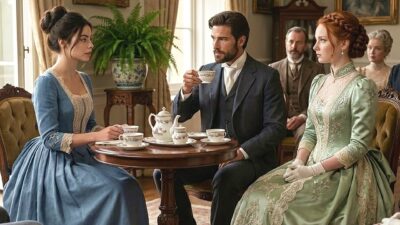
For eight years, everyone in the Duke’s household tiptoed around his illness, treating him like a ghost. That is, until he married a destitute woman for convenience, and she did the one thing no one else dared to do: she treated him like a living man.
A Transaction of Mutual Convenience
The library of Westford Hall was entirely silent, save for the steady, unforgiving tick of the mantel clock and the faint sound of rain lashing against the tall glass windows. Arthur Pendleton, the Duke of Westford, sat in the high-backed leather chair that had become his preferred refuge. He was thirty-six years old, quietly wealthy, meticulously organized, and according to the finest physician in the county, supposed to have been dead for at least a year.
He was breathing carefully, a habit he had cultivated over eight years to mask the weakness in his heart. His hands were perfectly still on the armrests.
Standing on the other side of his massive mahogany desk was a woman who had arrived at his front door twenty minutes earlier with muddy boots, a small leather valise, and exactly four shillings to her name. Her name was Beatrice Vance. She was perhaps six and twenty, wearing a practical woolen traveling gown that had seen better days, and she did not look frightened. She did not look intimidated by the grandeur of the room, nor by the title of the man sitting before her. She simply looked tired, cold, and entirely grounded in reality.
“I am offering you a transaction, Miss Vance,” Arthur said, his voice quiet, but carrying the unmistakable weight of command. “I am not going to dress it up in polite sentiments, and I will not insult your intelligence by pretending this is anything other than a matter of mutual convenience.”
Beatrice held her valise with both hands. “I prefer transactions, your grace. They are rarely disappointing. You said you require a wife.”
“I require a duchess,” Arthur corrected mildly. “If I die without an heir, or at least a widow to secure a certain portion of the trust, this estate and all its dependencies pass to a cousin in Northumberland whom I have met exactly three times. He is not a villain, but he is a fool, and I will not leave the lands my grandfather built to a fool. I have refused every match presented to me for eight years because I will not ask a young hopeful girl to marry a dying man and then force her to smile about it.”
Beatrice did not gasp. She did not offer a gentle, socially appropriate murmur of sympathy. She merely tilted her head. “And I am not a young hopeful girl.”
“You are a pragmatist,” Arthur said. “You arrived at my door seeking a position as a housekeeper because your relatives turned you out. You have nowhere to go. If you marry me, you will have a roof. You will be the mistress of this house when I die, which is an eventuality the entire county has been expecting for years. You will be left with a widow’s portion that will render you entirely independent for the rest of your natural life. That is the bargain. Security for you, peace of mind for me.”
Beatrice stood very still in the center of the vast, shadowy library. She looked at the intricate plasterwork on the ceiling, the thousands of leather-bound volumes, and finally at the pale, composed face of the Duke.
“I have four shillings,” Beatrice said, her voice steady. “I have spent the last six years running a household for an aunt who did not pay me. And when she died, her son informed me my services were no longer required. I know exactly what it is to be invisible, your grace. I know exactly what it is to be useful until I am not.” She met his gaze directly. “If I say yes, are you asking me to nurse you?”
Arthur’s eyes widened slightly. It was a remarkably blunt question. “No, I have a valet for that. I am not looking for a nurse. I am looking for a legal arrangement.”
“Then I will marry you,” Beatrice said.
Arthur looked at her for a long, silent moment. He had expected hesitation. He had expected tears or perhaps a desperate attempt to feign romantic attachment to soften the coldness of the deal. He received none of it. “You do not require time to consider?”
“Time is a luxury for people who have more than four shillings,” Beatrice replied, setting her valise on the floor. “I will marry you, your grace, and I will not pretend it is a tragedy.”
A House Holding Its Breath
They were married four days later in the estate’s private chapel, with only the vicar and two senior servants as witnesses. Beatrice wore her plain woolen gown. Arthur wore a perfectly tailored dark coat, standing tall and straight—though Beatrice noticed the subtle way he braced his weight against the wooden pew when he stood for too long. There were no flowers, no celebrations, and no illusions.
For the first three weeks of their marriage, they lived almost entirely separate lives. Arthur took his meals in his private study on the ground floor to avoid the stairs, and Beatrice took hers in the small dining room. She did not intrude on his routine, and he did not demand her presence. It was exactly the cold, safe arrangement she had accepted.
But Beatrice Vance had never been a woman who could sit idle. If she was to be the Duchess of Westford, she intended to understand what she was managing.
In her fourth week, she began to audit the house. She walked through every corridor, opened every ledger, and inspected every room. The house was meticulously clean, thanks to the formidable housekeeper, Mrs. Trant. But as Beatrice moved through the massive estate, a strange, unsettling pattern began to emerge. She found four guest suites in the west wing completely shuttered, the furniture covered in heavy canvas. She found a broken window sash in the morning room that had been stuffed with rags instead of repaired.
And most glaringly, when she walked the grounds one brisk Tuesday morning, she discovered the lower orchard. A dozen apple trees were completely dead, their branches brittle and gray, standing like skeletons in the morning mist.
Frowning, Beatrice returned to the house and summoned Mrs. Trant to the morning room.
“Mrs. Trant,” Beatrice said, gesturing to the heavy household ledgers spread across the desk. “I have a question regarding the lower orchard. The trees have failed.”
“Yes, your grace,” the housekeeper said, her hands folded neatly in front of her gray apron. “They took a blight some years ago.”
“And why were they not cleared and replanted?”
Mrs. Trant shifted her weight, looking uncomfortable for the first time since Beatrice had met her. “His grace… that is, the Duke did not give the order to replant.”
“They are apple trees,” Beatrice said, tapping her pen against the ledger. “They must be replaced.”
“Apple trees take five years to bear fruit, your grace,” Mrs. Trant said quietly, looking down at the carpet.
Beatrice stopped tapping the pen. The silence in the room suddenly felt heavy, thick with things unsaid. She looked at the housekeeper, piecing together the broken window sash, the shuttered rooms, the dead trees.
“I see,” Beatrice said softly. “No one repairs the window because it is merely a temporary draft. No one opens the west wing because there will be no future guests. And no one plants an orchard because a tree takes five years to grow, and the Duke is not expected to live that long.”
Mrs. Trant flushed a deep, mottled red. “We only wish to spare his grace any unnecessary trouble. The household… we accommodate his condition.”
“You are not accommodating him,” Beatrice said, her voice dropping to a fierce, quiet pitch. “You are burying him.”
Mrs. Trant looked up, shocked.
“This house is holding its breath,” Beatrice continued, standing from the desk. “Every servant, every ledger, every room. You are all walking on tiptoe, waiting for the master of the house to die. You have turned Westford Hall into a tomb.”
“Your grace! We love the Duke,” Mrs. Trant whispered, deeply offended. “We are being kind.”
“Pity is not kindness,” Beatrice said flatly. She closed the ledger with a sharp, decisive snap. “Have the dead trees cleared by tomorrow. Send to the nursery in the village. I want two dozen new saplings planted in the lower orchard before the ground freezes, and have the carpenter mend this window sash today.”
Mrs. Trant stared at her. “The Duke…”
“The Duke is breathing today,” Beatrice interrupted. “And while he breathes, this house will act as though there is a tomorrow. See to the orchard, Mrs. Trant.”
Planting for Tomorrow
Two days later, Arthur discovered the disruption. He had been reviewing correspondence in his study when his estate manager presented a requisition form for the purchase and labor of planting two dozen apple trees. Arthur stared at the sum—nine pounds, four shillings—with total incomprehension. He had not authorized any planting.
He found Beatrice in the library. She was sitting in a high-backed chair near the fire, a book resting in her lap, looking entirely at ease.
“Madam,” Arthur said, stepping into the room. He did not raise his voice, but the sheer coldness of his tone could have frozen a lake. “I have just been presented with a bill for an orchard.”
Beatrice calmly marked her page and closed the book. “Yes, the old trees were dead. It was time.”
“I gave explicit orders four years ago that the lower orchard was to be left alone,” Arthur said, gripping the edge of a mahogany side table. He was breathing a little faster than usual, anger breaking through his iron composure. “It is an absolute waste of estate funds.”
“It is nine pounds,” Beatrice said reasonably.
“It is not the money,” Arthur snapped. “It is the sheer practical futility of it. An apple tree takes five years to mature. Five years, Beatrice. What possible use do I have for a harvest I will never see?”
He threw the words like a weapon, the ultimate, unarguable fact of his existence. He expected her to flinch. He expected her to look away, to offer a stammered apology, to retreat into the delicate, fragile silence that everyone else used when his death was mentioned.
Beatrice did not look away. She sat perfectly still, holding his gaze with a steady, unyielding clarity.
“I am aware of how long a tree takes to grow, your grace,” she said, her voice completely level. “And I am aware of your prognosis. But I live here now, and I refuse to live in a house that has given up.”
Arthur stared at her, stunned.
“You may be expecting to die,” Beatrice continued, standing up and smoothing the skirts of her dress. “But you are alive this afternoon. And while you are alive, we will not leave dead things rotting in the ground simply because it is easier than hoping for a harvest. If you do not live to eat the apples, Arthur, then I will eat them, and I will remember that my husband planted them.”
She walked past him, her footsteps light and even on the carpets, leaving him standing alone in the center of the library.
Arthur did not move for a long time. His heart was hammering against his ribs, but for the first time in years, it was not from illness. It was from shock. He looked at the empty doorway. No one had spoken to him like that in eight years. No one had dared to contradict his grim arithmetic. They had smothered him in gentle, cloying compliance, letting him slowly fade into a ghost.
She had just demanded he act like a living man.
A strange, unfamiliar sensation flared in his chest, hot and sharp. It felt terrifyingly like life. He looked down at the requisition paper still crumpled in his fist. Slowly, he walked to the desk, dipped a pen in ink, and signed his name at the bottom, authorizing the orchard.
Shifting Boundaries
That evening, the silent boundaries of their marriage began to shift. Arthur did not eat in his study. When the dinner bell rang, he walked into the small dining room and took his seat at the head of the table. Beatrice looked up in surprise as he entered, but she said nothing, merely nodding as the footman pushed his chair in.
They ate in silence for the first course. Arthur found himself watching her. She did not eat with the delicate, birdlike hesitation of the society women he had known. She ate with the quiet efficiency of a woman who had known what it was to skip a meal.
“The trees were planted this afternoon,” Arthur said suddenly.
Beatrice paused, her fork suspended. She looked at him, her dark eyes unreadable. “Thank you.”
“Do not thank me. It was a completely irrational expenditure,” he said, cutting his meat with precise, deliberate movements. “I fully expect the rabbits to eat half the saplings before winter.”
“Then we shall trap the rabbits and have them in a stew,” Beatrice replied smoothly. “A very efficient return on your investment.”
Arthur stopped chewing. He looked at her, searching her face for a joke, but she was entirely deadpan. A sudden, surprising sound escaped his throat. It took him a second to realize it was a laugh. It was a rusty, unused sound, but it was real.
Beatrice’s lips twitched, a tiny, almost imperceptible smile warming her features. “I see I have amused you. I assure you, I am very serious about the stew.”
“I have no doubt you are,” Arthur murmured, reaching for his wine glass.
That dinner became a habit. By the end of November, they were dining together every evening. The vast, empty silence of Westford Hall was replaced by the rustle of ledger pages and the low murmur of conversation. Beatrice began helping him with the estate accounts, her sharp mind easily grasping the complexities of crop rotations and tenant leases.
Arthur found himself looking forward to the evenings. He found himself deliberately saving a difficult problem with a tenant farmer just to hear her pragmatic, unsentimental advice. He liked the way she rested her chin on her hand when she was calculating numbers. He liked the dry, intelligent cadence of her voice.
But the reality of his body was always there, a shadow in the corner of the room.
It happened on a rainy Tuesday in early December. They were in the drawing room after dinner. Arthur was standing near the fireplace listening to Beatrice read a letter from the estate manager when a sudden, terrible tightness seized his chest.
It was a mild episode, but the physical reaction was immediate. The breath left his lungs. He gripped the marble mantelpiece, his knuckles turning white, his head bowing as he forced himself to draw air through the sudden, suffocating pressure.
A young footman, who had been clearing the tea tray, immediately turned his back. The boy stared fixedly at the wall, entirely pretending the Duke of Westford was not struggling to breathe. It was the unwritten rule of the house: Never look at the Duke when he is weak. Preserve his dignity by pretending it isn’t happening.
Arthur hated it. He hated the polite blindness. It made him feel monstrous.
He managed a shallow breath and opened his eyes. Beatrice was not looking at the wall. She was sitting in her chair, the letter resting in her lap, looking directly at him. She had not panicked. She had not called for a doctor. She was simply watching him, her gaze steady, calm, and present. She did not offer pity. She offered an anchor.
Arthur stared back at her, his chest heaving, the tightness slowly beginning to recede. The footman scurried out of the room, desperate to escape the awkwardness. But Beatrice remained exactly where she was.
“Do you need to sit?” she asked, her voice quiet and normal. Not hushed, not fearful. Normal.
“No,” Arthur managed to say, his voice rough. He took a deeper breath, leaning heavily against the marble. “It is passing.”
“Very well,” Beatrice said. She did not fuss. She did not rush over to pat his arm. She simply picked up the letter again. “The manager believes the north pasture will need draining by spring.”
Arthur closed his eyes, a wave of profound, devastating gratitude washing over him. She saw him. She saw the illness. She saw the weakness. And she did not look away. Nor did she treat him like a broken thing. She just let him be a man.
In that moment, Arthur realized with absolute clarity that he was in terrifying danger. He had married her to die in peace. But looking at Beatrice Vance sitting in the firelight, he realized he was starting to want to live.
A Light in the Dark
The fracture in their fragile safety occurred two weeks later in the dead of night.
It was two in the morning. The house was entirely silent, swallowed by the deep, freezing darkness of winter. Beatrice woke to the sound of a strange, rhythmic wheezing echoing from the hallway. She threw off her covers, pulled a thick wool shawl over her nightdress, and stepped out of her bedroom.
She followed the sound down the grand staircase and toward the rear of the house to the glass-paneled garden room. The door was ajar. Inside, the room was freezing. The French doors leading to the terrace had been thrown wide open to the winter air.
Arthur was sitting in a heavy wicker chair in the center of the room. He was leaning forward, his elbows on his knees, his hands gripping his hair, fighting a desperate, agonizing battle for a single breath of air. This was not a mild episode. This was the violent, suffocating reality of his failing heart.
Beatrice froze in the doorway. The sheer physical terror of the scene hit her like a blow. She had known he was ill. She had known the terms of their marriage. But knowing it in a library was entirely different from watching the man she lived with fight for his life in the dark.
For a fraction of a second, her instinct screamed at her to run—to fetch the valet, to fetch a doctor, to do anything but stand there. But there was no doctor who could fix this, and the valet would only avert his eyes.
Beatrice stepped into the room and closed the door behind her. She walked over to the chair. Arthur could not speak. His chest heaved with a terrifying wet rattle, his eyes squeezed shut in agony.
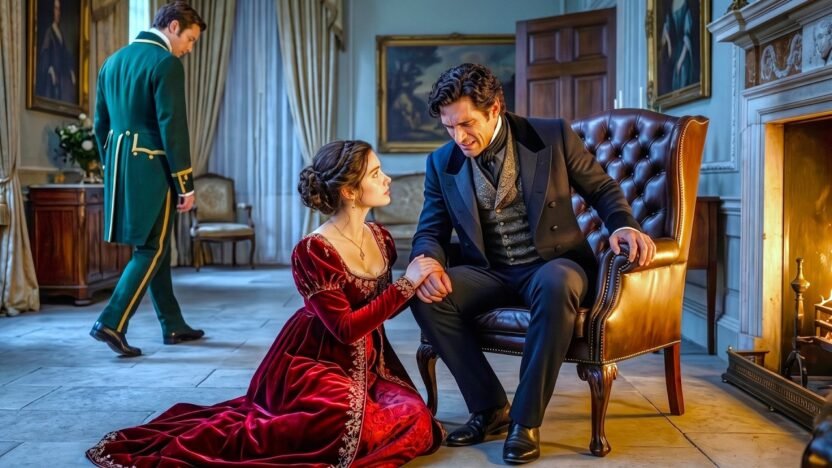
Beatrice did not say a word. She did not tell him it would be all right. She knew he would recognize it as a lie. Instead, she sank to the cold stone floor right beside his chair. She pulled her knees to her chest, leaned her back against the side of his chair, and reached up, placing her hand firmly over his white-knuckled grip on the armrest.
Arthur flinched at the touch, but she did not let go. She squeezed his hand—a warm, solid, undeniable pressure in the freezing room. She looked up at him, and when he finally forced his eyes open, gasping for air, he found her looking directly into his face.
She held his gaze. She did not look away from the sweat on his brow, the panic in his eyes, the absolute indignity of his suffering. She stayed with him in the dark, tethering him to the earth with the sheer unyielding force of her presence.
It lasted for forty minutes.
For forty minutes, they sat in the freezing room, her hand over his, her eyes never leaving his face. Gradually, agonizingly, the wheezing began to slow. The terrible, frantic heave of his chest settled into a shallow, exhausted rhythm. Arthur fell back against the cushions of the chair, his eyes closed, his body trembling with the aftermath.
Beatrice remained on the floor. The silence stretched for a long time, broken only by the wind outside.
“I am terrified,” Arthur whispered. His voice was broken, stripped of every layer of ducal pride and aristocratic reserve. It was the raw, bleeding truth of a man who had been pretending to be brave for eight years.
Beatrice swallowed hard, her own throat aching. She did not tell him he was strong. She did not tell him to be brave.
“I know,” she said quietly.
“I have not said that aloud in eight years,” Arthur said, turning his head to look at her in the shadows. “I have let this county believe I am a stoic. I have let them admire my composure. And every night I sit in this chair, and I am completely, utterly terrified of the dark.”
Beatrice tightened her grip on his hand. “Then be terrified. But you do not have to do it alone anymore.”
Arthur looked at her, his eyes shining in the dim light. He turned his hand over and laced his fingers through hers, clinging to her like a drowning man.
The Terror of Uncertainty
The next morning, the emotional landscape of Westford Hall was entirely shattered.
Beatrice sat in her bedroom, staring at her reflection in the mirror, feeling cold to her very bones. She had spent the night on the floor of the garden room, and when she had finally helped Arthur back to his bed near dawn, she had returned to her own room carrying a truth she could no longer deny.
She loved him. She loved his dry wit. She loved his careful, steady hands. She loved the way he looked at her when she solved a problem in the ledgers. She loved him with a quiet, devastating totality.
And it was the worst thing that could have possibly happened to her.
She had married him for security. She had married him knowing he would die, and that his death would provide her with a house, an income, and safety for the rest of her life. Her entire future was built on the premise of his grave. Now, the thought of losing him felt like a physical mutilation. If he died, she would have the house, the money, the title—and none of it would matter. She would be safe, and she would be entirely destroyed.
Downstairs, Arthur sat at his desk in the study. He had not slept. The exhaustion in his bones was absolute, but his mind was racing with a terrifying, electric clarity.
He had felt her hand on his in the dark. He had looked into her eyes and seen no pity, only a fierce, anchoring loyalty. She had not let him hide. She had not let him be a ghost.
For eight years, he had accepted a death sentence given to him by a doctor when he was twenty-eight. Dr. Ambrose had told him he would not see thirty-five. He was thirty-six. He had outlived the sentence, but he had spent the extra time simply waiting for the axe to fall, refusing to live, refusing to hope—because hoping was dangerous. If he hoped, the dying would hurt more.
But Beatrice had planted an orchard. Beatrice had demanded a tomorrow.
Arthur pulled a sheet of heavy parchment toward him. His hand was trembling slightly, but he dipped his pen in the ink. He wrote a letter to a specialist in London, a physician renowned for new studies of the heart. He demanded an immediate consultation. He demanded a new truth. He was going to risk hoping.
The three weeks it took for the specialist to arrive were an agony of suspension. Arthur and Beatrice moved around each other with a fragile, heightened awareness. The cold transaction of their marriage had burned away, leaving behind something raw and infinitely precious. But neither of them dared to speak of it. To speak of a future was to tempt fate.
When Dr. Harrison finally arrived from London, a heavy, suffocating snow had begun to fall over the estate. Arthur was sequestered in his bedchamber with the doctor for two hours. Beatrice sat in the small drawing room, staring blindly at the embroidery in her lap, her heart hammering against her ribs like a trapped bird. Every tick of the clock felt like a hammer blow.
Finally, the door opened. Dr. Harrison, a sharp-eyed man in his fifties, entered the room, followed by Arthur. Arthur looked exceptionally pale. His expression was completely unreadable.
“Your grace,” Dr. Harrison said, bowing slightly to Beatrice. “The Duke requested you hear my findings directly.”
Beatrice stood up, her hands clasped tightly together. “Tell me.”
“The previous diagnosis given to his grace eight years ago was grossly irresponsible,” Dr. Harrison said bluntly.
The words hit the room like a gunshot. Beatrice stopped breathing.
“The Duke does indeed suffer from a weakness of the heart valves,” the doctor continued, adjusting his spectacles. “It is a chronic condition. He will never have the stamina of a perfectly healthy man. He will have episodes of breathlessness and he must avoid severe exertion. However, to give him a specific expiration date of five years was medical arrogance. The heart is a mystery, your grace. It compensates. It adapts.”
Beatrice looked at Arthur. He was staring at the floor, looking entirely stunned. “What are you saying, doctor?” Beatrice asked, her voice trembling.
“I am saying there is no ticking clock,” Dr. Harrison said gently. “Could the condition claim him in a year? Yes. Could he live to see sixty also? Yes. There is no certainty here, only care and time.”
The doctor bowed and took his leave to gather his things. Silence descended on the drawing room, heavy and absolute.
Beatrice looked at her husband. She expected him to look relieved. She expected a smile. Instead, Arthur looked horrified. He walked over to the window, staring out at the falling snow. His hands were gripping the window frame so hard his knuckles were bone white.
“Arthur,” Beatrice said softly, taking a step toward him.
“Do you know what he just did?” Arthur said, his voice ragged, entirely devoid of joy. “He took away my ending.”
Beatrice stopped. “He gave you a chance at a life.”
“He gave me uncertainty!” Arthur whirled around, his eyes wild with a panic she had never seen in him. “For eight years, I knew exactly what was going to happen. I knew how to arrange my affairs. I knew how to protect this estate. I knew how to protect myself. I knew the end was coming, so nothing could hurt me.”
He paced across the room, the sudden movement making him breathless, but he didn’t stop.
“I married you because I was dying!” he shouted, stopping to press a hand to his chest. “I gave you a contract. You have security. You have a guarantee. And now… now I have no idea when I am going to die. I have no idea how to live. I have no idea how to be a husband to a woman who expects to be a widow.” He looked at her, his chest heaving, his eyes filled with the sheer terror of a man who has suddenly been pushed off a cliff. “I don’t know how to do this,” he whispered, the anger breaking into pure fear. “I don’t know how to live without a date.”
Beatrice stood in the center of the room. She looked at the man she loved—a man who had built a fortress out of a death sentence, and who was now terrified of the open sky. She did not offer him polite comfort. She did not coddle him. She walked across the room, stopping inches from him. She reached out and placed her hand flat against his chest, right over his damaged, beating heart.
“Neither do I,” Beatrice said, her voice fiercely steady. “Do you think I am not terrified? I married you for a roof, Arthur. I married you because it was a cold, safe transaction, and now I am standing here entirely in love with a man who could die tomorrow, or who could die in thirty years. I have lost all my safety.”
Arthur stared at her, the breath catching in his throat. “Beatrice…”
“I don’t have a guarantee anymore either,” she said, her eyes blazing with unshed tears. “If I love you and you die tomorrow, it will break me. If we live together for thirty years and I lose you, then it will break me.” She stepped closer, her hand gripping the lapel of his coat. “But I will not let you hide in a grave while you are still breathing. I choose the uncertainty. I choose the terror. I choose you.”
Arthur looked at her. He looked at the fierce, beautiful pragmatism in her eyes. The woman who had refused to look away from him in the dark. The woman who had demanded an orchard from a dying man.
The fear in his chest broke, crumbling into something entirely different. It felt like light. It felt like oxygen. He reached up and framed her face with his hands.
“Beatrice,” he whispered, and then he kissed her.
It was not a hesitant kiss. It was desperate, deep, and anchoring. He kissed her like a man who had been starving for eight years, and had suddenly been invited to a feast. Beatrice wrapped her arms around his neck, pulling him closer, anchoring him to the present, to the reality of her warmth and the beating of his own heart. He didn’t know how long he had, but holding her in his arms, the snow falling silently outside the window, Arthur finally realized that the amount of time didn’t matter, only what he did with it.
All the Time in the World
Six months later, the doors of the west wing were thrown open to let in the warm summer breeze. The estate room was bathed in golden afternoon light. Beatrice sat at the large mahogany table, a ledger open in front of her, the ink drying on a column of numbers.
The door opened and Arthur walked in. He moved a little slowly—he had climbed the stairs from the garden, and the exertion always cost him breath—but he was not walking like a ghost. He wore a light summer coat, and his face had caught a bit of color from the sun.
He walked over to the table and set a small, hard green object directly on top of the ledger.
Beatrice looked down. It was a tiny, incredibly sour-looking green apple.
“The lower orchard,” Arthur said, pulling out a chair and sitting beside her, catching his breath with a faint smile. “It appears one of the saplings was impatient.”
Beatrice picked up the tiny apple. She ran her thumb over the smooth green skin, a profound, quiet joy expanding in her chest. She looked up at her husband.
Arthur was watching her. The silence in the room was no longer heavy with things unsaid. It was comfortable, rich, and alive.
Beatrice put the apple down. She leaned her chin on her hand, resting her elbow on the table, and she looked him in the eye. Arthur looked back. He didn’t turn away. He didn’t hide. He met her gaze with the steady, quiet confidence of a man who knew exactly where he belonged. He reached across the table and took her hand.
“Shall we look at the accounts, your grace?” Beatrice asked softly.
Arthur smiled, raising her hand to press a kiss to her knuckles. “I believe we have all the time in the world, my love. And that is the quiet courage of choosing to live, even when the future is unknown.”
Enjoyed the story?
Beatrice didn’t just save Arthur’s estate; she saved his spirit by refusing to look away when he needed to be seen the most.
If this story of resilience and slow-burn romance warmed your heart, please leave a comment telling me your favorite moment between Arthur and Beatrice! And if you enjoy experiencing these stories brought to life visually through beautiful, animated storytelling, don’t forget to subscribe to The Regency Affair on YouTube. I’ll see you in the next story!