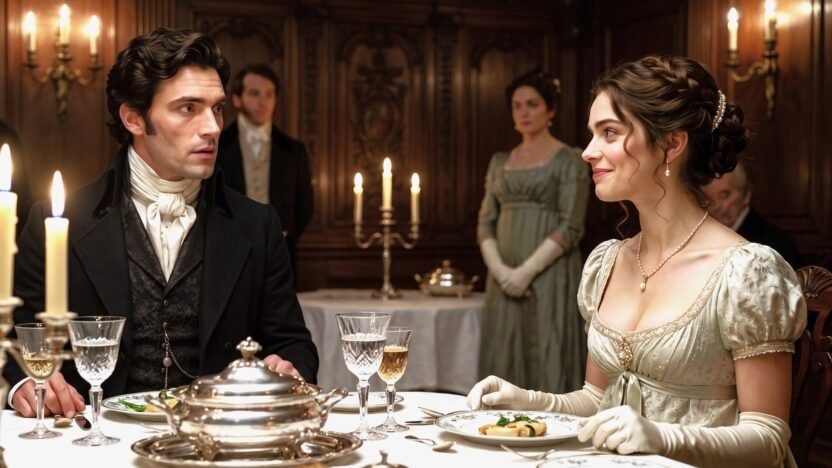
He was a Duke no woman dared look in the eye. She looked at him… and kept eating her dinner. What she didn’t know was that her one small act of defiance would make the most powerful man in England fall hopelessly, helplessly in love.
The dining room at Blackwood House was not designed for comfort. It was designed to remind everyone within it that the Duke of Blackwood answered to no one, and most guests understood this the moment they crossed the threshold. Candlelight moved along the dark paneling, catching on silver and crystal, and conversation kept itself carefully within the bounds of what was safe to say in his presence. It was, by every account, a room that taught people to lower their eyes.
Eleanor Whitmore had not been told this rule, or if she had, she had not thought it worth remembering.
She sat several places down from him, between her sister Clara and an elderly baronet who spoke a great deal about his hounds, and she ate her dinner with the unhurried attention of a woman who had somewhere better to be in her own mind, even if her body remained perfectly present at the table. She had noticed the Duke, of course. One did not fail to notice a man who occupied a room the way weather occupied a sky. But noticing him and being frightened of him struck her as two very different exercises, and she saw no particular reason to attempt the second.
It was Alexander who broke the pattern, though he would not have called it breaking anything. He simply looked at her, the way he looked at most people when he wished to take their measure — a long, unhurried study that had, over the years, proven remarkably effective at ending conversations before they became tiresome. Women in particular tended to find somewhere else to direct their attention. It was not cruelty on his part. It was simply what happened when a duke looked at someone for longer than politeness required.
Eleanor looked back.
She did not startle. She did not flush, or glance away, or busy herself suddenly with her wine glass, as he had watched a dozen women do in that very room. She met his eyes with an expression of mild, unbothered interest, as though he were a painting she had already decided she liked well enough, and then — and this was the detail that would return to him later, unbidden, at hours when he ought to have been thinking of something else entirely — she picked up her fork and continued eating.
The soft clink of silver against porcelain seemed, absurdly, to fill the whole room.
Alexander was not accustomed to being dismissed. He was even less accustomed to being dismissed so gently, without insult, without performance, as though he had simply failed to be interesting enough to interrupt her supper. He found himself watching her for a moment longer than he intended, waiting for the correction — the belated recognition of who he was, the flicker of nerves he was so used to producing in others. It did not come. She glanced up once more, caught him still looking, and offered the smallest curve of a smile, the kind one gives a stranger who has been caught staring, and returned to her meal.
“You seem troubled, Your Grace,” said Lady Margaret, who was seated near enough to have witnessed the entire exchange and who missed remarkably little that happened in her nephew’s house.
“I am not troubled,” Alexander said.
“No,” his aunt agreed, in the tone of a woman who intended to say a good deal more before the evening was through. “You merely look as though someone has failed to be afraid of you. It is a novel expression on you. I confess I find it becoming.”
He did not dignify this with a response, though later, walking the length of the gallery with his hands clasped behind his back as he did when he wished to think without being observed thinking, he found he could not entirely dismiss it either. He had spent a great many years learning to read a room in a single glance — who wished to please him, who feared him, who hoped to use him. It was a useful skill, and an exhausting one, and it had left him with very little patience for people who required managing. Miss Whitmore, whoever she was, had not required managing. She had simply gone on eating her dinner.
He found himself wanting to know why.
The answer, when Lady Margaret offered it to him the following afternoon in the sitting room, arrived with considerably less ceremony than he expected.
“Whitmore,” his aunt said, setting down her needlework. “The younger daughter of the family in Somerset. Sensible people, from what I understand. No fortune to speak of, but no scandal either, which in this circle amounts to nearly the same virtue.” She glanced at him over her spectacles. “You are asking rather a great many questions about a woman who did nothing more than continue her supper.”
“I am not asking questions.”
“You have asked me three since Tuesday.”
He said nothing to that, because there was, regrettably, nothing to say. He had asked. He had noticed himself wondering, at odd moments, what Miss Whitmore might think of some remark he’d made, or whether she found the same things dryly amusing that he did, and each time he caught himself in the wondering he set it aside with the same firm hand he applied to any thought that threatened to become inconvenient. It did not stay set aside for long.
He encountered her properly two days later, in the corridor outside the library, where she had paused to look at a portrait of his grandfather with an expression that suggested she found the old man’s painted scowl faintly ridiculous.
“He was not a pleasant man,” Alexander said, coming to stand beside her. “I am told he terrified three separate housekeepers into early retirement.”
“I can believe it,” Eleanor said, studying the portrait without any particular alarm at his sudden appearance. “He has the look of a man who enjoyed being terrifying. You do not have it, if you’ll forgive my saying so.”
“You find me insufficiently terrifying.”
“I find you”, she said, considering the word with the care of someone choosing it precisely, “reserved. There is a difference. A terrifying man wants you to be afraid. I do not think you particularly care whether I am afraid of you at all.”
It was, Alexander reflected afterward, the most accurate thing anyone had said about him in a very long time, and she had said it as easily as commenting on the weather, with no apparent awareness that she had done anything remarkable. He found himself, against every habit of restraint he had cultivated since boyhood, wanting to keep her talking. He asked after her family instead of ending the conversation, as he would have with anyone else, and she answered without artifice — a sister, Clara, two years her junior and considerably less patient with dukes and portraits alike; a father who preferred his horses to society; a small, unremarkable life that she described without apology and without the faint, hopeful angling for his interest that he had come to expect from young women in her position.
She did not seem to want anything from him at all.
That, more than the steadiness of her gaze at dinner, was the thing he could not stop turning over as he watched her walk on down the corridor a few minutes later, her skirts moving quietly against the old stone floor, without once looking back to see whether he was still watching.
He was.
The days that followed arranged themselves, without any deliberate design on his part, into a pattern Alexander did not examine too closely. He found reasons to be in the places Eleanor was likely to be. He told himself these reasons were sound. The library required his attention because he had been meaning to review his grandfather’s correspondence. The garden required a walk because the physician had recommended air and exercise for a man who spent too many hours at a desk. The breakfast room required his presence because it was, after all, his house, and a man was entitled to eat breakfast in his own home at whatever hour he chose, even if that hour had shifted, by slow and unacknowledged degrees, to align rather precisely with Miss Whitmore’s habits.
By the end of the first week, even Alexander could no longer pretend not to notice what he was doing. By the second, so could she.
“You are remarkably often wherever I happen to be, Your Grace,” she observed one morning, over toast she had not yet touched, watching him take the chair across from her with the unhurried air of a man who had wandered in by accident.
“I own the house,” Alexander said. “I am generally somewhere in it.”
“That is not an answer.”
He opened his mouth to supply one and found, to his private irritation, that he did not have one ready. She watched him fail to produce it with the faint, contained amusement of someone who had not expected an answer at all, only wished to see what he would do without one, and returned to her toast as though the matter were settled. It was not settled. It sat with him for the rest of the morning, an unaccustomed itch of a thought — that he, who had spent a lifetime commanding rooms into silence with a single look, had just been quietly and thoroughly outmaneuvered by a woman buttering her bread.
He began to look forward to being outmaneuvered.
Their conversations acquired a shape over the following weeks, a rhythm he came to recognize the way one recognizes a piece of music heard many times. There was a comfort in it that unsettled him more than any of Eleanor’s direct remarks, because comfort of that particular kind was not something he had permitted himself in a great while. He found her in the garden one afternoon, seated on the stone bench beneath the old pear tree, a book open on her lap that she was not, he suspected, actually reading.
“You are not reading that,” he said, settling onto the other end of the bench without waiting to be invited, a habit he had adopted with her alone.
“I am considering reading it,” Eleanor said. “It is a very fine book. I admire it a great deal, from a respectful distance.”
“What is it?”
“I have no idea. I picked it up because it looked serious, and I wished to look serious while I sat here thinking about something else entirely.”
“What were you thinking about?”
She turned the book over in her hands, not quite looking at him, and for a moment he thought she would deflect the question the way she deflected most things aimed too near her, with a light remark that closed the door before it had properly opened. Instead she said, after a pause that told him the answer mattered to her more than her tone suggested, “My aunt. I had an aunt, once, who was very beautiful, and very charming, and very sure that a certain gentleman would marry her, because he had told her so, in exactly the right words, at exactly the right moment. He did not marry her. He married someone else within the year, someone whose father had a title he wanted, and my aunt spent the rest of her life being spoken of, very gently, as a cautionary example.” She smiled, though it did not reach her eyes. “I was quite young. But I understood the lesson well enough. A woman ought never to build her whole future on being someone’s preference, because preference is a thing that changes, and she is left with nothing when it does.”
Alexander said nothing for a moment, turning the story over, understanding, with the particular clarity of a man recognizing something important a beat too late, that she had just told him something true about herself and dressed it as a story about someone else. “That seems a hard lesson to carry,” he said finally.
“It is a useful one.” She closed the book, having never opened it in the first place. “I find useful lessons are worth the cost of learning them.”
He did not press further, though the conversation stayed with him longer than most conversations did, resurfacing at odd hours the way her steady gaze had resurfaced that first evening. He began, without quite deciding to, watching her differently — not merely for the pleasure of her company, though that pleasure had become considerable, but for the shape of the caution beneath it, the careful distance she maintained even in her warmth, as though she had long ago decided precisely how much of herself was safe to offer and held firmly to the boundary.
It was Lady Margaret, inevitably, who said aloud what he had not yet permitted himself to think in plain words.
“Most people lower their eyes when His Grace looks at them,” she remarked one evening, apropos of nothing, watching Eleanor across the drawing room with the mild expression of a woman rearranging furniture in her mind.
“Perhaps most people have more sense,” Eleanor said, not unkindly, and Margaret laughed the short, surprised laugh of someone who has just heard her own private opinion spoken back to her by a stranger.
Alexander, close enough to hear, found he did not mind being the subject of the joke at all. He minded, rather more, the sudden and specific ache of imagining that room without her in it — a thought that arrived unbidden and would not be reasoned away, no matter how firmly he reminded himself that he had known the woman scarcely a month.
The letter from Bath came for her three days later. He did not read it, of course; it was not his to read. But he watched her receive it at breakfast, watched something careful and considering cross her face as she read it twice through, and when he asked, with a lightness he did not entirely feel, what news it carried, she folded it once and set it beside her plate.
“An opportunity,” she said. “A respectable widow, a family connection of my mother’s, has offered me a position as her companion. It would mean my own household, in time. My own income. A life that would not depend on anyone’s goodwill but my own effort.” She looked at him then, steadily, the way she had looked at him that first evening over her fork. “I mean to accept it.”
“For how long?” he asked, and heard, with some private alarm, how carefully controlled his own voice had become.
“Perhaps permanently,” Eleanor said.
He did not answer at once. When he did, it was with the composed, measured tone he had spent a lifetime perfecting, the tone that gave nothing away, that had ended more conversations than he could count. “I hope it proves everything you wish it to be.”
“Thank you,” she said, and something in her face — a flicker of expectation, quickly and deliberately smoothed away — told him it was not, in fact, the answer she had wanted.
She did not ask him what he wanted to say instead. He was grateful for that, and ashamed of the gratitude, because it meant he had been given an easy way out of a harder truth, and he had taken it without hesitation. It was only later, alone in his study with the fire burned down to embers, that the question returned to him with its full weight: would you miss me — she had not asked it in those words, but she might as well have, and he had answered as though the question meant nothing at all, when in fact it had meant everything, and he had simply lacked the courage, in that ordinary moment over breakfast, to say so.
Edmund Hartley arrived at Blackwood the following week, an old family friend of the Whitmores’, invited by Lady Margaret months earlier for reasons that had nothing whatsoever to do with the current state of Alexander’s composure and everything to do with a promise made to Edmund’s late mother. He was, by any fair measure, an agreeable man — good-humored, well-mannered, entirely without guile, the sort of gentleman who made easy conversation with everyone in a room and meant no particular harm to anyone by it. Alexander found, within an hour of the man’s arrival, that he disliked him intensely, and could not have said precisely why.
He watched Edmund fall into easy conversation with Eleanor in the drawing room that evening, watched her laugh — genuinely laugh, her whole face lighting with an unguarded warmth Alexander had rarely been given the privilege of seeing directed at himself, though he had, if he was honest, spent a great many hours trying to earn it. Edmund said something Alexander did not catch, and Eleanor’s laughter came again, easy and unforced, and something cold and unfamiliar moved through Alexander’s chest, something he did not have a ready name for because he had spent so long ensuring he never had cause to feel it.
“You knew Miss Whitmore’s family in Somerset, I understand,” Alexander said, when the conversation drew him in, and his own voice startled him — flatter than he intended, edged with something he had not sanctioned.
“Since we were children,” Edmund said cheerfully, entirely oblivious. “Eleanor used to beat me soundly at cards and never let me forget it.”
“How fortunate,” Alexander said, “that you have had so many years to recover your pride.”
The words fell into the room with more weight than the moment called for, and he heard them land, heard the small pause that followed, saw Edmund’s easy smile falter for the briefest instant in polite confusion before recovering itself. It was nothing. It was a single ill-judged remark among a hundred ordinary ones. But Alexander felt the stillness of his own body in the aftermath, the tightness in his jaw, the unaccustomed difficulty of arranging his face back into the composure that had never once failed him in thirty years of practice, and he understood, with a kind of distant horror, that he had just revealed something he had spent his whole life ensuring no one was permitted to see.
Eleanor had seen it.
He caught her eyes across the room in the silence that followed, and for a moment neither of them looked away — but it was not the steady, unafraid look she had given him that first evening over dinner. Something in her face had gone quiet and careful, turned inward, as though she were recalculating a sum she had thought long settled. She did not think, watching him, that the Duke of Blackwood had been jealous. She was not vain enough, or foolish enough, to assume that a man’s ill temper toward an old friend meant anything so significant as that. What she thought, watching the color rise briefly along his jaw and vanish just as quickly beneath his usual composure, was simpler and colder: that she had allowed herself, over these past weeks, to believe in a closeness that had perhaps never been offered to her at all — that she had mistaken a powerful man’s passing fascination for something it was never meant to be, and had very nearly made the same mistake her aunt had made, dressed in gentler clothing.
She looked away first.
It was such a small thing. No one else in the room would have marked it. But Alexander, who had spent a month learning the exact weather of her attention, felt the loss of it like a door closing somewhere in the house, quietly, without slam or drama, simply shut.
She was perfectly civil to him for the remainder of the evening, and perfectly civil the following day, and the day after that, and the civility was, he came to understand, its own kind of wound, because it asked nothing of him and offered him nothing in return — a smooth, careful surface with no purchase for him to hold on to. At dinner, she ate without once seeking his eyes across the table. The fork still moved, the same soft sound against porcelain that had once seemed to fill the whole room for him alone, but he found he could take no comfort in it now. It sounded, to his ear, like something ending.
She confirmed her departure for Bath within the week. He heard it from Lady Margaret first, and then from Eleanor herself, delivered with the same composed grace she brought to everything, as though she were simply informing him of a change in the weather.
“I leave on Thursday,” she said.
“So soon.”
“There is no reason to delay.” She did not quite meet his eyes as she said it, and that, more than anything, told him how far the door had swung shut. “I have imposed on your aunt’s hospitality long enough.”
He wanted, with an intensity that frightened him, to tell her to stay — to command it, the way he had commanded a hundred lesser things into being simply by wishing them so. The words rose in his throat and he swallowed them back, because some clear, unwelcome part of him understood that commanding her to stay would be the surest way to lose whatever fragile thing had grown between them, whether or not she went. He had no right to demand it. He had never told her what she meant to him, had let a dozen quiet mornings and a hundred small conversations pass without once saying the thing that might have mattered, and he could not now, at the last possible moment, expect her loyalty as though he had earned it through silence alone.
So he said nothing, and she left on Thursday as planned, and the house felt, in the days that followed, larger and colder than it had any architectural right to be.
He stood one evening in the same dining room where it had all begun, at the same table, in the same chair, and found himself looking at the empty place across from his own where she had never actually sat, because she had always been placed correctly, properly, several seats down among people of no particular consequence to him — and yet the emptiness felt located precisely there, in that space, as though the room itself had rearranged its geography around the fact of her absence.
He understood, standing there in the quiet with only the candles for company, that his silence had never been neutral. He had told himself, for a month, that restraint was a kind of safety — that by not naming what he felt, he protected himself from the risk of asking and being refused. But the refusal had come anyway, delivered not in words but in the simple, devastating fact of an empty chair, and he had brought it upon himself as surely as if he had spoken the wrong words aloud. Silence, it turned out, was not the absence of a choice. It was a choice, made and remade every day he failed to speak, and he had been making the wrong one for a very long time.
Lady Margaret found him there three evenings later, still occupying that same chair after supper had long been cleared away, staring at nothing in particular with the fixed, unseeing attention of a man revisiting a conversation that could no longer be changed. She did not ask what troubled him. She had watched him for a month grow quieter and more careful of himself in exactly the way he had been before Eleanor Whitmore arrived, as though he were carefully refitting an old armor he had briefly, foolishly, set aside.
“You have not eaten,” she observed, taking the chair beside him without waiting to be asked, a habit she had never broken in thirty years and did not intend to break now.
“I am not hungry.”
“No,” she agreed. “You are miserable, which is a different appetite altogether, and rather harder to satisfy.” She folded her hands in her lap and regarded him with the same clear, unsentimental patience she had used on him since he was a boy too proud to admit when he’d been thrown from a horse. “I will not lecture you, Alexander. You are a grown man, and a duke besides, and I am led to understand that dukes do not care to be lectured. I will only say this, and then I will let you sit here in peace with whatever it is you are doing to yourself. You spent a month teaching that girl, in a hundred small ways, that you valued her company above anyone else’s in this house. And then, at the one moment it might have cost you something to say so plainly, you gave her nothing at all. You cannot be surprised when someone finally stops waiting to find out.”
He did not answer her immediately. The fire had burned low, and the room held the particular silence of a house at the end of a long evening, and into that silence Margaret’s words settled with the quiet, irreversible weight of something he had already known and simply refused, until now, to hear said aloud by another voice.
“I do not know how to say these things,” he said finally, and the admission cost him more than she could have guessed, coming as it did from a man who had never once, in her memory, confessed to being at a loss for anything. “I have spent my whole life being asked for very little except decisions. No one has ever required me to ask for anything in return. I am not certain I know how.”
“Then you will have to learn quickly,” Margaret said, not unkindly, “because I do not think she intends to wait in Bath forever for you to work it out.”
He left the following morning, before he had fully reasoned through what he meant to say, because he understood, with unusual clarity for a man so accustomed to careful deliberation, that further deliberation would only give his old habits time to reassert themselves. The journey to Bath took the better part of two days, and he spent both of them turning over, with something close to dread, the plain admissions he had never permitted himself to make aloud to anyone — that he had invented excuses to find her; that he had begun, somewhere in that first week, to look for her eyes across every room he entered; that her absence had made his own house feel like a place he no longer entirely recognized.
He found her, on the second afternoon, in the modest sitting room of her employer’s house on a quiet street above the town, and she rose when the housekeeper announced him with an expression that gave him nothing to read — no warmth, no anger, only a careful, composed surprise that he recognized, with some discomfort, as the very same composure he had spent a lifetime perfecting himself.
“Your Grace,” she said. “I did not expect you.”
“No,” he agreed. “I did not entirely expect myself.” He turned his hat once in his hands, an old nervous habit he had thought himself long past. “I have not come to ask you to return with me, if that is your fear. I have come because I have been a coward, in the one matter that mattered most, and I find I cannot leave it uncorrected simply because correcting it is difficult.”
Something shifted, very slightly, in her expression — not forgiveness, not yet, but attention, the same careful attention she had once given him over a plate of untouched dinner. “Then say what you have come to say.”
He told her, then, without the polish he brought to every other conversation of his life — that he had begun looking for her before he understood why; that his excuses to seek her out had grown, by the end, embarrassingly transparent even to himself; that he had noticed, with a clarity that frightened him, the precise evening she had stopped looking for him in return, and that the noticing had taught him more about his own heart than thirty years of careful governance ever had.
“Do what?” Eleanor asked quietly, when he faltered.
“Ask,” Alexander said. “I have spent my whole life commanding. I find I do not know how to simply ask for something I want, without also demanding it, and I am asking you now, badly, because I would rather ask badly than continue saying nothing well.” He met her eyes, and did not look away, though every old instinct urged him toward the safety of composure. “I did not begin by loving you because you did not fear me, Eleanor. I fell in love with you because you saw me — not the title, not the house, not the thing everyone else sees when they look at a duke. Only me. I do not know that anyone has managed that before.”
She was quiet for a long moment, and he made himself bear the silence without filling it, because he understood, finally, that this too was part of the asking — the willingness to wait for an answer he could not control.
“I am not interesting to you simply because I am the only woman who was not afraid,” she said at last, though it was not quite a question. “Tell me that is true, and I will believe you, because I do not think you know how to lie convincingly. You have never once managed it in my presence.”
“It was never fear,” he said. “It was never the game of it, or the novelty. I do not want a woman who is merely unafraid of me, Eleanor. I want the one who saw past what I am, to who I am, and did not seem to think the difference mattered as much as everyone always told me it should.”
She looked at him a moment longer, searching his face for the crack in his composure that would tell her he was performing rather than confessing, and did not find it, because there was none to find. But she did not go to him. She did not offer him, in that moment, the answer he had crossed two days of road hoping to hear.
“I need to think,” she said, gently, “and I find I cannot think clearly while you are standing there looking at me like that.” A faint, unsteady smile touched her mouth, the first honest one he had seen from her since Edmund’s visit. “Give me until tomorrow, Your Grace. I promise I will not make you wait longer than that.”
He left her there with a bow that felt, for the first time in his life, entirely inadequate to the moment, and spent the night in a hired room above a coffeehouse that smelled of tallow and rain, doing something he had not done since boyhood: waiting on another person’s decision without any means of hastening or shaping it. It was, he discovered, a peculiar kind of suffering, made bearable only by the knowledge that he had, at last, done the one thing he had spent a lifetime avoiding. He had asked, plainly, and left the answer entirely in someone else’s hands.
Eleanor did not sleep well either, though for reasons she found harder to untangle than his. She sat a long while by the window of the small room that had become, over these past weeks, genuinely hers — paid for by her own arrangement, answerable to no one’s temper but her employer’s mild and undemanding preferences — and she turned his words over as carefully as she had once turned over her aunt’s old, cautionary story. I fell in love with you because you saw me. It was a fine thing to say. She did not doubt, any longer, that he believed it. But belief and certainty were not the same coin, and she had watched, once, a woman she loved stake her whole future on a man’s sincere belief in his own feelings, only to discover that sincerity was not the same as permanence.
What frightened her was not that Alexander might be lying. It was that he might be entirely honest, and still, in some future she could not see, find that his fascination had simply run its course, the way fascinations sometimes did, leaving her exactly where her aunt had ended — not deceived, only outlasted.
She went to him the following morning before he could come to her, because she found, when the moment arrived, that she did not want to receive this particular conversation as a guest in someone else’s house. She found him in the small public garden two streets over, where he had apparently been walking since first light, judging by the damp hem of his coat and the restless set of his shoulders, which eased, visibly, the instant he saw her approaching along the gravel path.
“Why did you come?” she asked, before he could speak first.
“To ask,” he said again, simply.
“And if I say no?”
“Then I will leave,” Alexander said, without hesitation, and she heard, in the steadiness of it, something that had not been there in the man who had first looked at her across a dinner table a month ago, testing whether she would lower her eyes. There was no expectation in it now. No quiet assumption of an outcome already decided. Only the plain fact of a question, honestly asked, with its answer honestly surrendered to her keeping. “I did not come to persuade you, Eleanor. I have spent a lifetime persuading people of things by the simple fact of who I am, and I find I have no wish to do that with you. I would rather you refuse me honestly than accept me out of habit, or duty, or because a duke asked and it seemed easier to say yes.”
She walked beside him a while in silence, the gravel crunching softly beneath their steps, and when she finally spoke, it was not to answer him directly but to tell him, at last, the thing she had never quite said plainly, even to herself. “I do not want to be someone’s fascination, Alexander. I do not want to be the interesting exception a powerful man collects for a season and then quietly sets aside when the season changes. My aunt believed she was chosen, and she was, for a while, and the while ended, and she had built nothing of her own to stand on when it did.” She stopped walking and turned to face him fully. “I have built something of my own now, however small. I do not intend to give it up simply because you have finally learned to say pretty things.”
“I am not asking you to give it up,” he said. “I am asking you to choose whether you wish to have both — this life you have built, and a place beside me, freely held, not surrendered. I cannot promise you that I will always know what to say, Eleanor. I have proven, rather thoroughly, that I do not. But I can promise you this: I will never make you wonder whether I chose you. Not once. Not for one single morning of whatever life we are given.”
She studied him for a long moment, searching, as she had the day before, for the crack that would tell her this was performance rather than truth, and found, once again, nothing but a man standing perfectly still, having finally set down every instinct toward control he had carried his whole life, waiting on her answer with nothing left to protect himself if it did not come.
“Then I choose you,” she said, quietly, “not because you are a duke, and not because you have finally learned to ask nicely, but because I find that I would rather risk being wrong about you than spend the rest of my life certain I was right to be careful.”
He did not command her. He did not sweep her into an embrace with the easy confidence of a man accustomed to having his wants granted. He simply reached for her hand, slowly, as though asking permission with the gesture itself, and when she gave it, he held it as if it were the single most consequential thing he had ever been given, which, in every way that mattered to him now, it was.
They returned to Blackwood together within the fortnight, and word of it moved through the county with the particular speed such news always managed, though neither of them paid the speculation much mind. Lady Margaret received the news with a satisfaction she did her considerable best to disguise as mild approval, and largely failed.
The wedding, when it came, was a quiet affair, held in the small chapel on the estate rather than in London, at Eleanor’s request and Alexander’s immediate, unhesitating agreement — a small thing, perhaps, but the kind of small thing that told her, more than any grand declaration could have, precisely how thoroughly he had learned to ask rather than assume.
It was some months later, on an ordinary evening, that they sat once more at that same long table in the dining room where it had all begun, the candlelight moving the same way along the dark paneling, the room arranged exactly as it had always been arranged. Alexander looked at her from his place at the head of the table, and Eleanor, seated now at his right hand rather than several places down among people of no particular consequence to him, looked back.
Neither of them looked away.
There was no room full of strangers now to notice the exchange, no need to perform composure for an audience that had long since stopped mattering to either of them. She held his gaze a moment longer than she once might have, and then, unhurried, she picked up her fork.
The clink of silver against porcelain sounded exactly as it had that first evening, and yet it did not sound the same at all. Alexander understood, watching her, that the sound had once meant a challenge he had not known he wanted — a simple, unafraid refusal to be diminished by his title. It meant something else now, something quieter and infinitely more valuable, and he did not need her to say it aloud to know it.
She had not merely stopped fearing him.
She had chosen him, fully and freely, and she went on choosing him, in small and ordinary ways, every evening after.
He smiled, and returned to his own supper, and the room, at last, felt exactly as full as it should.
And so the Duke who once ruled every room with a single glance learned that the only gaze worth having was the one freely given. Alexander and Eleanor found what so few ever do: a love built not on power, but on choice, made again and again, every single day. If this story warmed your heart tonight, please give it a like, subscribe for more clean historical romance audiobooks, and tell us in the comments which moment moved you most. We’ll see you in the next story.