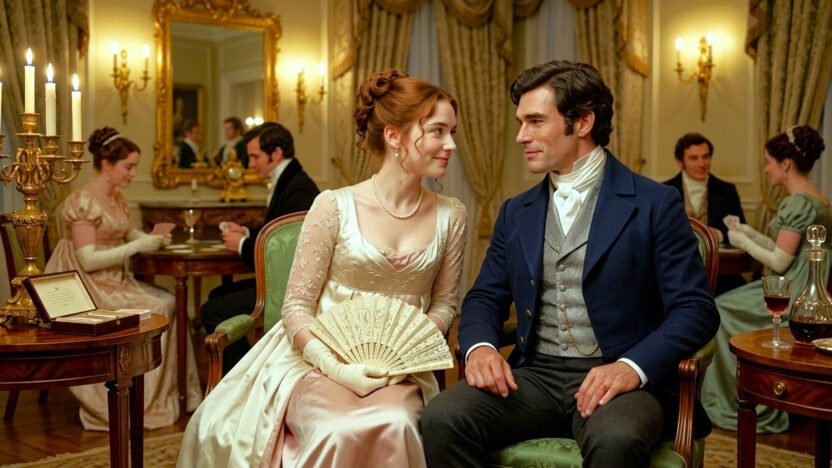
The invitation had promised a week of country hospitality, and Verity Ashcombe had learned, over eight seasons of promises like it, exactly how much weight such a word could bear. A week meant seven dinners, seven mornings of correspondence disguised as conversation, and at least one impromptu concert that no one had asked for and everyone would be obliged to praise. She had packed accordingly, which was to say she had packed her patience along with her gowns, and she arrived at Lady Osgood’s house with the particular calm of a woman who had stopped expecting to be surprised by anything a drawing room might produce.
She was wrong within the hour, though it took her rather longer to admit it.
The seating at the first dinner had been arranged, as such things always were, by a hostess with more goodwill than tactical sense, and Verity found herself placed beside a gentleman she recognized by reputation before she recognized him by face. Frederick Ashdown, Viscount Merrow, was spoken of in every drawing room she had ever stood in, always in the same admiring, slightly breathless register reserved for men who were rich, unmarried, and inconveniently charming. She had expected, therefore, to be charmed at her, in the practiced way such men so often were, all warmth aimed outward and nothing underneath it.
He said good evening to her with perfect correctness, and for the length of the soup course they discussed the weather, the road from London, and Lady Osgood’s famously temperamental cook, in the manner of two people fulfilling an obligation neither had chosen. It was only when the fish arrived, and their hostess laughed too loudly at something Sir Aubrey Finch had said three seats down, that Verity allowed herself the smallest private observation.
“He has told that story at every dinner I have attended this year,” she said, not quite to herself.
Frederick had not seemed to be listening. And yet: “The one about the hunting dog, or the one about his aunt’s parrot?”
“Both, generally. In sequence. He is very fond of a narrative arc.”
Something changed in his face then, a small loosening around the eyes that she suspected did not often appear at these tables. “I had thought I was the only person at this dinner keeping count.”
“You are not,” Verity said. “Though I imagine we are the only two.”
It was, she would later think, an unremarkable exchange to have started so much. But it did not stay unremarkable. Across the remainder of the meal, in the spaces between courses and other people’s conversation, they built a private commentary on the room, quiet enough that no one else could follow it, precise enough that each remark landed exactly where it was meant to. She noted the way Mrs. Devereux kept glancing at her husband whenever she made a joke, as though asking permission to have been amusing. Frederick noted, a moment later, that Mr. Devereux never once looked back. She had not expected him to see it too. She had certainly not expected the small, private satisfaction of being understood so quickly, by a man she had known for the length of a fish course.
“You are very unkind,” she told him, once, when his observation about a particular baronet’s waistcoat had made her nearly laugh into her wine.
“I am very accurate,” he said. “There is a difference, though I grant it is not always a comfortable one.”
By the time the ladies withdrew, Verity had catalogued an unfamiliar sensation, one she did not immediately have a name for. It was not the flutter she associated with a handsome man’s attention, the kind she had felt exactly once before, to her later regret. It was something quieter and, she suspected, more dangerous: the sense of having spent an evening as herself, rather than as the amiable performance she generally provided for public consumption. She was not certain what to do with that. She resolved, for the moment, to do nothing at all, and to see whether the sensation survived a night’s sleep.
It survived rather better than she had expected, and by the second evening’s entertainment, an informal gathering in the long drawing room before cards, she found she had already thought of him twice that day, which she considered, on reflection, twice too often.
She arrived early. This was not, she told herself, in anticipation of anything. It was simply her habit, born of a mother she barely remembered and a father who had taught her, without meaning to, that arriving before a room filled gave a person the rare privilege of choosing her own seat rather than accepting whatever remained. She chose a chair near the window, where the evening light still came in gold across the carpet, and she set her fan down on the seat beside her with no particular ceremony. She did not announce that the chair was reserved. She did not need to. It simply was, in the way of things one decides without quite deciding.
Sir Aubrey Finch arrived some minutes later, saw the empty seat, and made his pleasant, unhurried way toward it, as any perfectly acceptable gentleman might. He was, in fact, entirely acceptable — good-natured, well-mannered, possessed of a small but respectable estate in Kent and a genuine, uncomplicated fondness for her company. There was nothing wrong with Sir Aubrey Finch. That, Verity would later understand, was rather the point.
Frederick entered the room a moment behind him, and Verity watched, with an interest she did not examine too closely, as his gaze moved from her to the empty chair to Sir Aubrey’s approaching hand, and settled there for exactly as long as it took him to cross the room himself.
“Forgive me,” he said, arriving just ahead of the other man, his voice perfectly level, perfectly pleasant, entirely without heat. “I believe that seat has already been promised.”
Sir Aubrey, gracious as ever, inclined his head and found another chair without complaint. Verity said nothing at all, because she could not, for the moment, think of anything to say. She had promised the seat to no one. She had certainly not promised it to him. And yet here he was, settling into it with the quiet, faintly pleased air of a man who had just won a small contest that had, technically, not existed until he invented it.
“That was audacious,” she said, once Sir Aubrey was safely out of earshot.
“It was,” Frederick agreed. “I find I am not troubled by it.”
“You ought to be. I never said the seat was yours.”
“No,” he said. “You didn’t.” And he looked at her with an expression she could not immediately translate, somewhere between amusement and something more careful, as though he had surprised himself as much as her, and had not yet decided what to do about it. She found, to her own quiet alarm, that she did not want him to decide against it.
The dinner that followed the cards was a smaller affair, and afterward, as the older guests settled into a comfortable digestive stupor by the fire, several of the younger members of the party drifted toward the terrace doors, where the garden lay blue and cooling under a rising moon. Verity went because the room had grown too warm and too loud, and because a walk after a heavy meal was, she told herself, simply sensible.
Frederick fell into step beside her without either of them arranging it, in the way that had already, after only two evenings, begun to feel less like coincidence than habit. They walked the gravel path along the edge of the rose beds, saying little at first, and Verity found she did not mind the silence. It was, she realized with some surprise, the first comfortable silence she had shared with a man who was not her father.
“You did not deny it,” Frederick said eventually, “that you observe people. At dinner. I thought perhaps you would.”
“Why would I deny something you clearly already suspected?”
“Most women I have dined with would consider it an unflattering thing to admit. Suggests one is not entirely occupied with being agreeable.”
“I have been agreeable for eight seasons, my lord. I find it leaves rather a great deal of time free for other pursuits.” She glanced sideways at him. “You do it too. You are not nearly so occupied with your soup as you would have people believe.”
“No,” he admitted. “I have found it useful, over the years, to appear less attentive than I am. People say a great deal more in front of a man they believe is not listening.”
“That sounds lonely.”
She had not meant to say it quite so plainly, and she saw the words land somewhere she had not intended, a small flicker crossing his face before he mastered it. “I had not thought of it that way,” he said, after a moment. “I am not certain I care to, tonight.”
They walked on. The path curved past the old stone bench beneath the yew hedge, and Verity felt, without quite understanding why, that some quiet threshold had been crossed between them, one that had nothing to do with seats or dinners or the ordinary architecture of a house party, and everything to do with the fact that for the length of two evenings, she had not once had to perform herself for his benefit. She did not know yet what to call the thing growing between them. She knew only that when they turned back toward the lighted windows of the house, some part of her was already counting the hours until the following evening’s walk, and wondering, with a carefulness she did not examine too closely, whether he would be counting them too.
The third day brought rain in the morning and, by afternoon, the particular restlessness of a house party confined indoors longer than its guests had planned for. Lady Osgood, undaunted, proposed a tour of the east wing, a part of the house that had been closed up since her husband’s grandmother’s time and was, by her own cheerful admission, “in a state that would embarrass a more houseproud woman.” Most of the party declined in favor of cards. Verity found herself among the small handful who went, and was not entirely surprised, by then, to find Frederick among them too.
The east wing smelled of dust and old paper and the particular mustiness of rooms that had been shut against the weather for too many years. Sheets covered most of the furniture, ghostly and pale in the grey afternoon light, and the wallpaper in what had once been a lady’s sitting room had faded to a soft, unreadable pattern, water-stained near one window where a leak had gone unattended. Their small group thinned quickly, most of the guests retreating after the first two rooms, professing cold or boredom or both, until it was only Verity and Frederick left standing in a long gallery whose windows looked out over an unkempt garden gone entirely to seed.
“It could be lovely,” Verity said, before she had quite decided to say anything at all. “If someone cared for it properly.”
“You sound as though you have an opinion about how.”
“I have opinions about a great many things I am rarely asked about.” She moved closer to the window, where the rain had left the glass streaked and soft-edged. “That box hedge, for one, wants cutting back entirely, not trimming. And whoever planted roses along a north wall was optimistic to a fault.”
Frederick came to stand beside her, close enough that she was aware of it in a way she chose not to examine. “My own gardens want the same treatment. I have been putting it off for two years, mostly because my father’s gardener has strong feelings about the roses and I have not yet found the courage to disagree with him.”
“That is not courage you lack, my lord. That is simple avoidance.”
“It is,” he agreed, with a rueful honesty that surprised her. “I am told I have a talent for it.”
They spoke, after that, of the sort of house each of them might make, if the choosing were entirely their own — not the grand, abstract talk of fortune and consequence that filled so many drawing rooms, but something smaller and stranger and more revealing. Verity found herself describing a library she had imagined since girlhood, shelved floor to ceiling, with a window seat wide enough to curl into, and was startled to hear Frederick answer, without hesitation, that he would want the same, though his own memory of libraries was mostly of his father’s, cold and formal and arranged more for display than for reading. “I used to hide books behind other books,” he admitted, “so that no one would see what I was actually reading.”
“What were you reading?”
“Novels, mostly. Terrible ones. My father would have been appalled.”
“I begin to think, Lord Merrow, that you are considerably less serious than you allow people to believe.”
“I begin to think the same of you, Miss Ashcombe.”
It was a small exchange, and yet Verity carried it with her long after they had rejoined the others for tea, turning it over the way one turns over a stone found on a walk, uncertain why it seemed worth keeping and certain, all the same, that she meant to keep it. She had spent eight seasons being asked what she thought of the weather, of music, of other people’s engagements. She could not remember the last time anyone had asked what kind of library she wanted, and troubled to actually listen to the answer.
Sir Aubrey found her that evening before dinner, solicitous and warm as always, and asked whether she might reserve him a dance at the assembly two days hence. She said yes, because there was no reason not to, and because he was, in every particular that could be listed on paper, an entirely suitable man. She thought of Frederick’s dry observation about waistcoats, and found she had to hide a smile behind her fan, and understood, with a small internal jolt, that the difference between the two men had nothing to do with any fault in Sir Aubrey at all. It was simply that with Frederick, she was never performing the version of herself meant to be found agreeable. She had not realized, until she felt its absence, how tiring that performance had become.
The fourth evening was quieter, most of the party content to sit with cards and conversation after a full day’s activity, and Verity found herself on the terrace before the others had thought to gather there, watching the light go from gold to violet over the hedges. Frederick joined her without announcement, as he had begun to do, and for a while they said nothing at all, which by now felt less like the absence of conversation than another form of it.
“My father wrote to me this week,” he said eventually, his eyes on the darkening garden rather than on her. “Nothing of consequence. Only that I am past thirty and he trusts I am giving proper thought to the matter of a wife, now that the estate is settled enough to want an heir.” He said it lightly, almost carelessly, and yet something in his stillness told her the words had cost him more than his tone suggested. “It is the sort of thing fathers say. I do not think he meant anything by it beyond the ordinary.”
“But it troubled you.”
“A little.” He was quiet a moment. “My parents’ marriage was a very correct arrangement. Two people who managed a household and an estate together with considerable competence and very little warmth. I grew up believing that was simply what marriage was — a kind of well-run enterprise. It was not until I was much older that I understood some people expect rather more of it, and I have never been entirely certain I would know how to give that, even if I wished to.”
Verity did not offer him comfort, or reassurance, or any of the soft, automatic phrases a lesser conversation might have called for. She simply said, “I was courted once by a man I believed loved me a great deal. I learned afterward, quite by accident, that he had spoken to my father about my portion before he had ever properly spoken to me. I do not think he was cruel. I think he simply did not distinguish between the two things, and it did not occur to him that I might.” She looked out at the darkening hedges rather than at Frederick. “I have been careful ever since. Perhaps too careful.”
“I do not think that is a fault.”
“No,” she agreed. “But it is lonely, in its own way.”
He looked at her then, and something passed between them that neither named, an acknowledgment that they had each handed the other something they did not hand out easily, and that the exchange had been received with the care it deserved. Verity felt, for the first time in longer than she could easily account, entirely without performance — not charming, not agreeable, not carefully arranged for anyone’s approval. Simply known.
The days that followed passed more quickly than she would have liked, each one bringing its walk after dinner, its small exchange of observations, its accumulating weight of ordinary, unremarkable hours that had somehow become the center of her days rather than their pleasant decoration. It was her mother’s old friend, Mrs. Palmer, who mentioned over breakfast on the sixth morning that the Ashcombes’ own travel plans, long settled before the house party had ever been arranged, would take Verity and her father north within the fortnight, to visit her aunt in Yorkshire for the remainder of the autumn. Verity had known this, of course. She had simply not thought of it in some days, and hearing it spoken aloud now, with only two evenings of the house party left, produced in her a small, cold drop of feeling she did not immediately wish to name.
She was quieter than usual at tea that afternoon, turning the thought over without meaning to, and it was Frederick, watching her with the same attentiveness he brought to every room, who noticed first. He said nothing of it directly, but she caught him observing her twice across the drawing room with an expression she could not quite read, something drawn and careful, as though he too were turning over a thought he had not decided whether to speak. She wondered, with a discomfort that surprised her, whether her silence had been misread as distance, when it was, in fact, very nearly the opposite.
That evening’s walk began later than usual, the two of them lingering behind the others until the garden was nearly theirs alone, and for the first stretch of the path neither spoke at all. The silence, which had felt so easy only days before, had taken on a different weight now, charged with things neither had yet found the courage to say. Verity was acutely aware of the sound of their footsteps on the gravel, of the narrow distance between his sleeve and her own, of the fortnight that was closing in around them both like a door swinging slowly shut.
“You have been quiet today,” Frederick said at last.
“I have been thinking,” Verity admitted, “that this week will end.”
“Yes.” He did not pretend not to understand her. “I have been thinking of that too.”
They stopped, without quite deciding to, at the bend where the path opened onto the low stone wall overlooking the darkened fields, and Verity turned to look at him properly for what felt like the first time in days, rather than stealing the sideways glances she had grown so practiced at. He was looking back at her with an expression stripped, for once, of its usual careful composure, and in it she saw, unmistakably, the same uncertain, unguarded apprehension she suspected was written plainly across her own face. Neither of them spoke. It was not, she understood, a silence born of having nothing to say. It was the silence of two people who had, in the same unspoken moment, each recognized precisely what the other was afraid of losing, and had not yet found the words brave enough to say so aloud.
Neither of them moved to break it. The wind had picked up slightly, carrying the smell of wet earth and late roses, and somewhere behind them, faint and warm, came the sound of the house — laughter, the clink of glasses, a life continuing in a room they had both, for the moment, entirely left behind. Frederick was the one who finally spoke, and when he did, his voice had lost the careful, measured quality she had come to know so well over the course of the week.
“I do not want this to end when the week ends,” he said.
It was not eloquent. It was not, she would think later, the sort of declaration poets wrote about, full of vows and moonlight and grand promises. It was simply true, spoken plainly by a man who had spent a great many years learning not to say true things aloud, and the plainness of it struck her more forcefully than any polished speech could have.
“Neither do I,” Verity said, and found that admitting it cost her rather less than she had feared.
“Then let me say something properly, before I lose the nerve for it.” He turned to face her fully, the last of the daylight gone now, the garden lit only by the windows behind them. “I would like you to come to Calder, once the season allows it — with your father, with whatever companions propriety requires, all of it done exactly as it ought to be done. Not as a courtesy. I want you to see the place as it actually is, not dressed up for a house party, and I want to know whether what I feel for you can survive being seen in an ordinary week, in ordinary rooms, without an assembly or a dinner party to recommend it.” He paused. “I find I would rather know the truth of that than continue pretending to myself that this has only been a pleasant diversion.”
Verity was quiet for a long moment, long enough that she saw something flicker across his face, some old, practiced readiness to have his hopes disappointed. She understood that readiness. She had worn a version of it herself for longer than she cared to admit.
“Why me?” she asked, and the question was not coy, not the kind a woman asked to be flattered. She meant it entirely. “You could have any woman in that drawing room, my lord, and a great many of them would accept you for considerably less than an honest invitation.”
“I know,” he said. “I have been offered exactly that, more than once, and it has never once tempted me to accept it.” He did not look away from her. “You are the first person in longer than I can properly say who has made me feel that I am being listened to rather than assessed. You laugh at things because you find them funny, not because you believe it becomes you to laugh. You have never once agreed with me simply to be agreeable. I do not know how to explain what that has come to mean to me in the space of a week, except to say that I would rather risk your refusal honestly than keep your good opinion by saying nothing at all.”
It was, Verity thought, exactly the answer she had needed and not entirely expected to receive — not a compliment to her face or her fortune, but an accounting of who she actually was, offered by a man who had clearly been paying closer attention than she had allowed herself to hope. Something in her, some old careful guard kept in place since a courtship that had turned out to be about her portion rather than her person, loosened by a fraction she felt rather than chose.
“I will come to Calder,” she said. “But I will tell you plainly, since you have been plain with me: I mean to watch you closely while I am there. I have been wrong before about a man’s true nature, and I do not intend to make the same mistake twice for the sake of a pleasant week and a well-spoken invitation.”
“I would expect nothing less of you,” Frederick said, and there was something like relief in it, and something like the beginning of a smile.
The visit was arranged for early autumn, once the last obligations of the season had properly discharged themselves, and Verity arrived at Calder with her father and her aunt as chaperone, and with a private resolve she had not entirely voiced even to herself. She had told Frederick she meant to watch him closely, and she kept her word, though not in any manner he could easily have detected. She noticed how he spoke to the housekeeper, an older woman who had clearly known him since boyhood, with an easy respect that held nothing of performance in it. She noticed how he crouched, without a second thought for his coat, to examine a fence a tenant’s boy had been struggling to mend, and stayed a quarter of an hour longer than necessary simply to show the boy how the thing was properly done. She noticed that when a dispute arose between two farmers over a boundary hedge, he listened to both accounts fully before he spoke, and that his eventual judgment satisfied neither man entirely, which she had come, by then, to understand was usually the mark of a fair one.
None of it was performed for her benefit. That, she came slowly to realize, was precisely the point. In the house parties and assemblies of the season, a man’s charm was always at least partly a performance, offered up for an audience that expected to be charmed. Here, in the ordinary business of an ordinary week, there was no audience to perform for beyond the people whose lives his decisions actually touched, and he conducted himself with them exactly as he had conducted himself with her in Lady Osgood’s drawing room — attentive, unhurried, entirely himself.
They walked each evening, as they had at Lady Osgood’s, though here the paths were his own, worn by years of solitary use rather than a week’s shared habit, and he showed her the neglected wing he had spoken of in that other house’s east gallery, the library he meant one day to properly restore, the roses his father’s gardener refused to move from their unfortunate north wall. She found herself, without quite intending it, imagining her own hand in the ordering of those rooms, and caught herself at it more than once with a small, private start.
It was on the fourth evening of her visit, walking the same stretch of garden path where he had first asked her to come, that Verity understood, with a clarity that arrived less like a revelation and more like the quiet settling of something she had suspected for some time, that she had her answer. He had not been different with her because a house party had made it easy to be so. He was, simply, this — steady in small things as well as large ones, patient with people who owed him nothing of consequence, honest in rooms where no one was watching to reward him for it. The week at Lady Osgood’s had not created the man she had come to care for. It had only given her the first glimpse of him.
She did not wait for him to ask her anything further. That evening, when the family gathered before dinner in the smaller of Calder’s two drawing rooms, Verity arrived early, as she so often did, and chose a chair near the window, where the last of the daylight still came in gold across the carpet. She set her gloves upon the seat beside her, with no particular ceremony, and said nothing about it to anyone at all.
When Frederick came into the room a few minutes later and saw the empty chair, and understood exactly what it meant, he crossed the room without a word, and sat down beside her as though he had always belonged there.
Word of it traveled quickly, as such things did among families already inclined toward each other’s good opinion, and within a fortnight a small gathering had been arranged at Calder to make the matter properly known — nothing so grand as a ball, for neither Frederick nor Verity had wished for that, but a family dinner large enough to include both households and close enough to feel, as Verity’s father remarked with some satisfaction, like the beginning of one household rather than two.
The table that evening was longer than the one at which they had first sat side by side at Lady Osgood’s, and considerably less crowded with strangers performing for one another’s benefit. Verity’s father sat near the head of it, in quiet conversation with the Earl of Calder, the two of them discovering, somewhat to their mutual surprise, that they agreed rather thoroughly on the subject of enclosure and hedgerows. Verity’s aunt had already made friends with the housekeeper, whose good opinion Verity privately considered a far more reliable character reference than anything printed in the peerage. And Frederick, watching the room from his place beside her, wore an expression she had come to know well over the preceding months — not the practiced charm he had once offered to rooms full of people who expected to be charmed, but something quieter and entirely unguarded, the look of a man who had stopped bracing himself against the possibility of disappointment.
“You are staring,” Verity told him, not quite managing to keep the warmth from her own voice.
“I am allowed to, now,” he said. “I believe it is one of the privileges explicitly granted to a man in my position.”
“I do not recall that being written anywhere.”
“No,” he agreed. “But I intend to enforce it regardless.”
It was Frederick’s father who rose first, once the last course had been cleared, and said, with the particular gruff formality of a man unused to sentiment and determined to manage it properly all the same, that he wished to offer a toast to his son’s happiness, and to the good fortune that had brought Miss Ashcombe into a family that had, in his own quiet estimation, been waiting rather too long for someone to make it whole again. Verity watched Frederick’s face carefully as his father spoke, and saw there none of the old wariness she had once worried might never entirely leave him — only a kind of steady, grateful ease, the ease of a man who had finally stopped waiting to be told he was loved for anything other than his title, and had simply been told he was loved.
When the toast was done and the room had settled back into its comfortable noise, Frederick rose from his own place, and rather than returning to it, came instead to stand behind Verity’s chair. He said nothing dramatic. He did not require the room’s attention, and did not particularly seek it, though a portion of it came to him regardless. He simply drew out the chair beside hers — a chair that had, until that moment, remained conspicuously and deliberately empty at the foot of the table, reserved without explanation since the guests had first been seated — and sat down in it.
“I asked that this seat be kept open,” he said to her, quietly, beneath the returning hum of conversation, “because I find I have grown rather fond of the habit of claiming a place beside you before anyone else can. I did not think it right to break the custom on an evening as important as this one.”
Verity felt the small, familiar warmth of recognition spread through her, the private acknowledgment of a gesture whose meaning belonged entirely to the two of them, unremarked upon by anyone else at that crowded table. It was the same gesture, in its essential shape, that had first drawn his attention to her at Lady Osgood’s house — a chair claimed rather than assigned, a place chosen rather than merely occupied. But it carried, now, an entirely different weight. It was no longer the small vanity of a man unwilling to lose an interesting evening’s company to a more conventional rival. It was a promise, offered plainly, of every dinner and every ordinary evening still to come.
“You are not nearly so subtle as you believe yourself to be, my lord,” she told him, though her voice had lost every trace of its old teasing distance and held instead something far more certain.
“I have stopped trying to be,” he said. “I find I no longer see the use in it.”
Later, when the family had retired to the smaller drawing room and the youngest cousins had been sent up to bed protesting loudly against the injustice of it, Frederick drew Verity aside to the same window where she had first set her gloves upon an empty chair, weeks before, without announcement or ceremony. Outside, the garden lay dark and quiet under a rising moon, the same garden in which they had once walked in careful, unspoken silence, each afraid to be the first to name what was growing between them.
“I used to think,” Frederick said, looking out at the darkened hedges rather than at her, “that a man in my position could never truly know whether he was loved for himself or merely for what he could offer. I do not think that any longer.”
“What changed your mind?”
“You did,” he said simply. “You never once needed anything from me that I could not have offered as an ordinary man with no title at all. You wanted only my attention, and my honesty, and my company on a walk after supper. I find those are rather easier things to give than I once believed, once a person has finally been asked for them properly.”
Verity slipped her hand into his, an easy, unremarkable gesture between two people long past the need for careful distance, and felt him close his fingers around hers without hesitation. “I used to think,” she said, “that I would spend my whole life being courted for my portion, and never quite trusted for myself. I did not expect to find the one man in England who seemed entirely indifferent to it.”
“I was never indifferent to you,” Frederick said. “I was only, for a very long time, afraid to say so plainly. I do not intend to make that particular mistake again.”
Outside, the wind moved gently through the roses along the north wall — the same roses he had once complained of, planted by some long-ago optimist who had never troubled to consider whether they would thrive there, and which had, against all reasonable expectation, gone on blooming every year regardless. Verity thought, watching them sway faintly in the dark, that they made rather a fitting enough symbol for the two of them, though she did not say so aloud, and did not need to. Frederick, following her gaze, seemed to understand the thought regardless, in the way he had come to understand so much of what she left unspoken.
They stood together at the window a long while, saying very little, needing to say very little, two people who had spent a lifetime being watched, admired, and courted for everything except themselves, and who had found, at last, in each other, the rare and quiet luxury of simply being known. The house behind them was warm with lamplight and family and the comfortable noise of people who loved them. The garden before them was dark and settled and entirely their own. And the chair that had once been guarded so carefully, so silently, at the foot of a crowded table, stood now not as a small private signal between two uncertain people, but as the first small proof of a place that would, from that evening forward, always and unquestionably belong to them both.