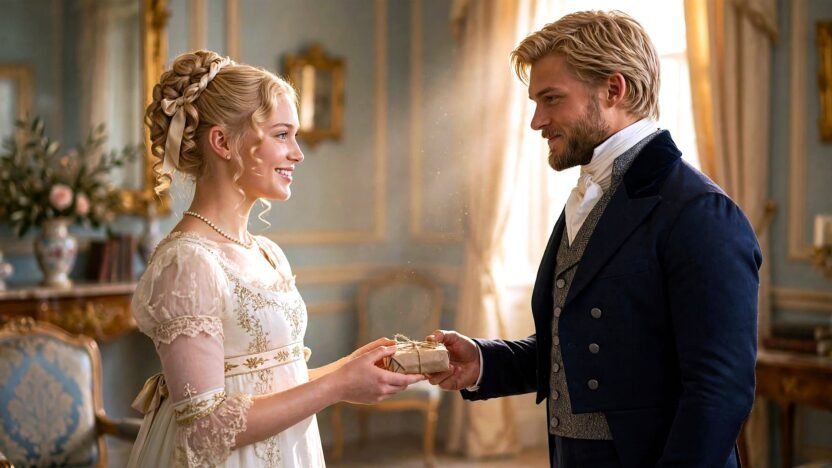
The first parcel confused him. It was a simple book she had mentioned wanting, yet Miss Maeve Sullivan sent it back to the Duke of Glenmore with a perfectly polite note of refusal. Most women in his world would have kept the gift and sought another. But Maeve was guarding a quiet independence she could not afford to lose. When the second gift returned, Declan realized the truth. She wasn’t rejecting his generosity. She was terrified of what it might cost her.
The heavy oak door of the study opened, the brass latch clicking softly in the quiet room. A servant stepped inside, his footsteps muted by the thick Persian rug, and gently placed a small, brown-paper parcel on the edge of the desk. Declan O’Brien, Duke of Glenmore, looked up from his correspondence. He recognized the shape of the package immediately. It was the exact dimensions of the volume he had sent away only yesterday morning.
He untied the string, the coarse paper rustling as it fell back. Inside lay the leather-bound book, exactly as it had left his hands. Untouched. Unopened. Beside it rested a small sheet of folded stationery. The handwriting was neat, elegant, and perfectly composed. Miss Maeve Sullivan thanked His Grace sincerely for his consideration, but she could not possibly accept such a gift.
Declan leaned back in his deep leather chair, listening to the crackle of the fire in the hearth. He was not angry. He was genuinely confused. The book was not an extravagant piece of jewelry or a grand romantic gesture meant to overwhelm a woman’s sensibilities. It was merely a collection of essays. During a dinner gathering the previous week, he had stood near enough to hear Maeve casually mention to a friend that she had been searching for that particular volume for months. Declan had happened to locate one in a Dublin bookshop. He had sent it simply because he remembered. That was all. Or at least, that was what he told himself.
In Declan’s world, women rarely refused anything a duke offered. They smiled, they flattered, and they accepted. Maeve Sullivan had just returned something she very clearly wanted. He tapped his fingers against the polished mahogany of his desk, looking at the polite, impenetrable note. He did not feel insulted. As the afternoon rain began to patter against the tall glass windows, Declan realized that for the first time in a very long while, he felt entirely curious.
Three days later, the opportunity to satisfy that curiosity presented itself. The setting was a thoroughly respectable afternoon gathering at a neighboring country estate. The drawing room hummed with the quiet clatter of teacups against saucers and the low murmur of polite conversation. Maeve sat near the tall windows, her pale golden-blond hair catching the muted Irish sunlight. She looked entirely at ease, her posture straight, her clear blue eyes carrying a quiet, observant intelligence. She possessed the education and manners to belong perfectly in this room, lacking only the fortune that usually accompanied them.
Declan crossed the room. He did not demand an audience, nor did he make a spectacle of his approach. He simply found an empty chair near hers, settling his tall frame into the seat, and waited until the natural flow of conversation offered them a moment of relative privacy.
“I hope,” Declan said softly, his deep voice meant only for her, “that you did not consider the book an impertinence.”
Maeve did not flinch, though a faint flush of warmth touched her fair skin. She met his gaze directly, her hands resting quietly in her lap. “Not an impertinence, Your Grace. Excessive generosity, perhaps.”
Declan tilted his head, studying the delicate line of her jaw. “Can returning a book one happens to find truly be considered excessive generosity?”
Her voice was steady, perfectly controlled. “That depends upon who offers it, Your Grace. And who must accept it.”
Maeve watched him carefully, bracing herself. She knew she had spoken too plainly. Men of his rank did not care to be reminded that their casual gestures carried weight, or that their generosity could feel like a burden to a woman with no fortune. She expected his expression to cool. She expected him to stand and walk away.
Instead, the corner of Declan’s mouth twitched in a shadow of a smile. He was not offended at all. He seemed to respect her honesty. Maeve felt a sudden, strange flutter of appreciation. He had the power to make her feel very small, yet he sat there, entirely calm, allowing her the space to disagree without demanding an apology.
The following week, the social circle expanded to a walking party across the rolling green hills of a local estate. The wind pulled at the ladies’ skirts and carried the scent of damp earth. Declan found himself walking a few paces behind Maeve. She had paused near a low stone wall, her sketchbook open, a small tin of watercolors resting on the rough stones. He stood in silence, watching her work. He noticed that while her brushstrokes were confident, she was being painfully careful with a particular shade of blue, rationing the pigment as if it were spun gold. She mentioned to a companion that replacing the finer pigments required an expense she could not currently justify.
Declan said nothing. He simply listened.
A few days later, a small wooden box arrived at the modest home Maeve shared with her widowed aunt, Mrs. Brigid Sullivan. Inside rested a complete set of the finest watercolors available. It was not delivered secretly. There was no improper letter attached, no demand for her company. Just the paints.
Maeve stood in her aunt’s parlor, looking down at the rich, vivid colors. She loved them. Her fingers ached to use them. And that was precisely the problem. She stared at the box for a long time, listening to the ticking of the mantel clock, her heart beating a little too fast. From her armchair, Mrs. Sullivan watched her niece’s silent hesitation, the quiet rustle of her sewing pausing, but she said nothing.
With a quiet exhale, Maeve closed the wooden lid. She wrapped the box in paper, tied it securely, and sent it back.
When the parcel was placed on Declan’s desk that evening, his reaction was entirely different than the first time. The returned book had amused him. The returned watercolors concerned him. He stood by the window, staring out at the darkening sky. The first refusal had not been a mere formality. Something about receiving anything from him genuinely troubled her.
What, he wondered, does she believe I am asking from her in return? She was not rejecting his gifts. She was rejecting what she believed accepting them might mean.
Declan realized he needed to change his strategy. If the objects made her uncomfortable, he would stop sending them. He would not stop seeking her out.
The following week, during a musical evening at a neighbor’s estate, Declan found an opportunity. He approached Maeve while she stood near the edge of the room, listening to the string quartet. He did not demand an explanation for the watercolors, but he gently steered the conversation toward the subject.
“I have begun to suspect, Miss Sullivan,” Declan said, his tone mild, “that my attempts to be helpful are causing you distress.”
Maeve looked away from the musicians. She appreciated that he had not ignored the awkwardness between them. “I admit, Your Grace, that certain forms of generosity can create obligations.”
Declan watched her carefully. “And you believe I would collect one?”
Maeve held his gaze. She answered with quiet, devastating honesty. “I do not know Your Grace well enough to know what you might expect.”
The words wounded him slightly. He was accustomed to people seeking his favor, anticipating his needs. He was not accustomed to being viewed as a potential threat. But her answer also made him realize something crucial: Maeve genuinely did not understand his intentions. How could she? He hadn’t spoken them.
Before he could respond, their conversation was interrupted by the arrival of other guests. Declan stepped back, yielding the space, but his mind remained entirely on Maeve.
Later that same evening, Maeve sought a moment of quiet in an adjoining sitting room. She stood near a tall vase of hothouse flowers, the heavy scent of lilies filling the air. From the other side of a partially open door, she heard the rustle of silk skirts and the low voices of two older women.
“His Grace seems remarkably attentive to Miss Sullivan,” one voice observed, carrying the sharp edge of social assessment.
“Indeed,” the other replied, her tone dry. “But attentions are not necessarily intentions.”
There was no cruelty in the remark. It was merely a statement of fact. And that made it worse. Maeve closed her eyes, the sound of the string quartet fading into the background. She realized other people had noticed. The society around them saw the Duke’s focus, but they did not assume it would lead to marriage. Why should they? She possessed no fortune, no grand connections. A duke could enjoy the company of a pretty, intelligent woman without ever offering her his name. The overheard words gave voice to her deepest fear. If she accepted too much from him now, where would she be when his interest inevitably passed?
The next day, Declan’s new approach began. There were no more parcels delivered to the Sullivan residence. No books. No paints. No objects at all. Instead, Declan gave her something else: his presence.
At gatherings, he made a point to speak with her. During group walks, he invariably found his way beside her. He asked about the subjects of her drawings rather than offering to buy her supplies. He listened, genuinely listened, when she disagreed with him about the merits of a particular author or the quality of a local road. He remembered small details from their previous conversations, but he no longer turned those details into presents.
Without the pressure of gifts between them, Maeve felt herself begin to relax. She no longer had to brace herself for an obligation she couldn’t repay. She began to discover the man beneath the title. She found that he possessed a quiet, dry humor, entirely distinct from the arrogant posturing of other wealthy men she knew.
During a brisk walk across his own sprawling estate, the wind whipping through the long grass, Maeve pointed out a small, thorny shrub growing near the path. She offered its Latin name, then its common one.
Declan looked at the plant, then at her. “I admit, Miss Sullivan, I have no idea what that is called.”
Maeve smiled, her eyes bright with a gentle teasing. “You do not know the flora on your own lands, Your Grace?”
Declan clasped his hands behind his back, the wind catching the edge of his heavy coat. “I possess several thousand acres, Miss Sullivan. I have never claimed to have been personally introduced to every shrub.”
Maeve laughed, a clear, genuine sound that seemed to hang in the crisp air. Declan watched her, the humor in his eyes softening into something deeper, more focused. He looked at her a fraction of a second too long. The air between them suddenly felt charged, heavy with unspoken things. Neither mentioned it. They simply continued walking, the silence between them no longer polite, but comfortable. Intimate.
Maeve realized, with a small jolt of surprise, that she had begun looking forward to his conversations. And Declan found himself scanning every room he entered, searching for the pale gold of her hair.
A fortnight later, during a quiet afternoon visit to the Sullivan home, Maeve was organizing her sketching materials in the parlor. Declan sat nearby, discussing estate matters with Mrs. Sullivan. Maeve pulled an old, worn leather drawing case from her bag. The leather was scuffed, the stitching fraying at the edges, and the brass clasp was broken, hanging loosely from its hinge.
Declan paused in his conversation, his attention drawn to the object. “That appears to have seen better days, Miss Sullivan.”
Maeve touched the worn leather with gentle reverence. “It belonged to my mother, Your Grace. It is old, and it is damaged, but I would never replace it.”
Declan looked at her hands, then at the case. He understood immediately. The value was not material. The value was memory. It was irreplaceable.
He did not offer to buy her a new one. He said nothing more about it.
Five days later, a servant arrived at the Sullivan door. He handed over a parcel, wrapped in plain brown paper. Maeve took it, a familiar knot of anxiety tightening in her stomach. She carried it to her small bedroom, sitting on the edge of her bed, and carefully untied the string.
It was her mother’s drawing case.
Declan had not bought her an extravagant new one. He had taken the case she already loved and had it repaired. The leather had been carefully cleaned and oiled, the stitching expertly reinforced, and the broken brass clasp had been replaced with a simple, sturdy mechanism that snapped shut with a satisfying click. He had preserved the thing she cherished.
Maeve sat in the quiet room, staring at the repaired case. She was deeply moved. The gesture was profound. It proved that Declan saw her. He listened. He remembered. He understood what mattered to her.
And then, a cold wave of panic washed over her.
This was no longer about a book or a set of paints. This was intimacy. This was an emotional bond deepening, tightening around her, and yet he had still never told her what these attentions meant. He had never spoken of a future. He was wrapping her in a net of thoughtful, profound generosity, and she had no idea if he intended to catch her or simply admire her before letting her go.
Accepting this gift was far more dangerous than accepting the others.
With trembling hands, she placed the case back into the brown paper. She wrote a note, her handwriting less steady than before. She thanked him for his profound kindness, but stated, unequivocally, that she could not accept it. And this time, she added a direct request: His Grace must please send her no more gifts.
When Declan received the repaired case, he did not return to his desk. He stood by the fire, holding the small parcel, staring into the flames.
The first returned gift had confused him. The second had made him curious. This one… this one hurt. He knew the gift itself had not offended her. He had done exactly what he thought was right. He had shown her that he understood her heart.
Something deeper was wrong. Something he could not decipher. Instead of going to her and asking why, Declan made his own assumption. He concluded that the intimacy of the gesture had frightened her. He concluded that she wanted distance.
And because he believed that respect required obedience, he decided to give it to her.
The air in the assembly room was warm, filled with the bright, flickering light of a hundred wax candles and the lively strain of the musicians in the gallery. Maeve stood near the edge of the polished floor, her hands resting lightly over her folded fan. When Declan entered the room, she saw him immediately. Her breath caught, just for a moment, in anticipation of how they would navigate this new, fragile territory.
He caught her eye across the room. He did not hesitate. He walked directly toward her and her aunt, his broad shoulders moving easily through the crowded room.
“Good evening, Mrs. Sullivan,” Declan said, his tone warm and perfectly measured. He turned to Maeve, offering a polite, impeccable bow. “Miss Sullivan. I trust you are both enjoying the evening.”
“We are, Your Grace, thank you,” Maeve replied. She braced herself for the quiet, private observation he usually offered—a dry comment about the extravagant feathered turban worn by their hostess, or a question about the book she was currently reading.
Instead, Declan simply offered a brief, entirely conventional remark about the quality of the musicians. He lingered for exactly the amount of time courtesy required of a gentleman greeting an acquaintance. And then, with another polite bow, he stepped away.
Maeve watched him walk toward the card room. She exhaled slowly, telling herself that the sudden hollowness in her chest was merely relief. This was what she had asked for. She had drawn a boundary, and he, being a gentleman, had respected it.
But at the next gathering, he behaved in exactly the same manner. He greeted her, he spoke briefly, and he moved on. He did not seek her out when the dancing began. He did not arrange to walk near her when the party strolled through the gardens. He was never cold. He was never punitive, nor did he make a spectacle of ignoring her or seeking the company of other women to provoke jealousy. He was simply absent.
He treated her exactly as he treated every other respectable young woman in the county. She was no longer special.
At first, Maeve clung to her relief. She was safe. There were no more parcels to return, no more unspoken obligations looming over her head. But as the days turned into weeks, the safety began to feel remarkably like a void. She realized that what she missed had nothing to do with beautiful books, expensive paints, or repaired drawing cases. She missed him. She missed his thoughtful questions, the quiet intelligence in his blue eyes, and the understated humor that made her smile when she least expected it. She missed his steady, calming presence.
With a growing sense of alarm, Maeve realized that her defenses had worked perfectly. She had pushed him away, and she had succeeded far too well.
The true cost of her success became clear during a crowded evening reception at the end of the month. Maeve had retreated to a quiet alcove just off the main drawing room, hoping to escape the overwhelming heat of the crowd. As she stood looking out at the darkened terrace, the sound of voices drifted from the other side of the heavy velvet curtain.
“Have you noticed?” a woman’s voice murmured casually. “The Duke of Glenmore no longer spends nearly as much time at Miss Sullivan’s side.”
“Indeed,” a second voice replied, accompanied by the soft flutter of a painted fan. “It seems His Grace’s interest has passed. A pity for her, but hardly surprising. These sudden fascinations rarely endure.”
The women moved away, their footsteps fading down the corridor as their conversation drifted seamlessly to the price of silk in London. For them, the observation meant almost nothing. A passing curiosity.
For Maeve, standing alone in the shadowed alcove, the words were devastating.
She pressed her hand against the cool glass of the window, her throat tightening. This was exactly what she had feared from the very beginning. She had warned herself that a duke’s attention could be fleeting, that she could not trust an undefined generosity. She had believed that if she accepted his gifts, she would have been left emotionally compromised, holding the remnants of his temporary affection when he eventually lost interest and walked away.
She had been so wise. She had been so remarkably prudent. She had protected herself perfectly.
Then why did she feel as though her heart were breaking? If his interest had only been a passing amusement, why did his absence hurt so much?
That evening, the fire in the Sullivan parlor burned low, casting long, wavering shadows across the worn rug. Mrs. Brigid Sullivan sat in her armchair, her needlework resting idle in her lap. For nearly an hour, she had watched her niece stare silently into the hearth, a book sitting unopened beside her.
Brigid did not offer false comfort. She did not pretend to know the secrets of the Duke’s heart. Instead, she asked quietly, “You are deeply unhappy, Maeve.”
Maeve looked away from the fire, lifting her chin in a fragile display of composure. “I am perfectly well, Aunt. I merely did what was necessary. I was prudent.”
“Prudence is a valuable trait,” Brigid agreed softly. She picked up her needlework, studying the stitches. “But I must ask you a question. When you returned that case to him… did you want him to stop sending you gifts? Or did you want him to give you a reason why you could accept them?”
The question pierced straight through Maeve’s carefully constructed defenses. She opened her mouth to answer, but the words caught in her throat. She could not speak.
Brigid let the silence hold for a moment before she continued. “Think of what the man actually did, Maeve. He never sent you anything secretly to compromise your reputation. He never asked for your gratitude. He never demanded private access to you, or used his wealth to pressure you into a corner. And when you explicitly asked him to stop… he stopped.”
Maeve closed her eyes. “He disappeared.”
“He stepped back,” Brigid corrected gently. “Because you pushed him away. Prudence and fear are not the same thing, Maeve. One protects you from danger. The other isolates you from life.”
Maeve stared at the flickering embers, the truth of her aunt’s words settling heavily into her chest. She began to understand the magnitude of her own mistake. She had been so terrified of becoming a dependent, of losing her freedom, that she had refused to see the respect Declan had shown her.
But as the realization settled, she also saw Declan’s mistake. She had asked him to stop sending her things. She had never asked him to stop speaking to her. He had assumed that her rejection of the objects was a rejection of the man.
He had assumed. Just as she had assumed.
They had spent months circling each other, interpreting silences, reading meaning into parcels and polite bows, all while carefully avoiding the terrifying vulnerability of the truth.
Maeve stood up, smoothing the skirts of her dress, a new, sudden resolve hardening her spine. If she wanted to know what his attentions meant, she could no longer wait for him to explain himself. She had to stop answering questions he had never actually asked. For the first time since the Duke of Glenmore had entered her life, Maeve chose to cross the distance between them.
The opportunity arrived three days later at a large, bustling country house party. The evening was warm, the French doors thrown open to the terrace, and the crowd was thick enough to provide anonymity. Maeve deliberately sought him out. She found Declan standing near the open double doors of the library, observing the room but participating very little. They did not sneak away, but they moved casually into the quiet perimeter of the library, remaining perfectly visible to the main hall while securing a precious few yards of privacy.
Maeve did not wait for her courage to fail. She looked up at him, her hands trembling slightly against her silk skirt. “I fear I have judged you unfairly, Your Grace. And I wish to apologize.”
Declan looked surprised, his posture instantly straightening. “You owe me no apology, Miss Sullivan. You never owed me acceptance of anything I sent.”
“That,” Maeve said softly, her voice remarkably steady despite the racing of her heart, “was precisely the difficulty.”
Declan’s brow furrowed. He did not understand.
So, for the first time, Maeve told him everything. She did not look away. She explained that a book or a set of paints from an ordinary acquaintance would have been one thing. But a succession of increasingly personal, profoundly observant gifts from a duke was entirely another.
“Every gesture told me that your attention was deepening,” Maeve explained, the words falling quickly now, stripped of all polite artifice. “But you never told me where that attention was leading. I have no fortune. You could marry almost anyone in the kingdom. I could not assume marriage merely because you were generous.” She took a slow, uneven breath. “And if I continued accepting those beautiful, meaningful things while knowing nothing of your intentions, I feared that gratitude itself would eventually make me feel less free to refuse you.”
Declan listened in absolute silence. The ambient noise of the party outside the library seemed to fade into nothing. Slowly, like the turning of a great lock, everything rearranged itself in his mind.
The book. The watercolors. The drawing case.
He had believed that the more carefully he chose each object, the clearer his affection would become. He had believed he was proving his devotion. Now, looking at the quiet, proud woman standing before him, he understood that the exact opposite had happened. The more meaningful the gifts became, the more terrifying they were without context. The more she needed an explanation, the more his silence had felt like a trap.
“I thought I was making myself clearer,” Declan said quietly, the weight of the realization settling into his bones.
“You were making yourself dearer,” Maeve replied, her voice dropping to a whisper. “That was not the same thing.”
The words landed with staggering force. The breath left Declan’s lungs. He stared at her, seeing her completely.
“I would rather you returned a thousand gifts,” Declan said, his voice thick with sudden emotion, “than accepted a single one because you believed you had no choice.”
Maeve looked into his blue eyes, and for the first time, she truly understood the man beneath the immense weight of his rank. He had never intended to buy her. He had only been trying to reach her.
She allowed the silence to hold for a moment before asking the question he had been avoiding. “Then why did you disappear?”
“Because you asked me to stop,” Declan answered honestly. “I believed I was respecting your request.”
“I asked you not to send me things,” Maeve said gently. “I did not ask you to stop speaking to me.”
Declan closed his eyes for a fraction of a second. He realized that he, too, had hidden behind interpretation. Instead of risking the truth, he had retreated.
An hour later, the rhythmic sway of the Glenmore carriage carried Declan back to his estate in the dark. He sat alone, listening to the heavy turn of the wheels, finally confronting his own behavior.
He had spent weeks telling himself a noble lie. He had convinced himself that he was protecting Maeve from the overwhelming pressure of his title. He had believed that by communicating through quiet gestures and objects, he was giving her the space to refuse him without the scandal of rejecting a formal proposal.
It was a beautiful, honorable excuse. And it was only partly true.
The rest was sheer cowardice. If he kept communicating his affection through books and repaired leather cases, he never had to place himself completely at Maeve’s mercy. If he never asked the question, he never had to hear her say no. His great mistake was not loving her through thoughtful gestures. His mistake was believing that thoughtful gestures could replace the terrifying, vulnerable honesty of actual words.
He knew exactly what he had to do differently. There would be no more clues. No more gifts speaking for him. No more expecting Maeve to infer intentions he did not have the courage to state plainly. He had to ask.
Several days later, the crunch of carriage wheels on gravel announced the arrival of the Duke of Glenmore at the Sullivan residence.
From the window of the parlor, Maeve watched Declan step down onto the drive. The very first thing she noticed was what he did not carry. There was no brown-paper parcel. There was no wrapped wooden box. There was no book, no bouquet of hothouse flowers.
For the first time in their entire courtship, Declan came to her empty-handed.
He entered the house and spent a brief, respectful ten minutes in the sitting room with Mrs. Sullivan, making his intentions unequivocally clear. When the door opened again, Mrs. Sullivan slipped out, and Maeve was invited in.
Declan stood by the hearth. There was nothing standing between them. No gift to explain him. No object to soften the risk of the moment.
He looked at her, his posture relaxed but his eyes intensely focused, and he told her the absolute truth. He confessed that for months, he had tried to find things that could say what he was afraid to say himself. He had believed an explicit declaration would feel like a demand, but he now understood that his silence had denied her the knowledge she needed to make a free choice.
He did not offer a rescue. He did not mention his wealth, or the Glenmore estates, or promise that she would never have to worry about the cost of watercolors again.
Instead, he told her what he admired.
“I admire your intelligence, Maeve,” Declan said, his deep voice filling the quiet room. “I admire your dignity. I admire your absolute refusal to be dazzled by my rank, and your willingness to disagree with me. Most of all, I admire the fact that you returned gifts you genuinely wanted because you valued your freedom more.”
He took a slow step closer, closing the distance between them.
“I do not want you to need me, Maeve,” he said softly, holding her gaze. “I want you to choose me.”
And then, for the first time, he asked. Directly. Clearly. Without hiding behind anything at all.
He asked her to marry him.
Maeve looked at the man standing before her. There was no debt in his eyes. There was no unspoken obligation, no trap, no heavy weight of his position pressing down upon her. There was only a question, offered by a man who was fully prepared to accept her answer, whatever it might be.
She was entirely free. And because she was free, her choice was remarkably simple.
“Yes,” Maeve said, her voice clear and bright in the quiet room. “I will.”
Only then, after the question had been asked and the answer freely given, did Declan reach into his waistcoat pocket. He brought out an old, beautifully cut sapphire ring that had belonged to his grandmother.
He offered it to her. Maeve held out her hand, letting him slide the cold gold onto her finger. She accepted the ring, finally and completely, because she had already accepted the man.
The engagement of the Duke of Glenmore to Miss Maeve Sullivan naturally provoked a wave of astonishment through the respectable social circles of the county. Maeve possessed an unblemished birth and excellent manners, certainly, but she had almost no fortune. When the news spread, accompanied by the clatter of teacups and the frantic rustling of silk fans, many who had previously observed them assumed His Grace’s attentions had been merely a temporary rural amusement before his inevitable return to London.
Yet, what mattered most to Maeve was not the breathless whispers of the society matrons, but Declan’s steady, unwavering behavior. He did not defend her theatrically in drawing rooms, as if she were a scandal he was determined to weather. He did not attempt to explain to anyone why a penniless gentleman’s daughter was worthy of his ancient name. He did not behave as though he had performed some grand, romantic act of social rebellion. He simply treated their engagement as the most natural, inevitable decision in the world.
When he guided her through a crowded assembly room, his hand resting lightly at the small of her back, Maeve finally understood something profoundly important. She had never been a secret indulgence. She had never been temporary entertainment, nor someone he considered beneath serious consideration. Declan had been entirely serious about her long before he knew how to say the words.
During a lighter moment a few weeks later, they were sitting together in the quiet comfort of the Sullivan parlor. A light rain patted gently against the windowpanes, and a fire crackled warmly in the hearth. Maeve was looking over a daunting list of wedding preparations, shaking her head at the sheer scale of what was required to marry a duke.
She looked up at him, a spark of dry amusement dancing in her clear blue eyes. “I suspect, Your Grace, that I am about to become the only future duchess in the history of Ireland who spent months returning absolutely everything her intended husband tried to give her.”
Declan, seated comfortably in the armchair opposite her, did not even look up from the newspaper he was reading. “I have not yet calculated exactly how much money your stubbornness saved me during our courtship, Maeve,” he replied, his tone perfectly dry. “But I imagine it was a considerable sum.”
Maeve laughed, a bright, warm sound that filled the small room and mingled with the sound of the rain. The shared humor released the last lingering tension of their past misunderstandings. There was no more fear, no more guarded distance. There was only the comfortable, steady warmth of a man she finally understood.
A few days later, Maeve stood near the tall window of the drawing room, overlooking the sprawling green countryside. She had her sketchbook in hand, lightly tracing the line of the distant hills. The afternoon sun broke through the clouds, casting a warm, golden glow across the polished floorboards.
She heard the familiar, steady rhythm of Declan’s footsteps crossing the room. When she turned, she saw him approaching. In his hands, he carried a small parcel, wrapped in plain brown paper and tied with a simple string.
Maeve went perfectly still. She looked at the parcel, then up at his face, raising one delicate eyebrow in a silent, pointed question.
Declan stopped a few feet away. For a long, quiet moment, they simply looked at each other, both remembering exactly how their story had begun. The profound confusion. The returned objects. The terrible, silent distance that had nearly cost them everything.
Then, Declan spoke. Two quiet, profound words.
“May I?”
Maeve understood everything contained in that simple question. The arc of their entire relationship rested within it. He no longer assumed. He no longer expected his gestures to speak for him. He asked. She decided.
A slow, warm smile touched the corners of her mouth. “That depends.”
Declan tilted his head, a look of wary amusement entering his blue eyes. “On what?”
“The gift.”
Declan stepped forward and held out the parcel. Maeve took it. The weight and shape of it were immediately familiar. She pulled at the string, the coarse paper rustling loudly in the quiet room as she let it fall away into her hands.
Inside lay a leather-bound book. It was the exact same collection of essays she had returned to him months ago. The very first gift.
He had kept it.
Maeve ran her fingers gently over the gold tooling on the cover, feeling the smooth, cool leather beneath her fingertips. She remembered the sheer terror she had felt the first time she held it, the overwhelming fear of an undefined debt.
Declan watched her carefully, his voice dropping to a soft, intimate register. “Do you still wish to return it?”
Maeve looked up at him. She looked at the man who had learned to respect her boundaries, who had found the courage to speak his heart, and who had offered her the absolute dignity of a true choice. Then, she looked down at the book.
“No,” Maeve answered softly. “This time I know why you are giving it to me.”
She pulled the book against her chest. She kept it.
Declan smiled, a quiet, radiant expression transforming his face completely. He stepped closer, resting his hand gently over hers. The object that had once meant terrifying uncertainty now meant absolute clarity. What had once felt like an unbearable obligation now represented a beautiful, freely made choice. Maeve leaned into him, accepting the gift, and accepting the man, completely free.
The journey from silent misunderstanding to honest choice is the truest foundation of lasting love. We hope Maeve and Declan’s story brought a moment of warmth and comfort to your day. If you enjoyed this journey into the Irish countryside, please like the video and subscribe to The Regency Affair for more elegant, emotionally satisfying historical romances. Tell us in the comments what you loved most about Declan’s final choice. Thank you for listening, and we look forward to sharing our next romance with you soon.