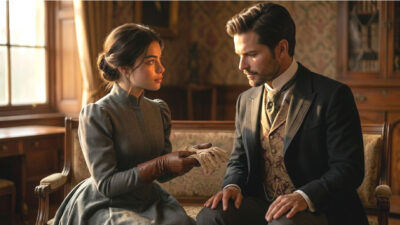
Clara Whitcombe had learned that disgrace was never loud in a village like theirs.
It did not usually shout. It nodded. It paused. It lowered its voice just enough for a woman to hear her own name, and then pretended innocence when she turned. It arrived folded inside civility, pinned beneath kindness, dressed in phrases like concern and propriety and what must be done.
That morning it came by hand, in cream paper, with the Ashbourne seal pressed into dark red wax.
Clara stood at the narrow table beside her kitchen window, staring at the folded notice while the kettle muttered over the fire. Beyond the small panes, Ashbourne Lake lay gray and still beneath a pale spring sky. Reeds bent at the shore in the same wind that had touched this cottage every season of her memory. The fishing lodge sat farther up the bank, partially hidden by alder and willow, its roofline familiar even at a distance. For five years she had avoided looking at it longer than necessary. That morning, the old habit failed her. Her eyes lingered there until the wax seal beneath her thumb seemed to burn.
Samuel was on the floor with his wooden boats, humming to himself, unaware that an envelope could alter the course of a child’s life.
“Will we go to the water today?” he asked.
Clara looked down. He was kneeling barefoot on the worn rug, his brown hair curling against his neck, his narrow shoulders bent in concentration as he floated a carved toy across the painted grain of the floorboard. There were mornings when she could almost believe he belonged only to her, that the shape of his brows and the stillness in his gaze were accidents of Providence and not a daily reminder of a promise broken beside the lake.
“If the wind softens,” she said gently.
He smiled without looking up. “Then I shall catch the biggest trout in Ashbourne.”
The words tightened something low in her chest. Nathaniel had once said nearly the same thing, laughing as he crouched at the dock in shirtsleeves, his boots muddy, his hair stirred by the same restless breeze. That had been before duty, before silence, before a sealed reply informed her that she had mistaken a gentleman’s tenderness for anything resembling devotion.
Clara forced herself back to the paper in her hand and broke the seal.
The notice was brief. Legal language always was, in her experience. That was part of its cruelty. It did not waste feeling when it could accomplish ruin with three polished sentences.
By order of the Ashbourne estate, the cottage by the eastern shore was to be vacated within ten days. Improvements to the lakeside property and preparations for the return of His Grace, the Duke of Ashbourne, required the premises to be surrendered. Any personal claim upon the dwelling was unsupported by deed and therefore void.
Ten days.
She read it twice more, as if numbers altered themselves out of pity.
The cottage had never truly been hers. It had belonged first to her father, who kept the fishing lodge in his good years and mended boats in his bad ones, and after his death the estate had allowed her to remain—quietly, provisionally, so long as she made no trouble, paid what she could, and accepted the sort of dependence respectable people pretended not to notice. A woman alone could survive on sufferance if she kept her head bowed low enough. A woman with an illegitimate child had even less ground beneath her feet.
That was the true constraint of her life, more binding than poverty and more exhausting than labor: she could not ask openly for justice without being made vulgar by the asking.
If she named Samuel’s father, she would be accused of scheming.
If she produced the sealed reply she had kept all these years, she would be told no lady preserved such letters unless she meant to use them.
If she demanded recognition, people would not see a wronged woman. They would see an ambitious one.
So she had done what dignity allowed. She had raised her son, kept her household, worked with her hands, and let the village think her foolish rather than mercenary. Better a quiet wound than a public tearing open.
The kettle began to rattle in earnest. Clara set the notice face down and lifted it from the hob. Her fingers moved from habit, not calm. She poured the water over tea leaves gone weak from a third steeping and added a little milk for Samuel. He came to the table at once, all earnest appetite and solemn eyes.
“May I take the boats after breakfast?” he asked.
“You may take one,” she said, and set the cup before him. “Not both. Last time one drifted to the reeds and I had to fetch it in my best skirt.”
He grinned. “Then I shall take the brave one.”
“The brave one?”
“The one with the blue stripe.”
Clara smiled in spite of herself. “Very well.”
Her gaze lifted to the mantel.
There, resting beside the small clock that no longer kept perfect time, lay the object she had never been able to throw away: a silver trout fly pinned to a square of faded blue wool. Nathaniel had tied it himself one long-ago afternoon, impatient with the artifices sold in London and determined to show off the skill he claimed all proper fishermen possessed. He had laughed when the silk thread tangled, then started over and fashioned the little lure with unexpected care, using blue fiber from the ribbon at his cuff for its tail. When he finished, he had placed it in her palm and said, Keep it, Clara. So you may remember that I mean to return.
It was a foolish thing to keep. A hook, thread, silver gleam. Too little to be a token, too intimate to be harmless. Yet it had become something else over the years. Not proof. Not hope. Only a private witness to the fact that once, beside this lake, she had not imagined being cherished.
Samuel followed her eyes. “May I see it?”
“Not today.”
He pouted faintly. “You always say that.”
“Because it is delicate.” She softened her tone. “And because some things are not for handling every day.”
He accepted this with the solemnity he gave to most pronouncements, though his gaze remained curious. Clara often wondered what he guessed, and what mercy childhood granted him by leaving unguessed.
By noon the village knew.
Mrs. Fenwick at the grocer’s looked too warmly sympathetic. Mr. Bell, who sold lamp oil and gossip with equal steadiness, asked if Clara would be remaining in the district “once the estate had made its arrangements.” At the baker’s, two ladies in travel cloaks paused their conversation when Samuel wandered toward a tray of buns, then resumed in voices that were meant to sound discreet.
“A pity,” one murmured.
“It was never a permanent solution,” said the other. “The Duke cannot be expected to indulge old irregularities forever.”
Clara kept her back straight as she counted coins onto the counter. Bread, flour, a bit of cheese. The ordinary purchases of a woman whose life was expected to continue even while being quietly uprooted. Samuel tugged at her sleeve to point out a sugared bun shaped like a rabbit. She bought it for him though she should not have.
Outside, the wind off the lake had sharpened. Samuel skipped a little ahead with his bun in hand, and Clara walked more slowly, the basket heavy on her arm. The path home curved past the water, and from there the fishing lodge could be seen clearly between the trees.
Smoke rose from its chimney.
She stopped without meaning to.
The lodge had stood dark for years except when servants came to clean it before the season. Now there were horses at the side, trunks by the steps, a servant in Ashbourne livery crossing the yard with purpose. The return mentioned in the notice was not some distant prospect. It had already happened.
Nathaniel was there.
Her breath thinned.
Five years collapsed with brutal ease. She remembered his hand braced on the dock rail. The warmth in his face when he looked at her. The gravity in his voice when he spoke of return, as if promise itself had weight enough to anchor a life. Then the answer that had come instead—cold, clipped, impossible to mistake.
You must not write again.
She had read those words until the paper blurred.
Samuel came running back. “Mama, look—the brave boat!”
He held up the toy with the blue stripe, and she realized he had tucked it into his coat pocket when she wasn’t looking.
“Not by the deep water,” she said, more sharply than intended.
He flinched. Clara knelt at once, setting the basket down on the damp path.
“I am sorry,” she said. “You may carry it. Only stay near me.”
He nodded, chastened but trusting. Children forgave so quickly. That, too, could break a heart.
At the cottage she lit the fire afresh, put away the food, and tried to occupy her hands. She mended one of Samuel’s shirts. She swept the back step. She counted the coins in the blue china bowl and knew, with sinking certainty, that ten days would not be enough to secure another place. Respectable cottages were not offered easily to women in her position, and never cheaply. She might ask in the village. She might write to her mother’s cousin in York. She might do a dozen humiliating things and still fail.
By late afternoon the wind had calmed, just as she had promised Samuel it might. He begged to go to the shore with his boat, and because she could not bear the cottage walls another hour, she wrapped him in his coat and took him down to the lake.
The water lapped softly over the stones. Samuel crouched at the edge, launching the little boat in a pool between reeds, wholly absorbed. Clara stood a few paces back, her shawl pulled close, watching him and not watching the lodge beyond.
The sky was deepening toward evening when she heard footsteps on the path behind her.
Not hurried. Not hesitant. Male. Certain.
Every part of her went still.
Samuel, intent on his toy, did not look up. Clara did. For one suspended instant the world seemed stripped of all the years that ought to have stood between this shore and that summer. Nathaniel, Duke of Ashbourne, was only a few yards away.
He was broader than before, his face leaner, the easy youth of him replaced by something sterner. His coat was dark and finely cut, his boots polished despite the damp ground, his gloves in one hand. But none of that mattered so much as the expression with which he looked at Samuel.
Not politeness.
Not passing curiosity.
Recognition had no right to be so immediate, and yet there it was—raw, disbelieving, almost wounded.
Samuel turned then, sensing the shadow of another presence, and rose with the small boat in his hand.
Nathaniel’s gaze moved from the child’s face to Clara’s and back again. When he spoke, his voice was low, controlled, and nothing like the boy she had once known.
“Tell me his name.”
Nathaniel had imagined many punishments for returning to Ashbourne Lake.
He had expected memory. That alone would have been severe enough. He had expected the old shame of having once been young, foolish, and certain that a promise made beside water could withstand bloodlines, solicitors, dowagers, and the slow violence of family expectation. He had expected to see the lodge and feel the echo of his former self waiting there, accusing him.
He had not expected to see his own face looking back at him from a child.
The boy stood between the reeds and Clara Whitcombe, one small hand curled around a wooden boat with a blue stripe along its side. His eyes were gray, not the soft blue of Clara’s, but Ashbourne gray—his father’s gray, his grandfather’s gray, the particular shade that had looked out from portraits in the long gallery for two hundred years. Nathaniel saw it in one sharp, impossible instant, and something inside him recoiled from the force of recognition.
Not proof. Not yet. He had been trained by bitter years to distrust first impressions, especially those that struck the heart before the mind could inspect them. But blood had its own insolence. It announced itself without waiting for permission.
“Tell me his name,” he said.
Clara’s face had gone very still. She did not lower her eyes. That, too, struck him. He remembered a girl who had laughed easily and blushed when praised. The woman before him did neither.
“Samuel.”
The boy looked from one adult to the other, sensing tension without understanding it.
“And his father?” Nathaniel asked.
A faint tremor passed through Clara’s mouth, so slight that only a man watching too closely would have seen it.
“A gentleman who once gave his word beside this lake.”
The words found their mark. Nathaniel felt them as cleanly as if she had placed a blade beneath his ribs. The water moved behind her, gray and patient. The same water. The same shore. He remembered taking her hand near the dock. He remembered saying things with the wild confidence of a man not yet made answerable to a title.
“You should have written to me.”
“I did.” Her voice did not rise. That made it worse. “You sent me your seal, your money, and your silence.”
Nathaniel’s fingers closed around his gloves.
For a moment, he could hear nothing but the reeds. Then Samuel’s little boat slipped from his hand. The child reached for it, but the toy bobbed beyond the stones, caught by a narrow current toward the deeper water.
“Samuel, no,” Clara said sharply, moving at once.
Nathaniel was nearer.
He stepped into the shallows without thinking, polished boots sinking into mud and cold water rising over the leather. He bent, caught the small boat before it tipped, and returned to shore with it dripping between his fingers. The boy stared at him as if a duke stepping into lake water were a wonder beyond explanation.
Nathaniel knelt, bringing himself closer to the child’s height. “A captain should not lose his vessel on a first voyage.”
Samuel accepted the boat with both hands. “It is the brave one.”
“So I see.” Nathaniel glanced at the blue stripe. “A brave vessel deserves a steadier launch next time.”
The child considered him solemnly. “Do you fish?”
“I have been known to pretend.”
Samuel’s mouth curved, cautious but pleased.
Clara placed a hand on her son’s shoulder. Not possessively. Protectively. Nathaniel noticed the distinction at once. There was no performance in her posture, no reaching for advantage, no attempt to soften him with the child’s face. If anything, she seemed determined to put herself between them and hide the very evidence that had already undone him.
That accuracy disturbed him more than pleading would have.
For five years, he had carried a version of Clara made from words supplied by others. She had taken money. She had left by choice. She had found his promise amusing once the shine of it faded. The story had been useful in its cruelty. It allowed him to despise the part of himself that had loved her, and then bury it.
But the woman standing before him wore poverty without theatrics, shame without surrender, and anger without vulgarity. Her shawl was thin. The hem of her dress had been mended by careful hands. Samuel’s coat, though worn, was clean and brushed. The child looked cherished, not neglected. Clara looked tired, not defeated.
These were facts. Nathaniel trusted facts.
“Who brought you the notice?” he asked.
Something in her expression changed. Not relief. Alarm.
“So you know of it.”
“I know an order was prepared for cottages along the eastern shore.”
“Prepared,” she repeated quietly. “What a merciful word.”
His jaw tightened. “I did not ask that it be delivered today.”
“But it was delivered.” She lifted her chin. “With your seal.”
My seal. The phrase struck harder than accusation. He had learned, after his father’s death, that a ducal seal could travel farther than a man’s conscience. Contracts appeared bearing his authority before he had read them. Letters were answered in his name. Decisions were arranged, softened, corrected by those who insisted they protected him from unpleasantness.
His mother had called it guidance.
His solicitor called it efficiency.
Nathaniel had once called it duty because the alternative was admitting how little of his life had belonged to him.
“I will look into it,” he said.
Clara’s eyes chilled. “Please do not trouble yourself, Your Grace. I have had enough of Ashbourne kindness delivered through papers.”
The title in her mouth was a door closing.
He stood slowly, water darkening the lower half of his boots. “Mrs. Whitcombe—”
“Miss Whitcombe.”
The correction was quiet. Samuel looked up at her, then back at Nathaniel.
Nathaniel inclined his head. “Miss Whitcombe.”
He ought to have said more. A question. A demand. An apology, perhaps, though he did not yet understand for what offense he was guilty and for what offense he had merely been made a weapon. But apology without knowledge felt cheap, and demand felt monstrous.
So he did the only small thing available to him.
He removed his dry glove from his left hand and offered it, not to Clara, but to Samuel. “For your boat,” he said. “The paint is still wet from the lake. Your mother’s pocket is too clean for it.”
Samuel looked to Clara for permission.
That look nearly broke Nathaniel’s composure. The child did not reach for what was offered until she allowed it. Not spoiled, not trained to beg. Protected.
Clara hesitated. Nathaniel could see refusal forming, born not of pride alone but of experience. Gifts had hooks. Kindness came with claims. She had learned that somewhere, and the knowledge sat between them like a third presence.
At last she gave the smallest nod.
Samuel placed the wet boat carefully into the glove, delighted by its new dignity. “Thank you, sir.”
Nathaniel’s throat felt rough. “You are welcome.”
Clara’s hand tightened on Samuel’s shoulder. “Come. The air is turning cold.”
She did not wait to be dismissed. She guided the boy past him toward the cottage path, her skirts brushing the wet grass, her spine straight as a drawn line.
Nathaniel watched them go until the alders swallowed the pale shape of her shawl.
Only then did he look back toward the lodge.
From the upper rise, his mother’s carriage stood before the steps.
The Dowager Duchess had arrived earlier than expected.
And for the first time in five years, Nathaniel felt the old machinery of his house moving around him with a sound he recognized.
Not duty.
Concealment.
Clara did not speak until the cottage door was closed behind them.
Even then, speech seemed too dangerous. She took the wooden boat from Samuel, still wrapped in the Duke’s glove, and set both on the table as if they might soil the air. Samuel, however, could not be expected to understand that certain objects were not merely objects. To him, a gentleman had rescued his boat, spoken kindly, and given it a handsome black leather harbor.
“He stepped into the lake,” Samuel said, his eyes bright.
“Yes.”
“With his fine boots.”
“Yes.”
“Was he angry?”
Clara untied his coat with careful fingers. “I do not know.”
“He looked sad.”
Her hands stilled.
Children saw too much when no one thought to guard their eyes. “Perhaps the wind made them water.”
Samuel accepted this possibility with partial satisfaction. “Do we know him?”
The question had been waiting for five years.
Clara turned away to hang his coat on the peg. “He owns the fishing lodge.”
“That does not mean we know him.”
“No,” she said. “It does not.”
Samuel went to the hearth, crouching to warm his hands, and Clara remained by the door a moment longer. Her body had begun to tremble now that the need for steadiness had passed. She pressed her palm against the wood and drew one breath, then another.
Nathaniel had not known.
She hated herself for thinking it.
One look of shock did not absolve a man. One wet boot did not mend five winters. One glove offered to a child did not explain a sealed letter, a purse of money, and the silence that followed. Yet the expression on his face when he saw Samuel had not been the expression of a man caught in a lie.
It had been the expression of a man struck by one.
No. She would not build hope out of uncertainty. Hope was how women in her position became foolish twice.
She crossed to the mantel and lifted the silver trout fly from its square of faded blue wool. The little lure lay light in her palm, delicate and absurd, its thread dimmed by age but not undone. How many times had she nearly cast it into the lake? How many times had she stopped because doing so felt less like casting away him than casting away the one part of herself that had once been innocent?
Samuel came beside her. “May I see it now?”
Clara should have said no.
Instead, perhaps because the day had already torn through every rule she lived by, she lowered her hand.
“Carefully.”
Samuel peered at the silver curve. “Is it for fishing?”
“It was meant to be.”
“Who made it?”
A simple question. A child’s question. The room seemed to wait for her answer.
“Someone who believed he would come back,” she said.
Samuel touched the faded blue thread with one small finger. “Did he?”
Clara closed her hand gently around the lure.
“Not when it mattered.”
A knock sounded at the door.
She turned so quickly that Samuel stepped back. For one wild instant she thought it was Nathaniel. But when she opened the door, no duke stood there. Only a young footman from the lodge, cap in hand, cheeks reddened by the wind. He held a folded note.
“From His Grace,” he said.
Clara did not take it.
The footman shifted, embarrassed. “He said there was to be no answer required.”
That did not make it safer.
At last she accepted the paper and waited until the boy had gone before breaking it open. There was no seal this time. No wax. No crest. Only a few lines in a firm hand she recognized despite herself.
Miss Whitcombe,
No person from this estate is to disturb you or your son while I examine the order concerning your cottage. I ask no trust from you. I only ask that you allow me time to discover whose words have traveled under my name.
The glove may remain with Samuel until his vessel is dry.
Ashbourne.
Clara read it once. Then again.
I ask no trust from you.
That, more than anything, unsettled her.
A proud man would have demanded belief. A guilty one might have offered money. Nathaniel had offered neither. He had named exactly what she could not give and, for the first time since the lake had taken her girlhood and returned it as rumor, he had not punished her for withholding it.
Samuel tugged at her skirt. “What does it say?”
Clara folded the note slowly. Across the room, the Duke’s glove lay open on the table, cradling the little blue-striped boat as if it were something worthy of care.
“It says,” she answered, keeping her voice even, “that we may stay a little longer.”
Samuel smiled.
Clara did not. Not yet.
But she crossed to the mantel, set Nathaniel’s note beneath the silver trout fly, and stood there with her hand resting over both, feeling the first dangerous shift in a grief she had thought long settled.
Not forgiveness.
Not trust.
Only the knowledge that the story she had survived might not be the whole truth.
Clara slept badly that night, and by morning the lake seemed to know it.
A low mist clung to the water, turning the far bank into a blurred line of gray and green. The fishing lodge was nearly hidden, though she could see the faint square of one upper window through the trees. Somewhere beyond that mist, Nathaniel was reading letters, questioning servants, perhaps discovering nothing at all. Men like him had entire households arranged to keep truth from troubling them. Clara had lived long enough under the Ashbourne shadow to know that paper could be made to say almost anything, and servants could be paid not to remember.
Yet his note remained beneath the silver trout fly on the mantel.
She had placed it there the evening before in a moment of weakness she regretted by daylight. It was not proper to keep his words near the old token. It made them speak to each other. The fly, with its faded blue thread, belonged to the girl who had believed a promise. The note belonged to the woman who had learned not to. Together they formed a dangerous little altar to uncertainty.
Samuel noticed it at breakfast.
“Is that the Duke’s letter?”
“Yes.”
“Will he come again?”
Clara cut his bread into smaller pieces than necessary. “I do not know.”
“May I show him the brave boat when it is dry?”
“It would be better not to expect anything from him.”
Samuel looked at her with the solemn disappointment of a child who had not yet learned the mercy of low expectations. “But he was kind.”
Kind. Such a small word, and such a perilous one.
Clara set down the knife. “A man may be kind in one moment and absent in the next.”
Samuel considered this, his brow knitting in a way that was so painfully Nathaniel’s that she had to look away.
By noon, the estate sent another messenger.
This time it was not a footman with a note. It was Mr. Havelock, the Ashbourne solicitor, riding in a closed carriage though the distance from the hall was scarcely two miles. He arrived with a clerk, a leather portfolio, and the composure of a man who had never been made cold by another person’s decision.
Clara met him at the cottage door.
“Miss Whitcombe,” he said, removing his hat with exact politeness. “I regret the intrusion.”
People who began with regret rarely intended to stop.
“My son is inside,” Clara said. “Whatever business you have may be said here.”
His eyes flicked once toward the kitchen window, where Samuel’s shadow moved behind the curtain. “As you wish. I am instructed to clarify the estate’s position regarding this dwelling.”
“His Grace wrote that no person from the estate was to disturb us while he examined the order.”
Mr. Havelock’s expression did not change, but something sharpened behind it. “His Grace is newly returned and has many demands upon his attention. The larger arrangements of the family cannot be delayed by a misunderstanding concerning a cottage.”
“A misunderstanding.”
“The property is required before the week’s end. The Dowager Duchess expects the eastern shore cleared before Lady Beatrice Vale and her family arrive for the engagement dinner.”
The words struck with an odd, hollow sound.
Engagement dinner.
Clara had thought herself long finished with jealousy. One could not be jealous of a life one had never been permitted to enter. Still, for a moment, she saw Nathaniel as he had been beside the lake, sleeves rolled, hair loosened by wind, saying her name as though it mattered. Then she saw him in the estate hall beside some suitable lady with a name polished by generations, while Clara and Samuel were erased from the shore before the guests arrived.
The pain was not jealousy. It was replacement made respectable.
“I have ten days according to the notice.”
“The notice was generous,” Mr. Havelock replied. “Circumstances have altered.”
“No,” Clara said quietly. “Circumstances have been concealed. That is not the same thing.”
His brows lifted.
A carriage sounded on the road behind him, wheels grinding over damp gravel. Clara turned, expecting perhaps another clerk, another servant, another piece of Ashbourne machinery sent to press her into silence.
Instead, the Duke himself stepped down from the carriage before it had fully stilled.
Nathaniel crossed the yard without looking at Mr. Havelock first. His gaze went directly to Clara. There was mud on the hem of his coat, as if he had come in haste over poor roads, and his expression held the contained severity of a man who had begun to understand he had been disobeyed.
“I gave instructions,” he said.
Mr. Havelock bowed. “Your Grace, I understood your note to concern informal disturbance, not lawful clarification.”
“Then you understood poorly.”
The solicitor colored.
Clara felt no triumph. A defense offered before a cottage door could be withdrawn before a drawing-room fire. She had seen powerful men perform decency when it cost them little. The true measure came when decency threatened comfort.
Nathaniel turned to her. “Miss Whitcombe, will you allow me to speak with you at the hall this afternoon?”
Her first instinct was refusal. The hall was his ground. His portraits, his servants, his mother’s carpets, his world. At the cottage, she could stand with the lake behind her and her son within reach. At Ashbourne Hall, she would be a tolerated impropriety beneath chandeliers.
“Why?”
“Because there are papers I have found and papers I have not,” he said. “And because the matter concerns more than the cottage.”
She looked at Mr. Havelock, whose mouth had tightened.
“Does it concern my son?”
Nathaniel’s face changed. Not openly. Not enough for others to read. But she saw the breath he did not take.
“Yes.”
The near softness in that single word nearly undid her.
He seemed to want to say more. His hand lifted a fraction, then closed at his side. “Clara—”
Her name in his voice broke across five years.
Mr. Havelock looked between them.
Nathaniel stopped himself at once. Whatever had risen in him was pulled back beneath the discipline of rank. “Miss Whitcombe,” he corrected, too late.
Clara hated that the correction hurt.
“I will come,” she said, “but not alone. My son remains where I can see him.”
Nathaniel inclined his head. “Of course.”
Of course. As if men had not spent years deciding otherwise for her.
That afternoon, Clara dressed with the care of a woman entering judgment. Her gown was plain brown wool, brushed clean until the seams protested. She pinned her hair simply and tied her bonnet with steady hands. Before leaving, she took the silver trout fly from the mantel and wrapped it in a scrap of linen.
She did not know why she brought it.
Not to plead. She told herself that twice. Not to prove tenderness to people who would only twist tenderness into strategy. But if papers were to speak, if seals and notices and ledgers were to decide the shape of Samuel’s life, then she would carry one small truth made by Nathaniel’s own hand. Not as a weapon. As witness.
Samuel wore his best coat. The Duke’s glove was folded around the blue-striped boat in his pocket, because he insisted it was safest there. Clara nearly made him leave it behind, then could not. The glove had become, absurdly, Samuel’s first treasure from a man who might be his father.
Ashbourne Hall received them with polished silence.
The entrance was too grand, the floors too shining, the servants too careful not to stare. Clara felt every inch of the social distance that had always existed between the cottage and the house, made visible now in marble and carved oak. Samuel’s hand found hers at once.
They were shown not to a private study, as she had expected, but to the estate hall.
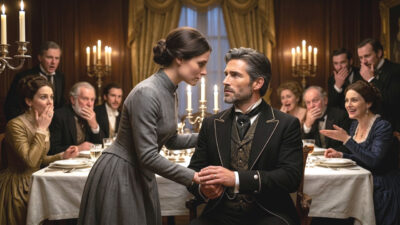
There were people inside.
The Dowager Duchess stood near the fireplace in black silk, tall and narrow and pale with displeasure. Beside her sat Lady Beatrice Vale, beautiful in a blue walking dress, her posture graceful, her expression arranged into sympathetic curiosity. Mr. Havelock stood near a long table spread with documents. Two older ladies Clara did not know occupied chairs by the window. Witnesses, then. Not by accident.
Nathaniel stood at the far end of the table.
When Clara entered, his expression hardened—not against her, she thought, but against the room.
“Mother,” he said, “this is not what I requested.”
The Dowager’s eyes rested on Clara as one might inspect a stain found on linen. “No, Nathaniel. It is what propriety requires. Private confusion becomes public injury when a woman brings a child forward on the eve of an engagement.”
Clara’s hand tightened around Samuel’s.
“I brought no one forward,” she said. “I was ordered from my home.”
Lady Beatrice lowered her eyes, either in discomfort or performance. Clara could not tell.
The Dowager smiled without warmth. “Your home?”
Nathaniel moved slightly. “Enough.”
But Mr. Havelock had opened his portfolio.
“Your Grace,” he said, “before accusations are made against the late Duke’s household, it may be useful to examine what is already documented.”
Clara felt the room tilt, though nothing had moved.
The solicitor drew out a folded paper. “Five years ago, Miss Whitcombe accepted a settlement from the Ashbourne estate and agreed to cease all correspondence with His Grace, then Marquess of Everleigh. The sum was fifty pounds.”
“That is false,” Clara said.
Her voice sounded too small in the hall.
Mr. Havelock placed the paper on the table. “There is a receipt.”
Nathaniel reached for it.
The Dowager did not stop him. That frightened Clara more than if she had. A person only allowed a paper to be examined if she believed its lie was well prepared.
Nathaniel read in silence.
Samuel pressed against Clara’s skirt. “Mama?”
She knelt, ignoring every eye in the room. “Stay beside me. Say nothing unless I ask you.”
His lip trembled, but he nodded.
She rose again as Nathaniel looked up.
There was conflict in his face now, and beneath it something worse: fear. Not fear of scandal. Fear that truth had been buried so deeply he might not know how to reach it.
“I never received fifty pounds,” Clara said. “I received a letter bearing your seal and enough money to make the insult unmistakable. I sent the purse back the same day.”
“To whom?” Mr. Havelock asked.
“To the lodge.”
“Convenient,” said the Dowager. “No doubt without receipt.”
Clara reached into her reticule. Her fingers found the linen-wrapped trout fly, not the letter. For one foolish instant she held it hidden in her palm, feeling the curve of the silver hook through cloth.
A promise beside the lake.
A child beside her.
A room waiting to decide whether she was liar or mother.
Nathaniel’s gaze dropped to her hand. Something in his expression altered, as if he recognized the shape before seeing it.
“Clara,” he said, and this time he did not correct himself.
The room heard. The Dowager’s mouth tightened.
He took one step toward her. “Had I known—”
“Do not,” she said, the words escaping before pride could soften them.
He stopped.
Her voice trembled, but she would not let it break. “Do not give me half a sentence in a room full of people who have already decided what I am.”
For one breath, no one spoke.
Then the doors opened behind them.
A footman entered, pale and flustered. “Your Grace, forgive me. The Vale carriage has arrived with Lord Vale. They ask whether the engagement papers are to be signed before dinner.”
The Dowager turned at once to Nathaniel. “Yes,” she said. “They are.”
Nathaniel did not look at her. He was looking at the linen bundle in Clara’s hand, at Samuel’s frightened face, at the receipt on the table bearing a lie that might yet carry the strength of law.
Mr. Havelock dipped his pen in ink and set it beside the engagement contract.
The Dowager’s voice was calm, mercilessly calm.
“Choose, Nathaniel. Sign for your house, or ruin it for a woman who claims too much and proves too little.”
Clara stood with the silver trout fly hidden in her fist, Samuel pressed to her side, and watched Nathaniel reach toward the table.
Clara saw Nathaniel’s hand move toward the table, and for one brief, terrible second she believed the past was about to repeat itself in a grander room.
Five years ago, he had vanished behind a seal.
Now he stood before a contract.
The difference was only furniture.
The estate hall held its breath around him. The Dowager Duchess watched with the calm of a woman who had placed every piece exactly where she wished it. Mr. Havelock’s pen lay ready, black ink shining wetly at the nib. Lady Beatrice Vale sat very still, her gloved hands folded in her lap, lovely and pale beneath the painted gaze of Ashbourne ancestors. Samuel’s fingers had curled into Clara’s skirt so tightly that she could feel each small knuckle through the wool.
Choose, Nathaniel. Sign for your house, or ruin it.
The words had been aimed at him, but they struck Clara too. For if he did not sign, the room would say she had ruined him. If he did, it would say she had been properly dismissed. Either way, the story had already found its villain, and it wore her face.
Nathaniel’s fingertips touched the edge of the engagement contract.
Something inside Clara went very quiet.
Not numb. Not broken. Quiet in the way the lake became quiet before winter took it, all motion hidden beneath a hardening surface.
She looked down at Samuel. His face was turned up toward the Duke, confusion and fear mingled with the last innocent remnant of admiration. He still had Nathaniel’s glove in his pocket. He still believed kindness meant something simple.
Clara could not allow that belief to be crushed in this room.
She loosened his hand from her skirt and knelt before him, ignoring the rustle that passed among the ladies by the window.
“Samuel,” she said softly, “you must listen carefully.”
His mouth trembled. “Are we in trouble?”
“No.” The lie cost her, but she made it gently. “We are going to be brave in a difficult place.”
“The brave boat is in my pocket.”
“I know.” She touched his cheek. “Keep it there.”
Then she stood.
Nathaniel’s hand had paused on the paper. His eyes were fixed on her now. The room might as well have emptied. For one trembling instant, she saw not the Duke of Ashbourne, not the man whose seal had sentenced her, but Nathaniel by the lake—young, earnest, making a promise he had perhaps meant when he made it.
That was what hurt most. Not the possibility that he had lied. The possibility that he had not.
Clara drew the linen bundle from her reticule and placed it on the table.
The Dowager’s gaze sharpened.
“What is that?” she asked.
“Not a claim,” Clara said.
Her voice carried better than she expected. Perhaps grief, when pressed far enough, learned to stand upright.
She unfolded the linen. The silver trout fly lay exposed against the cloth, its small hook dulled by years, the faded blue thread still bound to its tail. Nathaniel’s face changed at once.
He knew it.
Of course he knew it. His own hands had made it. His own cuff ribbon had supplied the blue.
Clara heard his breath leave him.
“You kept it,” he said.
The words were not meant for the room. That made them more dangerous.
The Dowager stepped forward. “A fishing trinket proves nothing.”
“No,” Clara agreed. “It proves only that I remember something Your Grace’s house would prefer forgotten.”
Nathaniel did not look at his mother. He looked at Clara as though the small object had torn a door open in him.
She reached again into her reticule. This time her fingers found the old letter.
For five years, she had kept it wrapped in oilcloth beneath the loose board by her bed. She had told herself it was practical to preserve it. Proof, should Samuel one day ask why his mother had not demanded more. But the truth was harder. She had kept it because throwing it away would mean admitting there had been no mistake, no hidden explanation, no lost road by which justice might eventually find them.
Now justice stood across a table from her and looked as though it might still fail.
She placed the letter beside the trout fly.
Mr. Havelock leaned forward.
The Dowager did not move at all.
“This,” Clara said, “is the reply I received after I wrote to tell Lord Everleigh that I was carrying his child.”
A sound crossed the room. Lady Beatrice’s gloved hand rose to her throat.
Nathaniel did not reach for the paper. “You wrote that?”
“I wrote twice.” Clara kept her gaze on him, though every word cut its own path out of her. “The first letter told you my father had died and that I had nowhere honorable to go. The second told you about the child.”
His face had gone gray.
“I never received them.”
“I know that now,” she said.
The admission shocked her with its own truth. She had not known it that morning. She had not known it even when he stepped into the lake for Samuel’s boat. But she knew it now. No guilty man looked at a letter as Nathaniel was looking at that one. No man who had knowingly abandoned his child would seem so ravaged by the existence of paper.
The Dowager’s voice cut through the room. “A convenient discovery, made precisely when my son is expected to secure his future.”
Clara turned to her.
For five years, she had feared that woman without ever standing fully in her presence. The Dowager had been an idea—a cold hand behind events, a name spoken carefully by servants, a portrait of authority Samuel had somehow lived beneath without knowing it. Now Clara saw her clearly. Not as a monster. That would have been easier. As a mother who believed love was disorder, and disorder must be removed no matter whose heart it took with it.
“I did not come to secure his future,” Clara said. “I came because your solicitor summoned me into a room where my son could hear his mother called a liar.”
“You brought the child.”
“Because every choice left to me has been made dangerous.”
Nathaniel flinched.
Good, Clara thought, and then felt ashamed of the thought. She did not want to wound him. That was not why she had come. If pain were enough to make a thing right, she would have been powerful years ago.
Mr. Havelock cleared his throat. “Miss Whitcombe, if that letter is genuine, it must be examined. Until then—”
“Until then,” the Dowager said, “my son will not be manipulated by tears, tokens, or a child’s unfortunate resemblance.”
Samuel made a small sound.
Clara moved before she thought. She put herself between him and the room, one arm behind her to draw him close.
Then she did the only thing left that belonged entirely to her.
She picked up the letter and held it out—not to Nathaniel, but to Lady Beatrice.
A stir of surprise passed through the hall.
Lady Beatrice looked startled. “To me?”
“Yes.”
“Clara,” Nathaniel said, low and urgent.
She did not look at him.
Lady Beatrice rose slowly, uncertain.
“You are the woman this family wishes him to marry,” Clara said. “You should know what house you are entering. Read it, if you choose. Or keep it sealed, if comfort requires it. But do not let anyone tell you later that you were not warned what can be done in a gentleman’s name.”
Lady Beatrice’s face lost some of its practiced composure. For the first time, Clara saw something living beneath the polish—not malice, not rivalry, but fear. A woman of rank could be bargained with too. Only the cage was finer.
The Dowager’s eyes flashed. “This is insolence.”
“No,” Clara said. “It is the last courtesy I can afford.”
The room went still.
There it was. Her cost.
If Lady Beatrice read the letter and dismissed it, Clara would be finished. If she kept it, Clara surrendered the one proof in her possession. If Nathaniel failed to act, Clara would leave Ashbourne with nothing but the knowledge that she had given another woman a chance she herself had never been granted: the chance to see the truth before binding her life to a lie.
She was not doing it to win him.
She understood that with sudden, fierce clarity. She was doing it because Samuel was watching. Because one day he might ask what she had done when surrounded by power, and she wanted to be able to answer that she had not begged, had not schemed, had not used him as a hook to catch a title.
She had told the truth and stood by it.
Lady Beatrice reached for the letter.
Before her fingers touched it, Nathaniel spoke.
“Stop.”
Not loudly. Not angrily. But with such authority that even the Dowager turned.
He stepped around the table, not toward the contract, not toward his mother, but toward Clara. His gaze rested for a moment on the trout fly, then on Samuel half-hidden behind her, then on the letter in her outstretched hand.
When his eyes lifted to hers, something in him had broken open.
Not resolved. Not healed. Broken open, as earth breaks before a seed can take root.
“They taught me,” he said, and his voice was rough enough that the room seemed indecent for hearing it, “that every tender thing offered to an Ashbourne man would one day come with a price.”
Clara did not answer.
He looked toward his mother then, and the pain in his face changed shape. Became recognition. Became fury held on a leash.
“I believed them,” he said. “Because it was easier than admitting I had let my life be managed by fear.”
The Dowager’s chin lifted. “Nathaniel, you forget yourself.”
“No,” he said. “I begin to remember myself.”
For one impossible moment, hope rose in Clara so sharply it frightened her. She crushed it down at once. Hope had no place here yet. There was still the forged receipt on the table, still the engagement contract, still the cottage notice, still an entire household built to survive truth by smothering it.
Nathaniel held out his hand.
Not for the letter.
For the trout fly.
Clara hesitated.
Then she placed it in his palm.
His fingers closed around the small silver lure as if it weighed more than the seal of Ashbourne.
He turned to Mr. Havelock. “Send for every ledger, letterbook, and household account from the summer of that year. Send for Mrs. Vale’s carriage to wait. No papers will be signed tonight.”
The Dowager’s voice went cold. “You would humiliate Lady Beatrice before her family?”
Clara drew Samuel closer. There would be consequences. Of course there would. A great house did not surrender control because one man finally looked ashamed.
Nathaniel turned back to Clara, and there was a question in his eyes he had no right to ask yet and no certainty with which to answer.
“I cannot mend five years in one evening,” he said.
“No,” Clara replied. “You cannot.”
He flinched, but he did not look away.
She took Samuel’s hand. “Come, my darling.”
Nathaniel stepped as if to follow.
Clara stopped him with one look.
“If you wish to find the truth, Your Grace, find it without asking me to stand here while your house decides whether my pain is convenient.”
The title struck him. She saw it land. She meant it to.
With Samuel beside her, Clara walked out of the estate hall, leaving the engagement contract unsigned, the forged receipt on the table, and Nathaniel standing with the silver trout fly in his hand.
Outside, the evening air was cold enough to sting.
Samuel looked up at her. “Are we leaving the cottage?”
Clara looked toward the dark line of the lake.
“I do not know,” she said.
And for once, it was the whole truth.
By morning, Clara had packed one trunk.
Not because she had decided to leave, and not because she had decided to stay. The trunk stood open on the cottage floor as a confession of uncertainty. Into it she placed Samuel’s winter stockings, her mother’s small Bible, two patched shirts, and the blue china bowl that had held their coins through lean years. She folded slowly, not trusting haste. Haste belonged to panic, and panic had never once served her.
Samuel sat at the table, pushing the brave boat back and forth along the grain of the wood. The Duke’s glove lay beside it, no longer damp, its fine leather absurdly grand against the scrubbed pine.
“Will he bring back the silver fly?” Samuel asked.
Clara’s hands paused over a stack of linen.
“I do not know.”
“He looked as if it hurt to hold it.”
Children spoke truths too cleanly for adult comfort.
Clara closed the trunk lid without fastening it. Through the window, Ashbourne Lake glittered under a clear sky, the mist gone, the water bright and indifferent. The fishing lodge stood visible among the trees. Smoke rose from its chimney. Men had been coming and going since dawn, some on horseback, some in estate livery, one carrying a locked dispatch box. Each sound from the road had tightened Clara’s breath.
She had told Nathaniel to find the truth without asking her to stand in judgment before his house. Now that he was doing exactly that, she discovered waiting could be its own kind of trial.
Near noon, a carriage stopped before the cottage.
Clara did not move at once. Samuel rose, but she set a hand on his shoulder.
“Stay behind me.”
The knock came softly.
When she opened the door, Nathaniel stood on the step.
He wore no hat. His face looked as though he had not slept, but there was a steadiness in him that had not been there before. In his hand he held the silver trout fly wrapped in her linen. Beneath his arm was a leather folio.
He did not step forward.
“Miss Whitcombe,” he said, “I have no right to ask you to return to Ashbourne Hall.”
“No,” Clara answered. “You have not.”
He accepted the blow with a slight bow of his head.
“But I am asking,” he said. “Not for my comfort. For yours, and for Samuel’s. There are people who spoke against you in that room. They must hear the truth in that room.”
Her fingers tightened on the edge of the door. “And if I refuse?”
“Then I will speak it without you,” he said. “But they will not see your face while they learn what was done to it.”
It was not the answer she expected.
He opened the folio and withdrew a folded sheet. “I found the household letterbook from the summer I left Ashbourne. Two pages had been cut out. Havelock admitted the receipt was copied from an account prepared by my mother’s steward, not signed by you. Your letter to me was never entered. But your returned purse was.”
Clara stared at him.
“The money came back?” she whispered.
“Yes.” His voice roughened. “It was recorded as charitable disbursement refused. No name. Only the date.”
The room behind her seemed to recede. For five years she had carried the humiliation of that purse as if its return had vanished into air. To learn it had existed somewhere, inked coldly into an account book, was not comfort. It was proof that the truth had been near all along, hidden not by chance, but by will.
Nathaniel extended the linen bundle.
“I brought this back because it was never mine to keep from you.”
Clara looked at the silver trout fly in his palm.
Once, it had been a promise. Then a wound. Now it had become evidence of something no ledger could manage: that the boy by the lake had known how to give before the Duke had learned how to doubt.
She took it carefully.
Samuel peered around her skirt. Nathaniel looked at him, and pain crossed his face so openly that Clara could not pretend not to see it.
“Samuel,” Nathaniel said, “I owe your mother the first apology. But I owe you truth as well.”
Samuel glanced up at Clara. She nodded once.
“Are you my father?” he asked.
No drawing-room, no court, no solicitor could have made the question more solemn.
Nathaniel went down on one knee on the cottage step, heedless of the dust. “I believe I am,” he said. “And before this day ends, I will say so before every person who tried to make your mother stand alone.”
Samuel was silent a moment. Then he held out the black glove.
“Your boat-carrier,” he said.
Nathaniel closed his hand around it as though receiving a coronet. “Thank you.”
Clara looked away, because tenderness was more dangerous than grief.
At Ashbourne Hall, the estate chamber had been prepared again, but not as before. The engagement contract had been removed from the center of the table. In its place lay the household ledger, the false receipt, Clara’s old letter, and a deed tied with green ribbon.
The Dowager Duchess stood near the fireplace, white with contained fury. Mr. Havelock looked ten years older. Lady Beatrice Vale was present too, but she did not sit beside the Dowager now. She stood near the window, alone, her expression grave. Lord Vale hovered behind her, displeased and uncertain.
Clara entered with Samuel’s hand in hers.
This time, no one could pretend not to look.
Nathaniel walked to the table, but he did not stand behind it like a judge. He stood beside Clara.
The difference was not small.
“My mother accused Miss Whitcombe of ambition,” he said, his voice carrying through the room. “My solicitor presented a false receipt. My house ordered her from her cottage, though it had already taken from her five years of safety, name, and peace.”
“Nathaniel,” the Dowager said sharply.
He looked at her. “You will not interrupt her truth again.”
The room went still.
He lifted Clara’s letter. “This was written to me five years ago and kept from me. The reply she received was forged under my seal.”
Mr. Havelock lowered his eyes.
Nathaniel picked up the false receipt next. “This document claiming Miss Whitcombe accepted settlement money is a lie. The estate ledger shows the purse was returned. She did not sell her silence. She was forced into it.”
Lady Beatrice closed her eyes briefly, as though the words had confirmed something she had feared.
Nathaniel unfolded another paper. Clara recognized the hand at once—not his, but the cold, elegant script of the Dowager.
“My mother instructed that Miss Whitcombe be made to understand her place. She wrote that affection was a disease in young men and must be cut away before it infected the line.”
The Dowager’s face hardened. “I protected you.”
“No,” Nathaniel said. “You protected control.”
Then he did the thing Clara had not expected, though he had promised public truth. He took the forged reply—the letter that had made her kneel beside her bed five years ago with one hand over her unborn child—and held it up.
“This paper spoke in my name,” he said. “It told Miss Whitcombe she was nothing to me. It told her to carry shame that belonged to my house.”
He tore it once.
The sound was small.
He tore it again, and again, until the seal split and fell in pieces onto the table.
Clara’s breath caught. She had thought she wanted to see that letter destroyed. She had not known until that moment how much of her life had remained folded inside it.
Nathaniel turned to Samuel.
“This is Samuel Whitcombe,” he said, and his voice changed on the name, deepening with something steadier than emotion. “My son.”
A gasp came from one of the older ladies near the wall. The Dowager gripped the mantel.
Nathaniel did not look away from Samuel. “If he chooses one day to bear my name, it will be his by right. Until then, no person in this house will speak of him as anything less than honored.”
Samuel stood very straight.
Clara felt his small fingers tighten around hers, not in fear this time, but in wonder.
Lord Vale muttered something about disgrace. Lady Beatrice turned on him before Nathaniel could speak.
“No, Father,” she said quietly. “Disgrace is not in the child.”
Her words, simple and unexpected, loosened something in the room. Not forgiveness. But the collapse of a lie’s last comfortable shelter.
Nathaniel picked up the deed tied with green ribbon.
“The cottage by the eastern shore is no longer held on Ashbourne sufferance,” he said. “It is deeded to Clara Whitcombe in her own name. No steward, solicitor, duchess, or duke may remove her from it.”
Clara could not speak.
He placed the deed before her, then turned toward Lady Beatrice.
“There will be no engagement.”
Lady Beatrice inclined her head. There were tears in her eyes, but no humiliation in her posture. “I understand, Your Grace. And I thank you for saying it before signatures made cowards of us both.”
Nathaniel bowed to her with genuine respect. Then he faced Clara.
The hall, the portraits, the watching servants, his mother’s cold silence—all of it seemed to fall away until only his voice remained.
“You said, ‘I did not come here to take your name. I came here to keep my son from growing ashamed of his own.’”
Clara’s eyes burned.
“I heard you,” he said. “Too late for the years you deserved. But not too late for the years I ask permission to earn.”
He did not reach for her. That mattered. He did not claim her before she chose. He stood before everyone who had misjudged her and left the final dignity in her hands.
Clara looked at the deed, at the torn pieces of the forged letter, at Samuel’s lifted face. Then she opened her palm. The silver trout fly lay there, its blue thread faded but still holding.
She gave it to Samuel.
“It was made beside the lake,” she said softly. “It used to mean a promise someone failed to keep.”
Samuel touched the silver curve. “What does it mean now?”
Clara looked at Nathaniel.
His face held regret, yes. But also patience. A willingness to remain standing in the consequences without demanding reward for finally telling the truth.
“Now,” she said, “it means promises must be kept in daylight.”
Weeks later, the trout fly hung in the cottage window, fastened inside a small frame Nathaniel had made himself from wood taken from the old dock. Not hidden on a mantel. Not wrapped away in linen. When the afternoon sun crossed the lake, the blue thread caught the light.
Nathaniel came every day at first, never presuming entry, never rushing Samuel, never asking Clara for more warmth than she freely gave. He repaired the broken step. He brought books for the boy and left them without ceremony. He sat with Clara by the shore and answered every question she asked, even the painful ones, especially the painful ones.
Love did not return as a storm.
It came as steadiness.
One evening, as Samuel launched the brave boat in the shallows, Nathaniel stood beside Clara where the reeds bent silver in the dusk.
“I loved you badly when I was young,” he said. “I would like to love you honorably now.”
Clara watched their son laugh as the boat rocked safely back toward shore.
Then she placed her hand in Nathaniel’s.
Not because the past had vanished. Not because a title had redeemed it. But because truth had been spoken, shame had been returned to those who made it, and she no longer stood alone beside the lake.
“I am not the girl who waited for you,” she said.
His fingers closed gently around hers. “No.”
She looked at the cottage, at Samuel, at the framed silver fly catching the last light in the window.
“I am the woman who stayed,” Clara said. “And this time, if you walk beside me, you will do so where everyone can see.”