They Laughed When She Took His Hand—But She Saw The Lonely Man Beneath The Duke
In a candlelit dining room, a duke the whole of London feared went pale and silent—and the guests laughed, certain they were watching cold arrogance. Only one woman saw the truth beneath it, and she did the unthinkable: a penniless companion with no name worth mentioning reached out and took his hand. They called her a schemer. They called her shameless. But the Duke of Wrenfield knew exactly what she had seen, and it terrified him more than the laughter ever could. Behind his silence lies a dead wife, a buried secret, and a lie that ruined more than one life. She should have looked away. Now neither of them can.
The wine in Gideon Ashworth’s glass had gone still, but his hand had not.
Marian Hale saw it before anyone else at the table did, because she was the only one not watching the duke’s face. She was watching his hand—the long fingers curled too tightly around the stem, the knuckles gone white, the faint tremor that traveled up from them like the first crack in river ice. Across the table, Mrs. Honoria Calloway was still talking, her voice bright as polished brass, and the word she had just spoken hung in the air where everyone could admire it.
“Cecily,” Mrs. Calloway repeated, as though the name were a sweet she was reluctant to swallow. “Your late duchess. Such a tragedy. One does wonder how a man recovers from a thing like that—if he recovers at all.”
The duke did not answer.
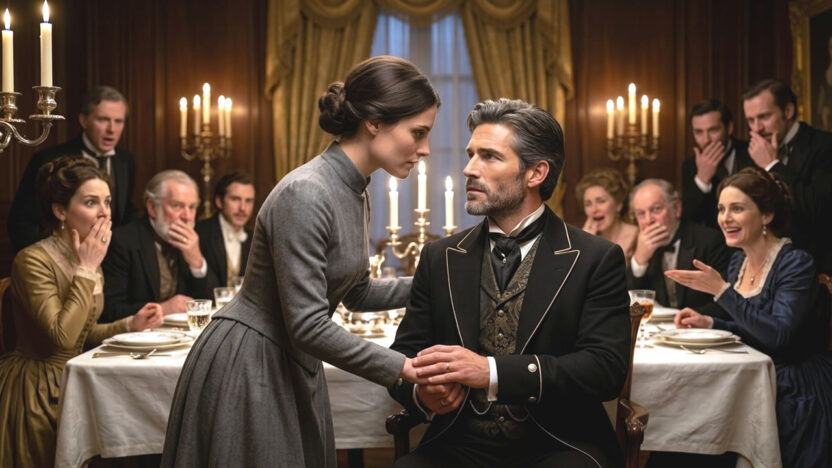
To the fourteen guests arranged along the Calloway table, the silence read as insolence. Marian watched it happen the way one watches a misunderstanding bloom and knows there is no time to stop it. They saw a cold man refusing to grace a grieving question with a reply. They saw the famous Duke of Wrenfield, the man mothers warned their daughters about, looking through Mrs. Calloway as if she were a draft from a badly fitted window. A few of the younger guests exchanged glances. Someone smothered a laugh behind a napkin.
But Marian, standing at the edge of the room where companions were meant to stand—useful, invisible, a step behind the chair of the woman who paid her—saw something else entirely.
She saw a man drowning at his own dinner.
She knew the look. She had spent the last three years of her father’s life learning it by heart: the way the breath went shallow and quick, the way the eyes fixed on a single point as if it were the only solid thing in a tilting world, the way the body sat very straight precisely because it was about to come apart. Her father had called them his spells, and had been ashamed of them, and had begged her never to let anyone see. She had become very good at hiding what was happening to a man while it was happening to him.
The duke’s chest rose and did not seem to fall.
“Your Grace?” Mrs. Calloway said, and there was a needle in her sweetness now, because she had asked twice and been answered with nothing, and a woman who has clawed her way up from the trade does not tolerate being looked through. “Have I said something to distress you?”
She knew she had. That was the cruelty of it. Marian understood in that moment that Mrs. Calloway had spoken the dead duchess’s name the way a child pokes a bruise—to see the flinch. To remind the table that the great Duke of Wrenfield had a wound, and that she, Honoria Calloway, was bold enough to press it.
The candle flames bent in a draft. The footman by the sideboard kept his eyes on the middle distance. Penélope Calloway, the daughter for whom this entire evening had been staged, watched the duke with the patient hunger of a girl who has been told a title is within reach.
And the duke’s hand, beneath the table’s edge where only Marian could see it, opened and closed against the white cloth as though searching for something to hold.
She should have stayed where she was.
A companion did not speak unless spoken to. A companion did not move from her post. A companion who valued the roof over her head and the bread on her plate—and Marian valued both, having lived without either—understood that the entire architecture of her survival rested on her remaining unseen. Mrs. Calloway had made the terms clear the day she hired her: You will be present, Miss Hale, and you will be silent, and you will be grateful. And Marian had been all three for eleven months, because the alternative was a workhouse or worse, and she was one and thirty with no dowry and no family and no other door left open to her in all the world.
She crossed the room anyway.
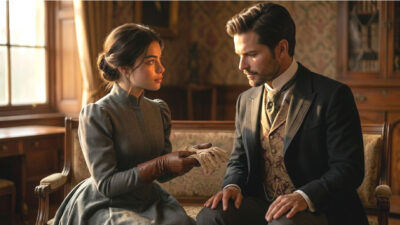
She did not decide to. That was what she would tell herself afterward, in the long hours when she lay awake counting the cost. Her feet simply carried her along the side of the table, past the startled turn of heads, until she stood at the duke’s right hand. And then, because there was no graceful way to do an ungraceful thing, she reached down and closed her fingers over his.
His skin was cold. His hand jerked at the contact—and then went still.
“Breathe out, Your Grace,” she said, very low, pitched for him alone. “Slowly. I have you. There is no hurry at all.”
For one suspended moment nothing in the room moved.
She felt the precise instant it reached him—felt his hand turn under hers and grip back, hard, with the desperate strength of a man who has found the one rail in a falling house. His eyes came up and found her face. They were grey, she saw, grey and wide and entirely undefended, and for that single moment he was not a duke at all. He was simply a frightened man who had been handed, without explanation or condition, something to hold.
Then the laughter began.
It started low, a ripple at the foot of the table, and spread upward as understanding spread with it. The companion. The plain, penniless companion in her made-over grey dress had crossed a duke’s dinner table to seize his hand in front of fourteen witnesses. The sheer audacity of it. The transparent, grasping ambition. They did not see a woman steadying a man through private terror. How could they? They had no idea the terror existed. They saw only a spinster who had forgotten her place and reached above it, and the comedy of that was too rich to resist.
“Miss Hale!”
Mrs. Calloway’s voice cut through the laughter like a blade through silk, and the use of her name—her name, spoken aloud in that company—was itself a kind of stripping. “Miss Hale, you forget yourself entirely. Return to your place at once.”
Marian let go of the duke’s hand.
It was the hardest thing she had done in a long while, because she could feel that he was not yet steady, that the cold was still in his fingers, that he needed another minute and she was being made to take it from him. But she straightened, and she stepped back, and she folded her hands in front of her, and she met Mrs. Calloway’s furious eyes across the candlelight.
“Forgive me, madam,” she said.
“I should think you would beg it,” Mrs. Calloway said. The bright brass was gone from her voice now; what remained was harder and far older, the sound of a woman defending a thing she had spent her life acquiring. “To impose yourself upon His Grace in such a manner. To make a spectacle of this house. One can only assume what you imagined you might gain by it.” She let the sentence sit, so that every guest could finish it privately, each in the most unflattering way available to them. “We will discuss your position in the morning.”
There it was. The roof, the bread, gone in a single sentence dressed as a rebuke.
Marian felt the heat climb her throat and kept her chin level through sheer will, because she had learned long ago that the one thing they could never take from you, if you refused to surrender it, was the angle of your head. She did not explain. She could not. To say he was not being cold, madam, he was in the grip of something he cannot help, and I knew it because I watched my father die of it would be to lay the duke’s weakness bare on the table beside the wine, in front of the very people whose laughter he would have to live among for the rest of his life.
She would not do that to a man, whatever it cost her. Even a man she did not know.
So she said nothing, and let them think the worst, and the worst was apparently very entertaining, because the murmuring carried a thread of cruel delight beneath the surface decorum.
“I believe,” said the Duke of Wrenfield, “that you are mistaken.”
The room stilled.
He had risen. Marian had not seen him do it. He stood now with one hand resting on the table—steady again, she noted, the tremor mastered—and the color had returned to his face, and with it something far more dangerous than color. He looked exactly as London said he looked: remote, exact, and cold enough to frost the silver. But Marian had seen his eyes a moment ago, and she knew the cold for what it was now. It was not the absence of feeling. It was a wall built around too much of it.
“Your Grace?” Mrs. Calloway said, uncertain for the first time that evening.
“You are mistaken in your companion.” His voice was quiet and it carried to every corner of the room. “I felt unwell. Miss Hale, alone among my present company, possessed the wit to notice and the decency to assist, rather than to sit and remark upon a man’s distress as though it were an amusement laid on for the evening.” His gaze moved, unhurried, down the length of the table, and one by one the smiles went out like candles pinched between two fingers. “I find I am tired of being remarked upon. I shall take my leave.”
“But—the dessert course—Penélope has—” Mrs. Calloway was rising too now, the whole evening she had built coming apart in her hands.
“My compliments to your cook.” He was already turning. And then, at the very last, he paused, and looked back—not at Mrs. Calloway, not at the table, but at Marian, standing alone in her grey dress at the edge of the light. “Miss Hale. You will call at Wrenfield House tomorrow at eleven. There is a matter I wish to discuss with you.”
It was not a request. Dukes did not make requests. But it was not, Marian understood with a small cold shock, a rescue either—not entirely. There was something behind those grey eyes that had nothing to do with gratitude. Something closer to wariness. He had felt her see him. He knew precisely how much she had seen.
And men like the Duke of Wrenfield, she was beginning to understand, did not let anyone walk away knowing what she now knew.
She became aware that her right hand was closed into a fist. She opened it, in the privacy of her grey skirts, and found a small weight pressed into her palm—a thing she did not remember catching. A silver button, worn smooth at the edges, torn loose from his cuff in the moment his hand had gripped hers and held on as if his life depended on it.
She closed her fingers over it before anyone could see.
“Yes, Your Grace,” she said.
The door shut behind him, and the room let out its breath, and Mrs. Calloway turned to her with a face like a closing trap—and Marian stood very straight in the wreckage of her own small life, the duke’s button warm in her fist, and understood that whatever came next, the evening had already divided her future cleanly into before and after.
She did not yet know which side of it she would survive on.
Wrenfield House did not look like a place where a man drowned at dinner.
Marian stood at the foot of its steps at one minute to eleven, the silver button sewn now to the inside of her glove where she could feel it against her wrist, and looked up at a façade so composed it seemed to disapprove of her. Soot had darkened the stone the way it darkened all of London, but here someone had clearly waged war against it; the windows were clean enough to throw the grey morning back at her. A telegraph boy passed on his bicycle, bell jangling, and somewhere beyond the rooftops a train let out a long exhausted sigh. She had not slept. Mrs. Calloway had not dismissed her after all—had, in fact, said nothing further at breakfast, which was infinitely worse, because it meant the woman was thinking.
A man does not summon a companion to his house to thank her. Marian had turned that truth over half the night. He had summoned her because she had seen something, and powerful men did not care to be seen.
The door opened before she reached it.
The butler conducted her not to a drawing room, where a guest would wait, but down a corridor lined with portraits and through to a study that smelled of leather, coal smoke, and cold tea. The Duke of Wrenfield stood at the window with his back to her, and did not turn at once, and she understood that the discourtesy was deliberate—a small reestablishment of the order of things, after last night had so thoroughly overturned it.
“You did not explain yourself,” he said, to the window. “Last night. When she dismissed you in front of fourteen people, you might have. A single sentence would have done it. He was unwell. You chose silence instead, and let them think you a fortune-hunter.” He turned then, and the grey eyes were exactly as guarded as she had feared. “Why?”
“Because the single sentence was not mine to speak, Your Grace.”
“It would have saved your position.”
“It would have spent yours.” She kept her hands folded, her chin level. “You would have had every drawing room in London discussing the Duke of Wrenfield’s nerves by Thursday. I did not think that a fair price for my situation, however much I value it.” She paused. “And I do value it. I should not like you to imagine I came here indifferent to what I lost last night.”
Something moved behind his face—surprise, perhaps, that she had named the loss aloud rather than performing not to feel it. He studied her with the frank, unhurried attention of a man accustomed to having all the time in the world, and she made herself endure it without fidgeting.
“Most people,” he said at last, “when they do me a service, contrive to remind me of it. Repeatedly. They polish the favor until I can see my obligation in it.” He set down the cup he had been holding. “You have done the opposite. You appear to wish I would forget the whole affair.”
“I wish you would, yes.”
“Why?”
“Because you did not enjoy being seen, Your Grace. I should not like to be the reminder.”
The silence that followed was different from the others. He crossed to the desk, and she watched him decide something, watched the decision cost him.
“My late wife,” he said, and stopped. The name had nearly unmade him last night; she saw what it took to approach it now, in daylight, by his own choice. “Cecily kept a great quantity of papers. Correspondence, household books, a library she catalogued herself and never finished. They have sat untouched for three years because I cannot bring myself to enter the room and my secretary has not the right to. I require someone discreet to set them in order. Someone who can be in a dead woman’s study without making a performance of reverence, and who can hold her tongue about what she finds there.” His eyes came up. “You have demonstrated a talent for holding your tongue.”
It took her a moment to understand. “You are offering me a position.”
“I am offering you employment, Miss Hale, at a wage that will make Mrs. Calloway’s seem an insult, and a roof that does not depend upon your invisibility.” A muscle moved in his jaw. “I find I dislike being the cause of someone’s ruin. It is a small enough thing to undo it.”
It was not, she thought, a small thing at all. And it was not, she also thought, the whole of his reason. He wanted her near for the same cause that made him wary of her—because she had seen him, and a man cannot keep watch over what he has sent away. He was not rescuing her. He was keeping her where he could see what she did with what she knew.
She ought to have been frightened by that. She found, instead, that she preferred it to charity. A man who watched you at least considered you a force in the world.
“I accept,” she said. “On one condition.”
His brows rose. People did not, she gathered, set conditions for the Duke of Wrenfield.
“That if I find, among your wife’s papers, something you would rather had stayed buried, you will permit me to bring it to you before I decide what it is.” She met his eyes. “I will not be made to keep a secret I have not agreed to keep. I have done that once already, for you, and you see what it cost. I should like to choose, the next time.”
For a long moment she thought she had ruined it. Then the corner of his mouth moved—not a smile, nothing so generous, but the place where a smile would go in a man who had forgotten the way.
“Agreed,” said the Duke of Wrenfield.
She began that same afternoon, in a room at the top of the house with north light and a fine grey film of three years’ dust.
Cecily’s study was not what Marian had imagined a duchess’s room would be. It was small, and crowded, and entirely without vanity—a working room, all shelves and ledgers and a writing desk worn pale where a woman’s forearms had rested. There was a portrait turned to the wall in the corner; Marian did not turn it back. There was the smell of old paper and, very faintly, of dried lavender gone to dust. She tied an apron over her good dress, opened the window a crack against the close air, and began.
The work steadied her, as work always had. She sorted correspondence into years, set the household books in their own stack, made a careful note of every volume in the half-finished library catalogue in Cecily’s neat, slanting hand. And as she worked she learned the dead duchess the way one learns a person through their leavings—learned that Cecily Ashworth had been clever, and orderly, and a great deal warmer than the cold house her husband now kept. She had underlined passages in her books. She had kept the letters of a sister in Yorkshire bound in ribbon. She had been, Marian thought, loved—and had loved back—and the ache of that filled the little room until Marian had to stop and stand at the window for a moment, looking out at the smoke and the rooftops, and remind herself that she was the help and not the mourner.
It was in the household ledgers that she found the first wrong thing.
She would have missed it had she been less practiced with figures—but eleven months of keeping Mrs. Calloway’s accounts had sharpened her eye for the place where a column does not say what it ought. Here, in the spring of the year Cecily died, the household payments ran in their neat course: the chandler, the coal merchant, the wine. And then, threaded among them in a different ink, in a hand that was not Cecily’s careful slant but something hastier, a series of payments to a name with no trade beside it. Mr. R. Vane. No goods. No service. Only sums—large ones—paid out across four months and then stopping, abruptly, the same month the duchess died.
Marian sat very still.
It might be nothing. A loan repaid, a debt of honor, a hundred ordinary things. But the hand was wrong, and the secrecy of it was wrong—why thread a private matter through the household book, among the candles and the coal, unless to hide it where no one looks twice?—and the date at which it stopped was wrong most of all. She turned back a page. Forward a page. And there, in the margin beside the final payment, in Cecily’s own slanting hand this time, pressed hard enough to score the paper, three words she could not unsee.
He knows now.
The light had begun to fail. Somewhere below, an electric lamp was lit and flickered, throwing a brief unsteadiness up the stairwell before it settled. Marian closed the ledger and held it against her chest and became aware that her heart was beating in the particular way it beat when the floor of a familiar room turns out to be a door.
She had told the duke she would bring him anything he might rather have left buried.
She had not understood, when she said it, that she might find the thing his wife had died beside.
A floorboard sounded in the corridor. She turned, the ledger still clutched to her, and found Gideon Ashworth standing in the doorway of his dead wife’s study—a place he had told her, that very morning, he could not bring himself to enter. He was looking at the room, not at her, his face stripped of all its careful cold, and she understood that he had not meant to come, that his feet had carried him here the way hers had carried her across the table last night, against every instruction of the sensible mind.
His eyes found the ledger pressed to her chest. Then they rose to her face.
“You’ve found something,” he said.
It was not a question. And Marian, who had promised herself she would choose her secrets from now on, stood in the lavender-dusted dark and made the first and most dangerous choice of all.
“Yes,” she said. “Your Grace—I think you had better sit down.”
He did not sit down.
Dukes, Marian was learning, met the things that frightened them on their feet. He came into the room instead—into Cecily’s room, which that morning he could not cross the threshold of—and he came slowly, the way a man wades into cold water, and he stopped an arm’s length from her and held out his hand for the ledger. She gave it to him. Their fingers did not touch. She had arranged that they would not, and saw him notice the arrangement, and saw it cost him something she had not expected.
He found the page without her guiding him, because she had left her thumb in it, and he read the name and the sums and the three words scored hard into the margin, and his face did the thing she had watched it do at the dinner table—the going-still, the wall assembling itself stone by stone. But he did not drown this time. He set the ledger down on the desk very precisely, squared it to the edge as though tidiness might hold the world together, and stood looking at his wife’s handwriting with his hands closed at his sides.
“Vane,” he said. “Roderick Vane.” He said it the way one says the name of an illness. “He was a man of business. He came to us through—” A muscle moved in his jaw. “Through friends. He managed certain investments. He was charming, and he was clever, and Cecily did not like him, and I told her she was being unjust.” His voice did not rise. That was the worst of it; it stayed level and exact, and the level exactness was a kind of bleeding. “She was not being unjust. She was paying him. Look at the sums. He was bleeding this house and threading it through the coal accounts where I would never look, because I never looked, because the household books were her province and I trusted—” He stopped.
“You trusted her,” Marian said quietly. “That is not a fault, Your Grace.”
“She wrote he knows now.” He turned the ledger toward her, as if she might not have read it, as if he needed a witness. “Three years I have believed I understood that morning. The horse, the wet road, the carriage gone off the bridge road in the dark. An accident. A grief. A thing that happened to me, that I bore.” His knuckles whitened against the desk. “And it was not a thing that happened. It was a thing that was done. She had found him out, and she wrote he knows now, and within the month she was dead on the bridge road, and I told the world it was the rain.”
The little room held very still around them. The lavender dust, the north light failing to amber, the turned portrait in the corner with its face to the wall.
“You could not have known,” Marian said.
“I could have listened.” And there it was at last, stripped of the cold entirely—not grief, but the thing beneath grief, the thing he had built three years of frost to keep from the air. “She told me she did not trust him. I told her she was being unkind. I sent her into that house, into that man’s dealings, alone, because I could not be troubled to believe a woman’s instinct over a clever man’s smile. I did not protect her. I have let London say I was careless with her on the road, and I have borne it, because it is easier to be thought careless than to be what I am.” He looked up, and the grey eyes were terrible in their plainness. “Which is the man who would not listen until she was past speaking.”
Marian had spent her life being useful, being steady, being the one who held the basin and the hand and the secret. She knew, in that moment, exactly what the useful thing to do was, and she did not do it. She did not reach for him. She had learned the hard way that comfort offered too quickly is a thing the giver wants more than the taker, and this man had been handled all his life by people who wanted his gratitude. So she stood where she was, and gave him the only thing she had that no one else had offered him.
“My father had spells,” she said. “The ones you had last night. For three years before he died I was the only one who knew, because he begged me to hide them, and I did, and I was proud of how well I hid them.” Her own voice was not quite level now, and she let it not be. “And then he died, and I understood that I had spent three years helping a frightened man pretend he was not frightened, instead of three years sitting with him while he was. I helped him perform. I did not help him. I have never forgiven myself for the difference.” She held his gaze. “So I know the shape of what you carry, Your Grace. Not the same weight. But the same shape. The believing you could have been enough, if only you had been someone other than what you were.”
For a long moment he said nothing. Outside, an electric lamp somewhere in the house buzzed and steadied. The train sighed again, distant, going somewhere.
“You are a singular person, Miss Hale,” he said at last, very low.
“I am a poor one, Your Grace, which has obliged me to be observant. People mistake the second for the first.” But she said it gently, and something in the room had changed, some pressure equalized, and when she drew the glove from her right hand and worked loose the small thing she had sewn inside it, her fingers were not quite steady either.
She held it out to him on her open palm. The silver button, worn smooth at the edges, that had fallen into her hand the night she took his.
“This is yours,” she said. “It came away when—last night. I kept it because I did not know how to return it without explaining, and the explaining seemed worse. But I find I do not like to keep a thing that is not mine.”
He looked at it for a long moment without taking it. Then he picked it up—and this time his fingers did touch her palm, deliberately, two cold fingertips against the warm center of her hand, and neither of them pretended it was an accident.
“It was my father’s,” he said. “These buttons. He had them put on every coat he owned and I have done the same, and I could not have told you why until this moment.” He closed his hand around it. “He was a cold man too, Miss Hale. London admired him for it. I learned the trick of it at his knee and I have worn it like—” he glanced at the button in his fist “—like a thing sewn to every coat I own. Until a companion in a grey dress reached across a table and held the hand of the man underneath, who I had quite forgotten was there.”
Marian did not breathe.
“I should put it back on,” he said. “The button.” A pause. “I find I do not want to. Not yet.”
He took her to the conservatory because, he said, the study had become unbearable—and because, she suspected, he was not ready to be done speaking to her, and a man does not say such a thing aloud. The conservatory was glass on three sides, warm with the breath of plants Cecily had loved and a gardener had kept alive out of loyalty to a dead mistress, and the rain that had begun while they talked ran down the panes in long unhurried lines so that the whole room seemed to be quietly weeping and entirely at peace about it.
They did not speak of Vane there. They spoke, instead, of nothing that mattered and everything that did—of her father’s parish, of a sister of his who had died young, of the absurd particular loneliness of a house full of servants. He told her a thing that made her laugh, and seemed astonished at the sound, as though laughter were a bird he had not known still nested in the rafters. She found that the cold of him was not gone but transformed; up close, in the wet green light, it read as carefulness, as a man holding himself very still so as not to want anything he could not have.
And she was careful too. She was a paid woman in a powerful man’s house, and the gulf between them was not a thing the rain could wash away, and she had been ruined once already by mistaking a man’s warmth for a future. She kept her hands folded. She kept the table’s width of air between them. She gave him her attention and her honesty and withheld the one thing she could not afford to spend—the hope, which she could feel pressing at the seams of her sensible heart like water at a coal-dark window.
It was nearly dark when Mr. Thorne found them.
The secretary was a spare, exact man, and he had clearly been hurrying, and he stopped in the conservatory door with the particular discomposure of a discreet person who has discovered something he was not meant to. His eyes went to the duke, and to Marian, and to the careful distance between them, and back to the duke.
“Your Grace. Forgive me. There is—I have been going through the spring quarter, as you asked, the year that—” He chose not to finish it. “The payments to Vane. You asked me to learn what became of the man. Whether he had left the country, as was said.” Thorne’s exactness cracked, just slightly. “He did not leave the country, Your Grace. I have it from the rolls of his club, paid through this very quarter. Roderick Vane is in London. He has been in London the entire time.”
The rain ran down the glass. The warmth of the conservatory did not change, but Marian felt the cold come into the room anyway, the old cold, the duke’s cold, snapping back into place around him like a coat resumed.
“And there is one thing more.” Thorne’s gaze moved, reluctantly, to Marian, and she understood with a lurch that whatever was coming had her name in it. “Vane was seen at the Calloways’ table. Last month. He dines there. Your Grace—” the secretary’s voice dropped “—he is a particular friend of Mrs. Honoria Calloway. Has been for years.”
Marian’s hand closed, in the folds of her skirt, around nothing—around the place where the button was no longer hidden, because she had given it away.
The man who had bled this house and frightened Cecily into the margin of a ledger was a friend of the woman who had put Marian into Wrenfield. The woman who had dismissed her in front of fourteen people and then, strangely, said nothing at all the next morning. The woman who was, even now, plotting her daughter’s path to a duke—and who knew, better than anyone living, exactly which wound to press to bring the Duke of Wrenfield to his knees at a dinner table.
She looked up and found Gideon watching her, and saw the same arithmetic completing itself behind his grey eyes, and saw—she would think of it for a long time afterward—the precise moment the warmth in them began, very slightly, to ice.
“Your Grace,” she said carefully. “I did not know.”
“No,” he said. But he had stepped back. The table’s width of air between them had become, somehow, a great deal wider, and neither of them had moved. “No. I don’t suppose you did.”
It was not quite belief. And in the not-quite, in the hairline crack that ran between I did not know and I don’t suppose you did, Marian felt the whole fragile architecture of the afternoon begin, very quietly, to give.
The summons came by the morning post, three days later, on Calloway paper.
Marian knew the hand before she broke the seal—Mrs. Calloway’s was a confident, rounded script, the writing of a woman who had paid to be taught it late and never quite trusted it. You will call upon me at four o’clock, it read. There are matters concerning your conduct that touch upon my family’s honor and the Duke of Wrenfield’s, and which I do not choose to commit to paper. Nothing more. Marian read it twice in the cold light of Cecily’s study, where she had spent three days pretending the conservatory had not happened, and felt the trap close so gently she almost admired the workmanship.
She ought to have refused to go. She had no obligation to Honoria Calloway now; she drew a duke’s wage and slept beneath a duke’s roof. But the letter touched upon Gideon’s honor, and that single word was a leash, and Mrs. Calloway had known it would be. So at four o’clock Marian stood again in the drawing room she had stood in eleven months as a servant, and found it was not Mrs. Calloway alone who waited for her.
The Duke of Wrenfield was there.
He stood by the window with his back half-turned, exactly as he had stood the morning he offered her employment, and the sight of that echoed posture frightened her more than anything Honoria might say. Penélope sat very upright on the sofa, pale, her hands folded, her eyes fixed on the carpet. And Mrs. Calloway presided over the room from the best chair with the serene satisfaction of a woman who has arranged every piece on the board and has only to push them.
“Miss Hale.” She did not invite Marian to sit. “I have asked His Grace here today out of duty. It pains me—it genuinely pains me—but a thing has come into my possession that no honest woman could keep silent upon.” She lifted a paper from the table beside her, holding it by one corner as though it were unclean. “I think you had better explain this.”
Marian took it. It was a letter, in a hand—she felt the floor tilt—in a hand very like her own. Not her hand. But near it, near enough; the same forward slant, the same way of crossing a t high and impatient. She read it, and the room receded to a hum.
Dearest H., it began—H., as though she and Honoria Calloway were intimates—and it went on, in that almost-hers writing, to lay out a scheme entire. That Marian had heard the duke was a widower haunted by his nerves. That she had contrived the scene at the dinner table deliberately, having learned the trick of his spells, to make herself indispensable to him. That she counted on his guilt and his loneliness to raise her, in time, above her station. He is easier worked than I had hoped, the letter said. A little tenderness and he forgets entirely that I am nothing. Keep faith, dear H.—a duchess’s coronet will repay us both, and you shall have your favor of me when I sit where Cecily sat.
The letter ended. Marian’s name was at the bottom of it, in that hand that was almost hers and was not.
“I never wrote this,” she said. Her voice came out steady, which surprised her, because nothing else in her was. “Your Grace, I never wrote a word of this. I have never in my life addressed Mrs. Calloway as anything but madam. I did not know who Roderick Vane was until your secretary spoke his name. This is—” she made herself set the letter down rather than crush it “—this is a forgery, and a clumsy one, and it is built precisely of the things I told you in confidence three days ago. The spells. My understanding of them. Someone has taken what I gave you freely and dressed it as a plot.”
“How convenient,” said Mrs. Calloway softly, “that the forger should know your own confidences.”
“It is not convenient. It is the opposite. It means the forger is close to one of us.” Marian turned to Gideon—turned fully, abandoning the careful distance, because the careful distance would not save her now. “Your Grace. You were there. You heard everything I said in that study. You watched me find the ledger. You watched me bring it to you when I might have kept it. Ask yourself whether the woman who handed you the proof of your wife’s murder, freely, asking nothing—ask yourself whether that woman wrote a duchess’s coronet will repay us both.”
She watched him. She had learned his face by now—the going-still, the wall, the wound beneath. And she watched the wound do its work, and understood, with a despair that had no floor to it, that Honoria Calloway had not aimed this letter at Marian at all. She had aimed it at Gideon. At the precise, particular ruin of a man whose deepest belief about himself was that he was easily, fatally deceived by a clever liar with a kind face. He is easier worked than I had hoped. The forger had not needed to convince him Marian was false. The forger had only needed to remind him that he had been fooled before—that he had trusted the wrong smile once, and a woman had died of it.
“You said yourself,” Gideon said slowly, not looking at her, “that you have a talent for holding your tongue. For being in a room and seeming invisible while you observe. You said it as though it were a virtue.” His voice was very level. The level was the bleeding. “You set a condition on me, the morning I hired you. That you would choose what secrets you kept. I thought it candor. I find I do not know, now, whether it was candor or warning.”
“It was candor. Your Grace, you know it was—”
“I knew Cecily did not trust Vane, and I told her she was unjust.” He turned from the window at last, and his eyes were the eyes of London’s cold duke, the frost gone all the way down. “I have a perfect record, Miss Hale, of knowing the truth of a person and choosing the comfortable lie instead. Forgive me if I decline to trust my own judgment of you. It has not, historically, kept anyone safe.”
It was not that he believed the letter. That was the cruelty Marian saw and could not undo: he did not believe it, not entirely, perhaps not even mostly. But he could not afford to disbelieve it, because to disbelieve it was to trust his own reading of her—and his own reading was the very thing he no longer dared rely on. Honoria had not turned him against Marian. She had turned him against himself, and used the wreckage to wall Marian out.
“Penélope,” Marian said suddenly.
The girl’s head came up. She had not spoken a word. She was white to the lips, and her folded hands were not folded so much as clenched, and Marian—observant because poverty had made her so—saw a young woman sitting very still precisely because she was about to come apart.
“You knew me eleven months,” Marian said gently. “You sat with me while your mother dined. I read to you when you were ill. You know my hand, Penélope. You have seen me write out menus and mend your mother’s accounts a hundred times. Is that my hand?”
The room held very still. Mrs. Calloway’s serenity did not so much as flicker, but her eyes went to her daughter and there was something in them that was not serene at all.
“Penélope,” Mrs. Calloway said. “Miss Hale is distressed and is grasping. You need not answer her.”
“It is—” Penélope’s voice cracked. She looked at the letter on the table, and at her mother, and at the duke, and Marian watched the girl arrive at the edge of something and stand trembling upon it. “It is very like her hand, Mama,” she said at last, faintly. “It is very like.” And she dropped her eyes again, and the small treason she had not quite committed hung in the air, and Marian understood that Penélope Calloway knew exactly whose hand it was, and was too frightened of her mother to say so.
It was enough to damn her and not enough to save herself. Very like. The girl had told the truth and the lie in one breath, and Honoria’s serenity returned like a tide.
“Your Grace,” Mrs. Calloway said, rising, “I will not keep you longer in the company of a woman who has so abused your trust. I took her in out of charity, and you took her in out of guilt, and we have both been repaid as the foolish are always repaid. I ask only that this house be spared the scandal of her dismissal being talked of. For Penélope’s sake.” She laid a hand, briefly, on her daughter’s bowed head, and the gesture was so tender and so monstrous that Marian’s stomach turned. “The poor child has a delicate position to consider.”
Gideon was already moving toward the door. He had not raised his voice once. He had not accused her of a single thing. He had simply, quietly, ceased to be reachable—and that was worse than any rage, because rage could be argued with and a closed door could not.
“Your Grace,” Marian said.
He stopped, his hand on the frame.
“I will go,” she said. “I will not make a scene of it; I have made one scene too many in this house already, and I would not give them the pleasure of a second.” She kept her chin level. The angle of the head: the one thing they could not take if you refused to surrender it. “But I will say this once, so that you have heard it said. I asked you for nothing. I have asked you for nothing from the first. And the day you discover who wrote that letter—and you will, because you are not the careless man you have decided to be—I want you to remember that I stood in this room and told you the truth while it cost me everything, exactly as I did at that dinner table. I have been ruined twice now for the crime of seeing you clearly. I find I do not regret the seeing.” She drew a breath. “Only that you could not.”
For one instant—one only—the frost broke. She saw it go through him like a crack through ice on a pond, the whole white surface of him shivering on the edge of giving way. His hand tightened on the doorframe. His mouth opened.
Then Mrs. Calloway said, gently, “His Grace’s carriage, I think, is waiting,” and the moment iced over, and he went.
It was Edith who came to her that night, in the small rented room Marian had taken with her last quarter’s wage, the only roof she had now that Wrenfield’s was closed to her.
The old housekeeper stood in the doorway with rain on her shoulders and a shawl clutched at her throat and the particular look of a woman who has spent three days arguing herself toward a door. She had served Cecily. She had served Cecily, and she had served the silence after, and Marian saw that the silence had become unbearable to her at last.
“I oughtn’t to be here,” Edith said. “If she learns of it—if he learns of it—” She stopped, and steadied herself, the way Marian had taught herself to steady at a tilting table. “Miss Hale. They are saying you forged a letter. That you schemed for the coronet. And I have held my tongue three years because I was afraid, and I watched them do it to you and I thought—I am too old to be afraid into my grave.”
“Do what to me, Edith?”
The housekeeper’s hands worked at the shawl. The candle guttered between them.
“The night my lady died,” she said, very low, “I was the one who took up the message that called her out onto the bridge road. A note, it was, that came to the kitchen door after dark, and I carried it up to her myself. I never told a soul who brought it, because I was afraid, and because the man who brought it told me—he told me, Miss Hale, with his hand on my arm—that it would go very ill for me if I ever said his name aloud.” She looked up, and her eyes were wet and steady. “But I saw him. I saw him plain in the lamp by the door. And I have seen him since, dining at the Calloways’ table, large as life and twice as easy. I know who sent my lady to her death. And I know it was no accident on a wet road.”
Marian went very still.
“His name,” she said.
“Vane,” said Edith. “Roderick Vane. And Miss Hale—” the old woman’s voice dropped to almost nothing “—the letter he carried that night. My lady never had time to burn it. I took it from her writing case after, meaning to give it to His Grace, and then I was too afraid, and I have kept it hid these three years in the one place no one would think to look.” Her fingers closed hard on Marian’s wrist. “I can put the truth of everything into your two hands. The murder. The forgery. The whole of it. But I cannot carry it to him myself. He will not see me; she has the running of his house now, near enough, and I am only an old woman they have stopped listening to.” Her grip tightened. “You saw him clear when no one else would. You are the only one left who might make him look.”
Outside, the rain came down on London, on the coal smoke and the gaslight and the long sighing trains. And Marian, ruined twice over in a borrowed room, felt the floor of the familiar dark turn, once more, into a door.
“Then we had better find a way,” she said, “to make a duke look.”
Cecily’s letter, when Edith drew it at last from beneath the lining of an old workbox, was not long.
It was written in haste, the careful slant gone urgent and uneven, and it was addressed to no one—or rather to whoever should find it, which Marian understood at once was its own kind of testament. Cecily Ashworth had known she might not live to hand it over. If I am found out before this reaches my husband, it began, let it be known that R. Vane has bled this house by his own contrivance and a forged authority over our accounts; that when I confronted him he did not deny it but smiled; and that he is not alone in the design. He has a partner in trade and in malice, a woman who covets a great match for her daughter and who has promised him she will deliver this family into a marriage of her choosing, that they may divide the spoils of it between them. He has named her to me, believing I would not live to repeat it. Her name is Honoria Calloway. And below, in a hand pressed nearly through the page: Gideon. If this comes to you and I do not—you were not careless. You were only kind, and I let you believe me safe so that you would not be afraid for me. Forgive me the kindness. I would do it again. Your C.
Marian read it three times in the candlelight of her borrowed room, and then she folded it, and she did not weep, though Edith did. She had a dead woman’s voice in her two hands now, and a dead woman’s voice would not be helped by tears. It would be helped by being heard.
Mr. Thorne came the next morning. Edith had gone to him in the night—the secretary being the one person in Wrenfield’s orbit she still dared approach—and Thorne, exact and loyal and quietly furious to learn how he had been worked, had spent the small hours doing the thing he did best. By the time he sat in Marian’s room with the rain off his coat, he had the rest of it: the bank’s own record of the forged authority over the Wrenfield accounts; a clerk who would swear to Vane’s hand; and the small, damning fact that the paper of the forged letter—the one bearing Marian’s almost-hand—had been bought by the quire from a stationer in the Calloways’ own street, by a manservant the stationer knew well.
“It is enough,” Thorne said. “It is more than enough, Miss Hale, to take to a magistrate.”
“A magistrate will be slow,” Marian said, “and quiet, and Mrs. Calloway will have a month to dress herself in injured innocence before any of it is heard.” She looked at the two letters on the table—the dead duchess’s truth and the living woman’s forgery, side by side. “She ruined me in front of fourteen people. Twice. She did it where it could be seen, because she understands that a thing seen is believed and a thing whispered is doubted.” She rose. “I will not be restored in a magistrate’s back room. If I am to have my name again, I will have it in the open, before the same eyes that watched it taken.”
Thorne looked at her for a long moment. “His Grace,” he said carefully, “is to dine at the Ashfords’ on Thursday. It is a large affair. The Calloways will be there—Mrs. Calloway has seen to it; she means to press her daughter forward now that you are gone and the field is clear.” A pause. “It is precisely the sort of evening you describe.”
“Then I shall need an invitation,” Marian said, “and I shall need His Grace to be there, and I shall need him not to know that I am coming.”
“He will not see me,” she added, more quietly, when Thorne looked doubtful. “If I write to him, she will hear of it; that house leaks toward her. And if he knew, he might forbid it, to spare me—or to spare himself the hope. He has decided he cannot trust his own eyes where I am concerned. So I will not ask his eyes to choose. I will simply put the truth in the middle of the room and let it be seen by everyone at once, his included.” She drew a steadying breath. “He need only do one thing. He need only look.”
The Ashfords’ drawing room blazed with electric light, the new kind, harsh and steady where the old gas had flickered, so that everything in it was lit without mercy—the silver, the satin, the powdered shoulders, the small cruel mouths. Marian came in late and on the arm of Lady Ashford herself, who owed Thorne a discreet favor and had been glad to pay it with an invitation and a question asked of no one. Heads turned. The grey companion who had disgraced herself at the Calloways’ table, returned and gowned in dark green silk that Edith had sat up two nights to alter from one of Cecily’s own—the duchess would have wished it, the old woman had said fiercely, threading the needle; she would have wished it. Marian wore the dead woman’s gown like an argument, and she walked into the light, and she found, across the room, the two faces she had come for.
Honoria Calloway saw her and went the colour of tallow.
The Duke of Wrenfield saw her and went very still.
He was thinner than three weeks ago. The frost was all over him, the cold duke entire, and she knew now what the cold was and her heart turned over to see how much of it he had rebuilt. He did not come to her. Of course he did not. He stood by the cold hearth with his hand at his side, and she saw him decide to believe she was an apparition, a thing his guilt had conjured, and she saw him decide not to hope.
She did not go to him either. She went to the centre of the room, where the light was hardest, and she waited until the murmuring had built enough that to speak into it would be to command it.
“Mrs. Calloway,” she said clearly. “I believe you have something of mine. A letter, in my hand. You showed it to His Grace and to your daughter and you used it to put me into the street.” The room hushed, scenting blood, uncertain yet whose. “I have brought one of my own to show in return. Two, in fact. I think the company will want to hear them.”
“This is an outrage.” Honoria was on her feet, her voice pitched to carry, to drown. “Lady Ashford, I cannot think how this creature came to be admitted—she is a dismissed servant, a forger, a woman of no character whatever—”
“Then a woman of no character cannot harm you by reading aloud,” Marian said, “and you have nothing to fear from a single page.” And before Honoria could answer she had begun to read, and her voice—she had been a clergyman’s daughter; she had heard the lessons read every Sunday of her girlhood and knew how a true thing should sound spoken in a room full of people—her voice carried Cecily Ashworth’s last testament into every corner of the merciless light.
R. Vane has bled this house. He has a partner in malice, a woman who covets a great match for her daughter. He has named her to me. Her name is Honoria Calloway.
The room made a sound like a tide going out.
“A forgery,” Honoria said, but the brass had cracked in her voice, the late-taught confidence failing her at last. “Another forgery, of course, the woman traffics in them—”
“It is in the late duchess’s hand,” said Mr. Thorne, stepping from the wall where he had stood unremarked, “which any number of persons here can attest to, and it is corroborated. Her Grace’s writing case. The bank’s record of the authority Mr. Vane forged over the Wrenfield accounts. The stationer in your own street, madam, who sold your man the paper on which Miss Hale’s hand was so carefully copied.” He laid the documents, one by one, on the long table beneath the lights, and the small sounds they made falling were very loud. “And Mrs. Brand, late housekeeper to His Grace, who carried the message to Her Grace on the night she died and who knows whose hand delivered it to the kitchen door.”
“He threatened me to silence,” came Edith’s voice from the doorway, steady now, three years of fear spent at last. “Roderick Vane. The same as dines at her table. I’ll swear it before God and a magistrate both.”
And Penélope Calloway stood up.
She was shaking. She did not look at her mother. She looked at Marian, and then at the company, and she said, in a voice that gathered strength as it went, the thing she had not been brave enough to say in her mother’s drawing room: “I saw the letter written. The one in Miss Hale’s hand. I saw it copied at our own table, from a sheet of Miss Hale’s old accounts, by—” her voice broke and held “—by a man my mother calls a friend. I was too afraid to speak. I am ashamed that I was. Miss Hale read to me when I was ill, and I let them put her in the street, and I have not slept since.” She turned to her mother then, white and final. “I will not marry where you have killed to set the table, Mama. I will not.”
Honoria Calloway stood alone in the hard electric light, in a room full of the people whose good opinion was the whole of her life’s long climb, and Marian watched the climb fall away beneath her all at once—watched her become, in the space of a held breath, exactly the thing she had spent thirty years and one daughter’s heart trying never to be: small, and new, and seen. There was no triumph in the watching. There was only the floor giving way, which Marian knew the feel of, and did not wish on anyone, and did not lift a hand to stop.
Then she turned from Honoria, because Honoria was finished and did not matter, and she looked for the one face she had crossed a ruined city to reach.
He was already moving.
The Duke of Wrenfield came through the parting crowd, and the frost was gone—not mastered, not walled, but gone, fallen clean away, and what stood in its place was the man she had seen for one moment over a dinner table three weeks and a lifetime ago. The undefended one. The one underneath. He stopped before her, and the whole bright cruel room held its breath to watch what a duke would do.
“You came,” he said, low, only for her, exactly as she had spoken to him once. “You put it in the middle of the room. Where I had only to look.” His voice was not steady. He let it not be. “Marian. I have spent three weeks calling myself the man who would not listen, and I had become him again, and you—you stood in that drawing room and told me the truth while it cost you everything, and I let her tell me to leave.” His hand rose between them. “I have been wrong about exactly one thing in my life with any consistency. I have always trusted the cold and doubted the warmth. I should like, if it is not too late, to learn the opposite.”
He opened his hand. On his palm lay the silver button, worn smooth—his father’s button, the one she had returned to him in a dead woman’s study, the one he had said he did not want to sew back on. Not yet.
“It is not sewn back,” he said. “I find I never want it sewn back on a coat again. I should rather it were yours.” His grey eyes did not leave her face. “Marian Hale. They laughed when you took my hand. I have come to take yours, before all of them, so that they understand precisely what they were laughing at.” And the Duke of Wrenfield, whom London feared, held out his hand to a clergyman’s penniless daughter in the hardest light in the room. “Will you have it? Knowing what I am. Knowing I will need teaching.”
The room was utterly silent. Somewhere an electric lamp hummed.
Marian looked at the hand—the same long fingers she had closed her own over in the dark of her ruin, when she had nothing to gain and everything to lose and had done it anyway because a man was drowning and she could not look away. She thought of her father, whom she had helped to perform instead of helping to be. She thought of I would do it again, in a dead woman’s hand. She thought of every room she had stood at the edge of, useful and invisible, waiting to be chosen and never quite chosen, and she understood that the waiting was over, not because he had ended it, but because she had walked into the light and ended it herself.
“I will,” she said. And she put her hand in his, and closed the dead man’s button warm between their palms, and this time—this time—no one in all that bright room laughed.
This time they were silent, because they had finally, every one of them, been made to see.
She did not go back to Wrenfield House by the servants’ door.
It was spring by the time the magistrates were done with Vane and the columns had wrung the scandal dry, and the morning she came to stay she came up the front steps in the clean light with Edith on one side and Thorne behind, and the great door was opened for her, and she walked into the hall as the woman who lived there and not the woman who served. Gideon met her at the foot of the stairs. He was not cold. He had been unlearning it, all that long winter, the way a man unlearns a language he was beaten into as a child—imperfectly, and with effort, and with her hand to hold when the old words came back to him in the dark.
Above the mantel in the hall, Cecily’s portrait hung at last with its face to the room. Marian had turned it herself. She would have wished it, Edith had said of the gown, and Marian had come to believe the dead duchess would have wished this too—the truth told, the house warm, the kind man finally permitted to be kind in the open air.
On Gideon’s coat, over his heart, the worn silver button caught the morning light. He had sewn it back on after all. But he had sewn it there, where it had never been, where a man keeps the thing he means never to lose again.
“Welcome home,” he said.
And Marian Hale, who had been ruined twice for the crime of seeing him clearly, stepped into the warm bright house that had finally been made safe, and was, at the last and for the first time, entirely seen.
If you enjoyed this story, consider subscribing to this channel for more Victorian romances. Thank you for listening, and take care.