Blackmoor did not welcome people. It absorbed them.
Cecily had understood this on the morning she arrived, two years past, when the carriage turned through the iron gates and she saw the house for the first time — not the romantic silhouette she had imagined from her father’s description, but a long, grey-faced edifice that sat against the November sky like a statement of fact. No ivy softened its corners. No lantern burned at the entrance. The footman who handed her down from the carriage did not meet her eyes, and Rowan, the eighth Duke of Blackmoor, had greeted her in the front hall with a handshake and a comment about the lateness of the hour.
She had been nineteen. She had thought: I can work with this.
She had been right — which was, in its own way, the cruelest thing.
The house had needed her in the way a sinking ship needs a capable hand at the pump: urgently, completely, and without anyone pausing to learn the hand’s name. The estate ledgers, when Mr. Graves the solicitor finally surrendered them to her inspection, were not merely disordered. They were a history of elegant neglect — the previous duke’s fondness for London life recorded in column after column of withdrawals, of deferred repairs, of tenant rents uncollected because no one had ridden out to collect them. Three farms in the eastern quarter had been abandoned entirely. The kitchen garden had gone to thistle. The orangery roof had been leaking for so long that the floorboards had warped into something resembling the surface of a winter pond.
Cecily had sat with those ledgers for three days before she spoke a word about them to anyone.
On the fourth day, she sent for the head groundsman and asked him to explain the drainage situation in the lower fields. He had looked at her with the cautious expression of a man unsure whether he was being tested. She had simply waited, her hands folded on the desk that had been assigned to her — a small writing table tucked into the corner of the morning room, well away from the mahogany monument that occupied the center of Rowan’s study. When the groundsman finally spoke, she listened. She took notes. She asked three more questions, thanked him by name, and then wrote the first of what would become a long series of letters to creditors, contractors, and solicitors in Rowan’s name — or rather, in the name of the Duchess of Blackmoor, acting on behalf of His Grace — because that was the formula Mr. Graves had suggested and Rowan had approved without reading.
He had not read most of what she sent him in those early months. He initialed the documents she placed on his desk, reviewed the quarterly summaries she prepared with the care one gives a weather report, and returned to whatever business occupied him in London or in the east wing where he kept his private correspondence. Their meals together — when they shared meals at all — were exercises in polished silence. He was not unkind. He was simply elsewhere, even when present, a man so thoroughly accustomed to his own interior country that the presence of another person registered as little more than a change in the quality of the air.
Cecily had been raised in a house full of noise — four brothers, a mother who laughed too loudly at her own jokes, a father who read aloud from the newspaper every morning and demanded opinions in return. She had expected marriage to be quieter. She had not expected it to be this.
But the work had saved her. The work always saved her.
By the end of the first winter, the eastern farms were tenanted again. By spring, the kitchen garden had been replanted — she had done much of it herself, in the early mornings before the household stirred, wearing her oldest dress and a pair of leather gloves that had belonged to her mother. The gloves were a faded brown, the stitching worn soft at the knuckles, and she had brought them from her father’s house without quite knowing why. They smelled faintly of the potting shed she had grown up in. They made her feel, in the silent mornings with her hands in Blackmoor’s cold soil, like she was still someone who existed somewhere outside this house.
She kept them in the top drawer of the writing table. She put them on whenever the work required her to kneel in the earth or handle something the maids could not be asked to manage. The gardener, old Mr. Phelps, had noticed them once and said nothing, which was his way of approving.
The orangery roof was mended in July. She had stood inside it the afternoon the last tile was set, looking up at the clean panes and the light coming through them, and felt something so close to happiness that she had not known what to call it.
Rowan had walked past the orangery that same evening on his way to the stables. He had not looked in.
The county dinners were the worst of it.
Not because they were unpleasant — Cecily was good at dinners, good at conversation, good at the precise calibration of warmth and reserve that the wives of powerful men were expected to maintain. She had been raised for exactly this. She did not mind the work of it.
What she minded was the introduction.
My wife. Always those two words, delivered in the same register as my carriage or my man of affairs, followed immediately by a pivot to the gentleman on his left, the conversation already moving on before she had extended her hand. She had watched herself disappear into those two words so many times that she had developed a private game: she would count the seconds between her introduction and the moment the conversation forgot her entirely. Her record was four.
Lady Ashworth, the wife of the county’s largest landowner, had taken pity on her at the third dinner and drawn her into a separate conversation about the restoration of the tenant cottages. Cecily had spoken carefully, precisely, about the drainage work and the repointing of the stone — and Lady Ashworth had looked at her with an expression of undisguised surprise.
“You managed all of that yourself?” she had said.
“Someone had to,” Cecily had replied, and smiled in the way she had learned to smile, the smile that asked nothing in return.
She had not told Rowan about that conversation. There was no reason to. He would have initialed it, like everything else.
It was the second Tuesday of October when Lord Aldric arrived.
Cecily knew who he was before he was announced — she had read enough of the correspondence to understand the shape of him: Rowan’s father’s younger brother, a man who had spent thirty years maneuvering at the edges of the dukedom’s finances and who had, according to Mr. Graves’s carefully worded notes, a long-standing interest in the property’s eventual disposition. He arrived in a well-appointed travelling carriage with two outriders and a valet, which told her the visit was intended to impress. He was shown to the drawing room and offered refreshment, both of which she arranged, because she arranged everything.
She was crossing the entrance hall with the household accounts under her arm — the October reconciliation, which she had been working on since breakfast — when she heard Rowan’s voice from the open door of his study, and then Aldric’s, and then her own name.
She did not stop walking. She had learned not to stop walking when she heard her name spoken in rooms she had not been invited into.
But then Rowan appeared in the doorway.
“Cecily.” His voice was the same as always — even, measured, carrying no particular feeling in either direction. “Come in, please. My uncle has raised a matter that concerns the estate.”
She entered. She stood. She held the account ledger against her chest like a shield she was pretending not to need.
Lord Aldric rose from his chair with the elaborate courtesy of a man who has decided in advance to be charming, and looked her over with the frank assessment of someone examining a piece of property whose value he has already appraised.
“Your Grace,” he said, which was her title and never felt like it.
“Lord Aldric,” she replied.
Then he turned back to Rowan as if she had already left the room, and began to speak.
She stood and listened. She kept her face entirely still. She was very good at keeping her face still — it was one of the skills Blackmoor had given her, along with an understanding of drainage systems and a talent for negotiating with creditors who assumed, until she corrected them, that they were dealing with a man.
She listened to Aldric explain the proposal. She listened to Rowan say the situation was more complicated than it appeared. She listened to Aldric say that a wife was only as useful as the next one, that any capable woman could keep books, that the rational solution was clear.
She looked down at the gloves tucked into the pocket of her dress — she had been wearing them that morning, in the kitchen garden, before the accounts pulled her inside. One finger of the left glove was folded back against itself, the worn stitching at the knuckle catching the morning light.
She looked up.
Rowan’s eyes had moved to her. “Cecily, you needn’t be present for this.”
She held his gaze for one moment — steady, clear, asking nothing.
“I was present for all of it, Your Grace,” she said. “Replace me, then.”
She set the account ledger on the table beside the door — gently, precisely, as if completing a task — and walked out.
She did not go far.
This was the thing about Blackmoor that Cecily had never quite reconciled herself to — there was nowhere inside it that felt entirely hers, and nowhere outside it that felt safe to be seen leaving toward. The village was a mile down the chalk road, and a duchess walking alone toward the village in the middle of a Tuesday morning would generate exactly the kind of talk she had spent two years carefully preventing. The orangery was too close to the house. The kitchen garden was visible from Rowan’s study window.
She went to the far end of the walled garden, where the espaliered pear trees grew flat against the old stone in patterns that someone had trained with great patience a generation ago and no one had touched since. It was one of the first things she had noticed about Blackmoor — all this patient work from the past, still holding its shape, still bearing fruit, entirely unacknowledged. She felt a kinship with it she had never spoken aloud.
She sat on the low stone bench beneath the oldest tree and put her mother’s gloves on, though there was nothing to do with her hands. It was simply that wearing them helped her think.
Replace me, then.
She turned the words over. She had not planned them. They had arrived fully formed, the way certain truths do when they have been waiting long enough — not as anger, not as ultimatum, but as a plain statement of fact delivered to a man who trafficked exclusively in plain statements of fact. If she had calculated it, she could not have chosen better. But she had not calculated it. She had simply reached the end of something.
She was not crying. She noticed this with a mild curiosity, the way one notices unexpected weather. She had cried, in the early months — quietly, in the mornings, before the household woke, with her face turned toward the window so that even the empty room would not witness it. She had stopped sometime in the spring of the first year, not because things had improved, but because the crying had begun to feel like a conversation with someone who was not listening. And Cecily had never seen the point of speaking into silence.
She pulled the left glove straight at the knuckle where the stitching was wearing through. She should mend it. She would mend it tonight, after supper, if there was a supper, if she was still here to attend it.
She did not know, quite, what happened next. She had not thought that far.
She heard him before she saw him — not Rowan, but the crunch of boots on the gravel path that ran along the inside of the garden wall, a heavier tread than the gardener’s, moving without the gardener’s habitual pauses. She did not turn. She heard the footsteps slow, and stop.
A silence.
Then: “Mr. Phelps tells me you replanted this section in March.”
Rowan’s voice. Even, as always. But something in it was not quite the same as the study — a fraction slower, perhaps, or simply stripped of its public surface by the absence of an audience.
Cecily did not look at him. “He told you that just now?”
“I asked.”
This was unusual enough that she turned.
He was standing at the gap in the box hedge that served as the garden’s entrance, still in his morning coat, his hands at his sides. He was not a man who stood uncertainly — she had never seen him uncertain of his physical placement in a room or space — but there was something in his posture that was not quite its usual architecture. As if he had arrived here without a fully formed plan and was now contending with that fact.
“The accounts are on the table by the door,” she said. “October reconciliation. Mr. Graves will need the figures by Friday.”
“I am not here about the accounts.”
She waited.
He came into the garden properly then, not toward her bench but to the pear tree nearest the wall, and stood looking at the espalier work with what appeared to be genuine attention. She watched him trace one of the horizontal branches with his eyes, following its trained line from the central trunk to the stone.
“This is old work,” he said.
“Your grandfather’s, according to Phelps. Trained over twelve years.”
“I didn’t know that.”
“There is quite a lot about this estate you don’t know,” she said, and then heard herself say it, and felt the particular quality of silence that followed a true thing spoken without softening.
He did not flinch. He turned from the tree and looked at her directly — not the glancing acknowledgment she usually received, the peripheral recognition of a man whose attention was always already elsewhere, but a full, considered look. As if he were reading something and had decided to start from the beginning.
“No,” he said. “There is.”
She did not know what to do with that.
In two years of marriage she had developed a comprehensive internal catalogue of Rowan’s responses to uncomfortable facts: the slight tightening at the jaw, the redirect to practical matters, the initialing of documents that allowed him to register receipt without engagement. She did not have a category for acknowledgment. It sat in her chest like an unfamiliar object, something picked up off the ground whose purpose was not immediately clear.
She looked down at her gloves.
“You should go back inside,” she said. “Lord Aldric will want an answer.”
“Lord Aldric can wait.”
“His proposal won’t.”
“Cecily.” He said her name the way he had said it in the study — no inflection added, nothing performed — but it landed differently out here, in the October air, with no audience and no furniture between them. “What you said. In the study.”
“I meant it.”
“I know.” A pause. “That is what I came to say. That I know you meant it.”
She looked up at him. He was still watching her with that same careful attention, the look of a man doing arithmetic he had not expected to find difficult.
“That is not an answer,” she said.
“No,” he agreed. “It isn’t.”
He did not offer one. She had not expected him to — Rowan was not a man who produced answers before he had finished the question, and she had the sudden, disorienting sense that he was only now, standing in the walled garden in front of the tree his grandfather had trained with twelve years of patience, beginning to understand what the question was.
She should not find this moving. She was determined not to find this moving. She had been determined about a great many things in this marriage, and the determining had served her well, and she was not going to abandon the habit now simply because he had come to find her in the garden and looked at her as if she were a real person.
“The Phelps boy,” Rowan said, abruptly. “The younger one. He told me last week that the drainage work in the lower field was the best he’d seen done on this property in twenty years. I didn’t ask him who had arranged it.”
Cecily said nothing.
“I should have asked.”
“Yes,” she said. “You should have.”
Another silence. This one had a different quality — not empty, but full of something neither of them had a word for yet.
“The orangery roof,” he said.
“July.”
“The east farms.”
“First tenants moved in March of last year. The Holloways. They have a daughter named for your mother, as it happens — the village register will show it, if you look.”
Something crossed his face. It was brief and quickly governed, but she had become, in two years of watching a face that rarely changed, quite skilled at reading its minor movements. This was not guilt, exactly. It was something closer to the expression of a man who has walked into a room and realized it is much larger than the door suggested.
“I didn’t know that either,” he said.
“I know you didn’t.”
He looked at the gloves then — not pointedly, just a glance, the way one’s eye catches on a detail that suddenly connects to something else. “You were wearing those the morning you spoke to Graves about the Holloway lease. I remember thinking they were too old for the meeting.”
Cecily stared at him.
“You noticed that,” she said.
“I notice more than you believe I do.” He said it without defensiveness, without the inflection of a man making a case for himself. Just: a fact, offered plainly, in the only register he seemed to possess. “I have simply been very poor at demonstrating it.”
She did not answer immediately. The pear tree cast a thin October shadow across the bench, and somewhere beyond the wall Phelps’s boy was raking something, the sound of it steady and unhurried. She was aware, with the particular precision that came to her in moments of real importance, that she was being seen — not assessed, not catalogued, not processed into the administrative record of this household — but seen, in the old-fashioned sense of the word, the sense her mother had used when she said Cecily, make sure someone sees you.
She had been waiting two years for this. She knew better than to trust it after four minutes in a garden.
“Your uncle is inside,” she said again.
“He is.”
“And his proposal.”
“Yes.”
“And you haven’t refused it.”
The pause before his answer was exactly long enough to be honest. “Not yet,” he said.
She nodded. She had known this. She pulled the left glove straight at the knuckle again — the worn stitching, the familiar gesture — and stood.
“Then we have nothing further to discuss,” she said, “until you have.”
She walked past him toward the house. She did not look back. She was very careful not to look back.
Behind her, she heard him remain exactly where he was — not following, not calling after her — just standing in the garden in front of the old tree, in the October light, in the particular silence of a man who has been shown something he cannot now unsee.
It was not enough. She knew it was not enough.
But it was, she thought, the first true thing that had passed between them in two years of marriage. And she tucked it somewhere small and careful inside herself, not for hope — she was too old in this house for hope — but for the record. Because she had always kept good records.
Lord Aldric stayed for dinner.
Cecily had known he would. Men like Aldric did not travel with two outriders and a valet to deliver a proposal and leave before the soup course — they stayed to observe the effect of what they had dropped, the way a man drops a stone into water and lingers to watch the rings. She had set the table herself, which was not her usual practice but which felt, tonight, necessary. Three places. The good china, because the alternative was to use the second china and give Aldric the satisfaction of believing he had already won something.
She dressed for dinner with the same care she always took and felt nothing particular about it. The dark blue silk, the pearl earrings that had been her grandmother’s. She looked at herself in the glass for exactly as long as it took to confirm that nothing was out of place, and then she went downstairs.
Aldric was already in the drawing room, standing at the fireplace with a glass of Rowan’s brandy, examining the portrait of the sixth duke with the proprietary attention of a man mentally redecorating. He turned when she entered and performed the elaborate bow again, the one that said I am being gracious to the furniture.
“Your Grace,” he said. “You look remarkably composed, given the afternoon.”
“I am always composed, Lord Aldric,” she said pleasantly. “It is one of my more useful qualities.”
He smiled. It did not reach anything behind it. “Indeed. Rowan is fortunate in that, at least.”
She moved to the side table and poured herself a small glass of sherry, not because she wanted it but because it gave her hands something to do that was not wringing his neck. “Will you be staying long?”
“That depends rather on how this evening resolves itself.”
“Most things do,” she said, and turned to greet Rowan, who had appeared in the doorway in his evening clothes, and who looked at her with the same careful attention he had brought to the garden — that new quality in his gaze, the one she was still learning not to trust.
Dinner was an exercise in architecture.
Aldric built his case the way experienced men build cases over a meal — slowly, laterally, through apparently unrelated subjects that all led to the same conclusion. He spoke about the county’s shifting political landscape. He spoke about the advantages of strategic alliance in uncertain times. He spoke about the late duke’s wisdom in recognizing that sentiment was a poor foundation for decision. Through all of it, Cecily ate her soup and her fish and her roast, and contributed precisely the number of words required to avoid being considered either hostile or absent, and watched Rowan’s face.
Rowan ate. Rowan listened. Rowan did not commit.
This was either encouraging or devastating, and she could not yet determine which.
“The Pemberton widow is a sensible woman,” Aldric said, over the remove. “Forty-one, I believe. No romantic illusions. Considerable property in three counties and a brother in the Lords. The arrangement would be — clean.”
“You use that word often,” Cecily said.
Aldric looked at her with the mild surprise of a man unaccustomed to furniture that speaks. “I beg your pardon?”
“Clean. You’ve used it three times this evening in reference to the proposed arrangement.” She set down her fork with perfect composure. “I find myself curious what you consider the present arrangement to be, by contrast.”
A beat of silence. Rowan had gone very still.
“Complicated,” Aldric said, after a moment. “No offense intended, Your Grace.”
“None registered,” she said. “I merely like precision. You’ve been imprecise about costs.”
“Costs?”
“Of the dissolution. You’ve outlined the benefits of your proposal at some length, but you haven’t mentioned what it would cost to unwind the current estate arrangements. The Holloway tenancy, for instance, is held under terms I negotiated directly — terms that are considerably more favorable to Blackmoor than standard. They don’t transfer automatically. Then there are the creditor agreements — three of them, all personally guaranteed by correspondence under my signature and Rowan’s seal. If the seal changes hands, those agreements will need to be renegotiated from the beginning, and the creditors will know they have leverage.” She lifted her wine glass. “I’m happy to prepare a full accounting, if it would help.”
Aldric stared at her.
Rowan was looking at her with an expression she had never seen on his face before. She could not name it. She filed it for later.
“That is—” Aldric began.
“Useful information,” Rowan said. His voice was flat and final in the way that ended conversations. “Thank you, Cecily.”
She inclined her head. She drank her wine. She did not look at either of them again for the remainder of the course.
After dinner, Aldric retired to the blue guest room — the second-best room, which she had assigned with the precision of a woman who understood that symbolic gestures are often the only power available to her — and Cecily found herself alone in the small sitting room off the hall, the one she used in the evenings because it was warm and because no one else ever came to it.
She had the estate map spread on the table and her mother’s gloves folded beside it, though there was no earthly reason for the gloves to be there. She had carried them from the writing table without thinking, the same way she sometimes carried a book she never opened — for the company.
She was looking at the eastern quarter of the map, at the Holloway farm marked in her own hand, when the door opened.
She did not look up immediately. The footsteps were Rowan’s — she knew them now, had catalogued them the way she catalogued everything in this house — but she let him come into the room before she acknowledged him.
“You didn’t have to do that,” he said.
“I know.”
“At dinner. You didn’t have to defend the estate arrangements.”
“I wasn’t defending the estate arrangements.” She looked up. “I was demonstrating their complexity to a man who was treating them as an inconvenience. There is a difference.”
He stood in the middle of the room with his hands at his sides, the same posture as the garden, the same quality of a man who has arrived somewhere without a prepared text. In the lamplight he looked, she thought, younger than he usually did — or perhaps simply less armored. The evening coat, the careful evening face, and underneath both of them something that was working very hard not to show itself.
“Cecily,” he said. “I need you to understand that I have not agreed to Aldric’s proposal.”
“You have not refused it either.”
“No.” He crossed to the window and stood with his back to her, looking out at the dark. “He holds the remaining debt. Twelve thousand pounds. If he calls it — and he will call it, if I refuse him outright tonight — I will need to liquidate part of the estate to cover it.”
She had known the number. She had been managing around it for eighteen months. “I know,” she said.
He turned. “You knew.”
“I’ve known since February of last year. It’s in the secondary ledger — the one you’ve never asked to see.” She held his gaze. “I was managing the exposure. Quietly. I had another six months before it became critical.”
The expression that crossed his face was not simple. It had several layers and she could read most of them: the recognition, the arithmetic, and beneath both of those something older and less comfortable — the particular weight of a man realizing how much has been happening in his house without his knowledge, and that the reason it has been happening without his knowledge is entirely his own.
“Six months,” he said.
“Possibly eight, if the Hendry lease renewed as expected.” She looked down at the map. “Lord Aldric arriving now is not a coincidence. Someone told him the debt was being managed. Someone told him he needed to move before the leverage disappeared.”
The silence that followed was the sharpest one yet.
“His man of affairs and Graves have corresponded,” Rowan said slowly. “I saw a letter — I didn’t think—” He stopped. “I didn’t think.”
“No,” she said, gently, because she was not angry anymore — she had moved through anger sometime in the walled garden and come out the other side into something clearer and more dangerous, which was the plain truth. “You didn’t.”
He came away from the window then, not to the door but toward the table, and stood looking down at the estate map, at the marks in her handwriting, at the Holloway farm and the drainage lines and the creditor notations in the margins. She watched him look at it the way she had watched him look at the espaliered pear tree — as if encountering for the first time something that had been in front of him for years.
His hand moved to the edge of the map. He did not touch it. He stopped just short.
“If I refuse Aldric,” he said, “and he calls the debt — I need to know I have enough time to resolve it another way.”
“Six months,” she said again. “Perhaps eight.”
“And you would—” He stopped. Began again. “You would stay. Through that.”
The question landed in the room and neither of them moved.
She looked at him across the table — across the map that was, in some real sense, more a record of her two years here than anything else in this house — and felt the near-admission rise in her chest like water finding its level. She felt how close it was to the surface. She felt exactly how much it would cost her to say it, and exactly how much it would cost her not to.
“I don’t know,” she said.
It was the truest thing she had said all day, which was saying something.
His jaw tightened — that familiar small movement, the one she had learned to read, but with a different quality now, not withdrawal but something more like pain. He nodded once. He looked down at the map.
“The gloves,” he said quietly, almost to himself.
She glanced down. The worn leather gloves, folded beside the map. His eyes were on them.
“They were my mother’s,” she said.
“I know.” He looked up. “You wear them when the work matters to you.”
She had no answer for that. She was not sure there was one.
“Good night, Cecily,” he said, and walked to the door, and paused with his hand on the frame.
She waited.
“I will tell Aldric in the morning,” he said, without turning, “that his proposal requires further consideration. That will buy us two days before he forces the matter.”
Us. The word arrived in the room like something small and unfamiliar, like the first green thing after a long winter, and she was very careful not to look at it directly.
“Two days,” she said.
“Yes.”
He left. The door closed with its usual quiet precision.
She sat for a long time looking at the estate map and the gloves beside it, and the lamplight moving over both, and felt the peak of everything pressing down on her — the debt and Aldric and the two days and the word us and the look on his face when he said you wear them when the work matters to you — and knew, with the clarity that came to her only in the very still center of difficult things, that the next move was not his.
It was hers.
She did not sleep.
This was not unusual — she had passed many nights at Blackmoor moving between the bed and the window and the small desk in the corner of her room where she kept her personal correspondence, the letters to her mother and her eldest brother that she wrote more carefully than anything in the estate ledgers because they were the only place she was fully honest. But tonight she did not write. She sat at the desk with a blank page in front of her and her mother’s gloves folded at the corner of it, and she thought.
The thinking took most of the night.
By four in the morning she had reached the end of it, and what she found there was not the answer she had expected. She had expected to find, at the bottom of all the arithmetic, a calculation — the clean kind, the kind the ledgers rewarded, where you added the costs against the benefits and the number told you what to do. She had been making that kind of calculation for two years. She was very good at it.
What she found instead was simpler and considerably more inconvenient.
She knew what she was going to do. She had known, if she was honest, since the moment in the sitting room when he said us and she had been so careful not to look at it. The knowing had simply required the night to arrange itself into something she could act on.
She was not going to do it for him. That was the thing she needed to be certain of, and by four in the morning she was certain. She was going to do it because Blackmoor’s tenants had names and children and leases that she had negotiated in good faith, and because twelve thousand pounds of debt called in a panic would not hurt Rowan half as much as it would hurt the Holloways and the Hendrys and old Phelps and the kitchen gardener’s boy who was learning to espalier the new apple trees in the western wall. She was going to do it because the work was real, and the work was hers, and she was not going to let a man like Aldric dismantle it because he had arrived with leverage and found a duke who did not yet know how to refuse him.
She was going to do it because it was right. Not because she hoped it would change anything between herself and Rowan. Not because of the word us or the way he had looked at the gloves.
She told herself this carefully, the way one tells oneself necessary things in the dark, and by the time the first grey light came through the window she mostly believed it.
She dressed before the household woke.
Not the blue silk — that was last night’s armor and last night was over. She put on the grey wool, the practical one, the dress she wore when she was working. She put her mother’s gloves in her pocket. She went downstairs to the small sitting room and retrieved from the locked drawer of the writing table — her writing table, the small one in the corner, not the mahogany monument — the document she had been keeping there for eight months.
It was a letter of private credit, arranged through her own family’s solicitor in London, drawn against her personal inheritance — the modest one her grandmother had left her directly, outside the marriage settlement, in a codicil her grandmother had added with the particular foresight of a woman who had learned things the hard way. Cecily had arranged the credit facility in February of the previous year, when she had first understood the shape of the debt and begun to suspect that the shape would eventually force a moment like this one.
She had told no one. Not Graves. Not Rowan. Not her mother, who would have worried, or her brother, who would have tried to help in ways that would have made everything more complicated.
She had simply arranged it, and kept it, and waited to see if she would need it.
Twelve thousand pounds. Her grandmother’s money, plus a portion of the principal she had been quietly setting aside from the household economies — the savings from renegotiated supply contracts, the improved tenant revenues, the orangery kitchen garden that now supplied the house through autumn. It had taken eighteen months of careful management. It was, to the pound, exactly enough.
She sat at the writing table and looked at the document for a long time.
Using it would dissolve the debt. Aldric would lose his leverage. Rowan would be free to refuse the proposal without consequence.
It would also mean that she had put her entire personal inheritance into this estate — into his estate — with no guarantee of anything in return. If he chose to dissolve the marriage anyway, for reasons of his own, she would have no independent resource to leave with. She would have given Blackmoor everything she had and walked away with nothing but the clothes she stood in and her mother’s worn leather gloves.
This was the cost. She looked at it directly, the way she had learned to look at difficult numbers — without flinching, without softening them into something more comfortable.
It was a very high cost.
She picked up the document and folded it and put it in her other pocket, opposite the gloves, and went to find Graves.
Mr. Graves was an early riser. She had known this for two years — he was always at his desk in the estate office by half past six, a habit she respected because she shared it. She knocked at the office door at twenty minutes past six and he opened it with the expression of a man who had been expecting her, or something like her, for some time.
“Your Grace,” he said.
“Mr. Graves.” She came in and sat in the chair across from his desk, the one she always used, and placed the document on the desk between them. “I need you to process a credit transfer. This morning, before Lord Aldric is awake.”
Graves looked at the document. He looked at her. His expression did not change, but she had known him long enough to read the stillness in it.
“This is your personal inheritance,” he said.
“Yes.”
“The full facility.”
“Yes.”
A pause. “His Grace is not aware of this arrangement.”
“No.”
Another pause, longer. Graves was a careful man — he had survived three dukes by being careful — and she could see him performing the precise calculation she had performed herself in the small hours of the morning, weighing the irregularity of the thing against its legality, which was impeccable, and against whatever he understood about the state of this household, which she suspected was more than he had ever said aloud.
“It will clear the debt entirely,” she said. “Aldric’s leverage disappears. Whatever Rowan decides after that — about the proposal, about anything — he decides freely. Without a pistol at his head.”
“And if His Grace decides—” Graves began, and then stopped, because he was a careful man and some things were too careful even for him to say.
“Then I will have made a very expensive choice for its own sake,” she said. “Which is, as it happens, the only kind worth making.”
Graves looked at her for a long moment. Then he picked up the document and reached for his pen.
“I’ll need an hour,” he said.
“You have until Aldric’s valet brings his breakfast tray. After that, I would rather he heard it from Rowan than from the estate office.”
“Understood.” He paused, pen in hand. “Your Grace — the Holloways’ daughter. The one named for the late Duchess.”
She looked at him.
“Her name is Catherine,” he said quietly. “I thought you might like to know.”
She had not known. She had seen the entry in the register — female child, named for the Duchess of Blackmoor — but not the name itself. Catherine had been Rowan’s mother’s name. She had not known that either, not for certain, until now.
She kept her face entirely still. “Thank you, Mr. Graves,” she said, and stood, and walked out of the estate office into the early morning corridor with the particular uprightness of a woman who will not bend in hallways.
She was in the kitchen garden when she heard the voices.
She had gone there because it was where she went when she needed to be outside and not seen, and because the October cabbages required attention and because physical work was the only thing that reliably silenced the part of her mind that wanted to calculate outcomes she had already decided not to calculate. She was on her knees with her mother’s gloves on and her hands in the cold earth when the sound carried over the kitchen garden wall from the direction of the morning room — Aldric’s voice, raised in a way it had not been raised at dinner, and then Rowan’s voice, lower, and then a silence, and then Aldric again.
She did not go in.
She pressed her hands into the earth and stayed where she was and felt the cold of it through the worn leather and thought about her grandmother, who had been a farmer’s daughter before she married well and who had told Cecily once, in the kitchen garden of a different house, that the most important thing about good soil was that it did not ask permission to grow things. It simply grew them. Whether anyone was watching or not.
She heard the morning room door open and close. She heard footsteps in the corridor — Aldric’s, heavier and faster than usual, carrying the particular rhythm of a man who has not gotten what he came for. She heard the bell for his valet.
She sat back on her heels and looked at her gloved hands and the dark earth on them.
The outside door of the kitchen garden opened.
Rowan stood in the doorway. He was in his morning coat again, the same as yesterday, and he looked at her across the rows of autumn cabbages with an expression she had not seen on his face before — not the careful attention of the garden, not the complicated arithmetic of the sitting room, but something rawer than either, something that had not yet been organized into his usual composure.
“Graves told me,” he said.
She had expected this. She had known Graves would tell him — had known it was inevitable from the moment she walked out of the estate office, and had decided that it did not change anything. The decision was made. The document was filed. Whatever came next came next.
“Then you know the debt is cleared,” she said.
“Cecily—”
“Aldric has no leverage.” She stood, brushing the earth from her gloves. “Whatever you decide — about the proposal, about any of it — you decide freely now. That’s all I wanted.”
“That is not—” He stopped. He came into the garden properly, not stopping at the doorway, crossing to where she stood between the cabbage rows, and she had time to notice that he had not bothered with his hat and that his hair was slightly disordered in a way she had never seen before, as if he had come here directly from something that did not allow for the usual arrangements.
“That is not all you wanted,” he said.
She looked at him.
“You put your entire inheritance into this estate,” he said. “Into my estate. With nothing — with no guarantee of—” He stopped again. She could see him struggling with something, the internal architecture straining against whatever was trying to come through it. “Why?”
“I told you. The tenants—”
“Don’t,” he said. “Please.”
The please was so unexpected that she went quiet. She had never heard him say it like that — not as courtesy, not as social form, but as a real request, a man asking for something he actually needed.
“The tenants,” she said again, more quietly. “Phelps. The Holloways’ daughter, who is named Catherine, which I only learned this morning from Graves. The work — the two years of it — that is real, Rowan. It belongs to something real. I was not going to let Aldric take it apart because I was afraid of what I might lose.”
He looked at her for a long moment.
“And what did you think you might lose?” he said.
The near-admission from the sitting room rose again, closer this time, right at the surface. She felt the full weight of the choice she had already made pressing against this new question, and she understood with the sudden clarity of a woman standing in a kitchen garden in October with her grandmother’s inheritance spent and her mother’s gloves on her hands that there was one cost she had not been willing to name, even to herself, at four in the morning.
Not the money. Not the security.
The possibility. The small, careful, unfiled thing she had been carrying since the walled garden, since the word us, since he said you wear them when the work matters to you.
She was not going to say it. She was not ready to say it. And he was looking at her with that raw, unorganized expression, waiting, and the morning was very quiet, and the earth smelled of cold and growing things.
“Everything,” she said at last. And turned back to the cabbages, because she had to turn somewhere, and the cabbages at least were straightforward.
Behind her, she heard him breathe.
She heard him not leave.
He did not leave.
She was aware of him behind her — not moving, not speaking, simply present in the kitchen garden in a way that was different from any presence he had offered in two years of marriage. There was a quality to it she could not name precisely: not pressure, not demand, but a kind of weight, the weight of a man who has decided something and is waiting for the right moment to say so, or perhaps waiting to understand how.
She worked. She turned the earth at the base of the cabbages with the small trowel she kept hanging on the garden wall, and she felt the cold October morning on the back of her neck and the familiar texture of the worn leather at her knuckles and she waited for whatever came next with the same steadiness she had brought to everything in this house — not because she felt steady, but because steadiness was the only posture she had ever found useful when everything else was uncertain.
“My father,” Rowan said, behind her.
She stilled.
“He told me once — I was perhaps twelve — that sentiment was the luxury of men who could afford to lose.” His voice was not quite his usual voice. The evenness was there, but underneath it something was moving, slow and tectonic. “He had a way of delivering these instructions as if they were facts of nature. As if they had been true before he said them and would remain true after. I believed him. I had no particular reason not to.”
She set the trowel down. She did not turn.
“He said it to my mother,” Rowan continued. “That evening. At the dinner table. She had asked him something — I don’t remember what. Something small. Whether he had enjoyed the music at the Ashworth gathering, perhaps. Something that simply wanted an honest answer.” A pause. “He told her sentiment was a luxury. And she smiled and asked the footman for more wine and never asked him anything like that again.”
Cecily turned then. She could not help it.
He was standing where she had left him, between the last two rows of cabbages, and he looked — she searched for the word and found it — arrived. As if he had been traveling for a long time toward this particular kitchen garden on this particular October morning and had only now understood that this was where he had been going.
“I have been,” he said carefully, “building that same house. Without noticing I was building it. Without asking whether anyone who lived in it could breathe.”
She said nothing. She did not trust herself to say anything.
“You put your inheritance into this estate,” he said. “Into something that has given you — nothing. Two years of work and a writing table in the corner of a room and an introduction at dinner that does not include your name. And you did it anyway. Not for me. Not to change anything. Simply because it was right.”
“Rowan—”
“I am not finished.” He said it quietly, with no edge in it. “Please.”
She closed her mouth.
“I have been watching you,” he said, “for longer than I admitted in the garden. I told you I notice more than you believe I do, and that was true, and insufficient. I watched you ride out to the Holloway farm the first winter. I watched you in the orangery the day the roof was finished — you stood inside and looked up at the light and you were — you were the only person in this house who looked like that. As if something had been worth the work.” He paused. “I didn’t know what to do with that. I had no — architecture for it. So I filed it. The way I file things I don’t have a category for.”
She realized her hands were pressed together at her waist, the earth-darkened gloves folded one over the other, and she made herself relax them.
“Last night,” he said, “after I left you in the sitting room. I went to my father’s study — the one I’ve kept locked since he died, the one I haven’t changed because changing it would require me to have an opinion about what it should become.” Something shifted in his expression. “I sat at his desk and I understood, quite suddenly, that I had been afraid. Not of the debt or of Aldric or of anything practical. Afraid of becoming something other than what he made me, because becoming other than what he made me would mean everything he made me was wrong.” He looked at her steadily. “And then I thought about you standing in the garden in those gloves saying replace me, then, and I thought: she is not afraid. She has more cause than I do and she is not afraid. She acts anyway. She acts from who she is, not from who she was made.”
The October light was coming over the garden wall now, pale and thin, and it fell across the cabbage rows and the dark earth and his face, and she felt something happen in her chest that she had been carefully not feeling for two years — not allowing herself to feel, because allowing it would have meant admitting how much she had wanted it.
“I went to Aldric this morning,” Rowan said, “before Graves could reach me. Before I knew what you had done. I refused the proposal.”
She stared at him.
“Without knowing,” she said.
“Without knowing. The debt was still active. The leverage was real.” He held her gaze. “I refused it because I am not my father, and because you are not furniture, and because whatever it costs to find another way to clear twelve thousand pounds it cannot possibly cost more than losing the only person in this house who has ever actually been in it.”
She felt the tears arrive then, not dramatically, just quietly, the way water finds its way through stone — not from sadness, not quite, but from the sheer accumulated weight of two years of being precise and steady and dignified and asking nothing, and the sudden release of all of it.
She did not wipe them. She let them come.
He crossed the cabbage rows.
He was not a graceful man in the way of men who have been told they are graceful — he was careful, deliberate, each movement considered. He crossed to where she stood and reached into his morning coat and produced a document that she recognized immediately: the marriage contract, the original, the one with its degrading administrative capacity clause that Mr. Graves kept in the locked estate filing cabinet.
She looked at it.
“I asked Graves for it this morning,” Rowan said. “Before I went to Aldric. I wasn’t sure I had the right to do what I wanted to do with it without telling you first.”
“What did you want to do with it?” she said, though she thought she knew.
He tore it in half. Then in half again. Then he held the pieces for a moment, looking at them, and then he walked to the small iron incinerator at the corner of the kitchen garden where the dead plant matter was burned in autumn, and he lifted the lid and put the pieces inside and struck a match from the box on the wall beside it.
They stood together and watched it burn.
When it was done he reached into his coat again and produced a folded letter — new paper, his own handwriting, several pages. He held it out to her.
“I would like you to read this,” he said. “And then I would like, if you are willing, to read it aloud. To Aldric, before he leaves. And to the household, if you will permit it.”
She took the letter.
She unfolded it with her earth-darkened gloves still on, which meant she had to be careful at the creases, and she read.
He had written her name at the top. Not the Duchess of Blackmoor or my wife or any formula. Just: Cecily. And then below it, in his precise and slightly formal hand, everything. The Holloway farm and the drainage work and the orangery roof and the creditor negotiations and the tenant relationships and the kitchen garden and the household economies and the county dinner introductions that had not included her name. He had written it all, in order, in detail, in the flat declarative sentences of a man who has decided that the only way to say something is to say it plainly. And then, at the bottom, in slightly different ink, as if added later — added this morning, she thought, after Graves, after Aldric, after the decision was already made:
She did all of this without being asked, without recognition, and without complaint. She did it because she is a person of extraordinary character and because this estate and its people matter to her. They matter to her more than they have mattered to anyone in this house in a very long time, including me. I have been a poor steward of everything she has given Blackmoor, and a worse steward of what she has given me. There is no replacement for Cecily, Duchess of Blackmoor. There never was. There never will be.
She read it twice. The garden was very quiet.
“You wrote this before you knew about the credit transfer,” she said.
“Yes.”
“Before Graves told you.”
“Yes.”
She refolded the letter carefully along its creases. She held it against her chest, over the grey wool, the way she had held the account ledger in the study two days ago, but differently — not as a shield. As something she intended to keep.
“Why the household?” she said. “You could have shown Aldric alone.”
“Because Aldric is not the only one who needs to know it.” He was watching her steadily. “Phelps needs to know it. Mrs. Harrow in the kitchen needs to know it. The Holloways’ daughter, someday, when she is old enough to be told the kind of person her county’s duchess is.” He paused. “And because you have spent two years being invisible in your own house, and I would like, with your permission, to correct that. Publicly. Without qualification.”
She looked at him for a long moment — this man she had married under a contract that called her administrative capacity, this man who had initialed her work without reading it, this man who had sat in his father’s locked study in the middle of the night and understood, finally, what he had been building — and she felt the last of the careful management release in her, the two years of precise and steady and asking nothing, and what was underneath it was not, as she might have expected, exhaustion.
It was something much older and simpler. Something that had been growing in Blackmoor’s cold soil for two years, quiet and unwitnessed, the way her grandmother had said the best things grew.
“Yes,” she said. “With my permission.”
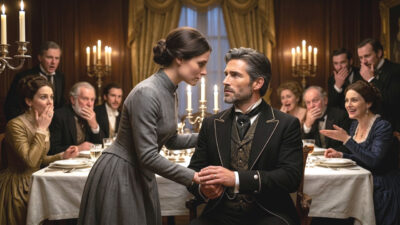
Lord Aldric came downstairs at half past nine to find the household assembled in the entrance hall — not formally, not in any arranged way, but present: Mrs. Harrow and the kitchen staff, Phelps and his boy, the footmen, Mr. Graves with his careful face, and Cecily standing beside Rowan at the foot of the stairs in her grey wool dress with her mother’s gloves in her hand.
Aldric looked at the assembled household and then at Rowan and then, with the expression of a man revising several assumptions simultaneously, at Cecily.
Rowan read the letter aloud.
He read it in his even, precise voice, the same voice that had said my wife at county dinners for two years, and it was the same voice and entirely different, because it was saying different things — specific things, true things, her name and her work and the Holloway farm and the orangery and the letter’s final lines, which he read without inflection and without hurry, because he was, whatever else he was, a man who understood that certain things required being said plainly.
There is no replacement for Cecily, Duchess of Blackmoor. There never was. There never will be.
Mrs. Harrow made a sound that she immediately suppressed. Phelps looked at the floor with the expression of a man who approves of something and is not going to say so out loud, which was his highest form of praise.
Aldric said, into the silence that followed, “This is very irregular, Rowan.”
“Yes,” Rowan said. “Most correct things are.”
Aldric left after luncheon. Cecily stood at the window of the small sitting room and watched his carriage go down the chalk road and felt the house settle around her — the particular settling of a place after a long-held tension releases, the way a body feels after weeks of cold when the warmth finally comes.
She heard Rowan in the doorway.
She did not turn immediately. She looked at the chalk road and the October fields beyond it, the eastern quarter where the Holloway farm sat with its new tenants and its new roof and its new daughter named Catherine, and she felt something she recognized from the day the orangery roof was finished — that thing so close to happiness she had not known what to call it.
She knew what to call it now.
She turned.
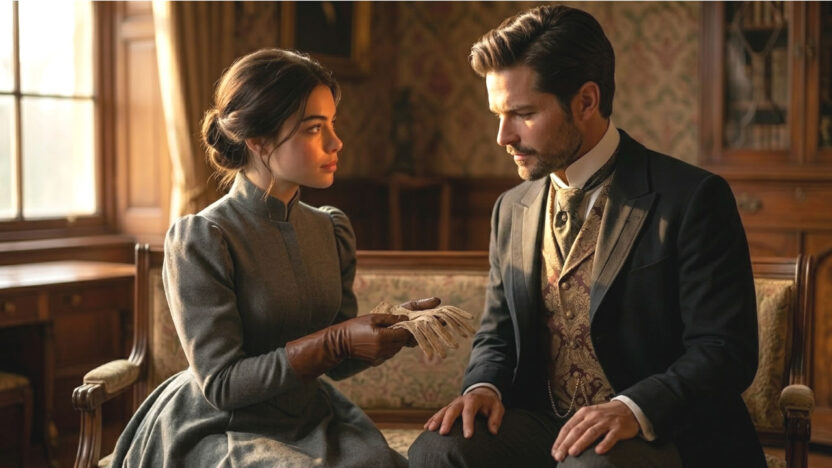
He was standing in the doorway with her mother’s gloves in his hand. She had left them on the hall table after the assembly — she couldn’t remember doing it, but she must have. He was holding them with the careful attention he had given the espaliered pear tree, as if understanding that they required a certain kind of handling.
“These need mending,” he said. “The left one. At the knuckle.”
“I know,” she said. “I’ve been meaning to.”
“I could — ” He stopped. “I would like to learn,” he said. “If you would show me. I would like to know how to take care of things that matter.”
She crossed the room. She took the gloves from his hands and looked at the worn stitching at the left knuckle and then looked up at him, at his face in the afternoon light, open in a way she had not seen it, all the inherited architecture finally, quietly, come down.
“It’s not difficult,” she said. “It only requires patience.”
“I have been told,” he said, “that I am capable of patience when I understand what I am waiting for.”
“And do you?” she said. “Understand?”
He looked at her — fully, completely, in the way she had been looked at in the kitchen garden and the walled garden and the small sitting room, the accumulated weight of all those moments arriving together at once.
“You,” he said. “I was waiting for the part where I understood that it was you. That it has always been you. That there was never going to be anything worth tending in this house that you hadn’t already put your hands into.”
The October light came through the sitting room window and lay across the floor between them, and outside the chalk road was empty, and somewhere in the eastern quarter the Holloway farm was going about its afternoon, and the kitchen garden needed its cabbages seen to, and the espaliered pear trees were doing what they had done for forty years without anyone watching.
Cecily put her mother’s gloves in his hands.
“Then we had better begin,” she said.
And for the first time in two years of marriage, in the small sitting room of a house that had finally learned to hold them both, she smiled at him without managing it — fully, freely, the way her mother had always smiled, the way she had almost forgotten she could — and he looked at her as if she had just given him something he had not known he was allowed to want.
Outside, Blackmoor went on growing.
It did not ask permission.
It never had.