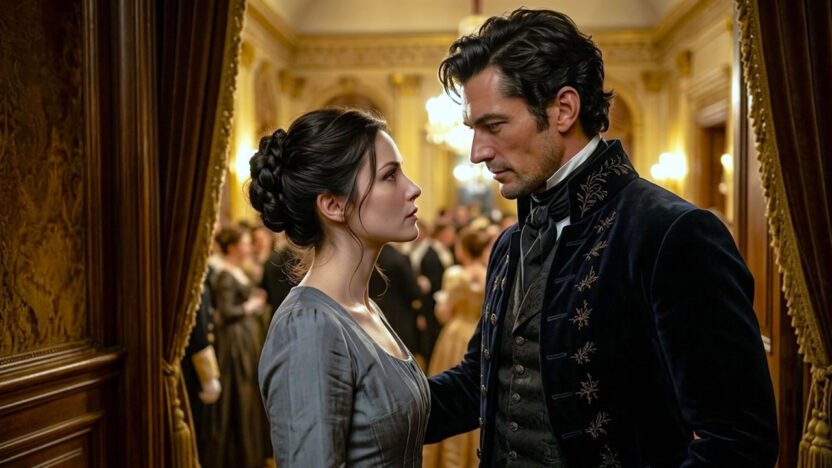
The society of London thrived on two things: immense wealth and catastrophic ruin. To possess the former was to be a god. To suffer the latter was to become a ghost.
Arthur Pendelton, the Duke of Rothford, had always been a god among the aristocracy. He was a man carved from cold pragmatism, ruling an empire of estates and fortunes that had commanded respect for generations. But power is a fragile thing when it is bound by the spite of a dying man.
His late father’s will was not a final testament of love. It was a perfectly laid trap.
The terms, whispered in the hushed, candlelit offices of London’s finest solicitors, were as humiliating as they were absolute. To keep the vast, unentailed western estate—the very lifeblood of the Rothford legacy—Arthur had to marry. But he could not choose an heiress. He could not align himself with a powerful peer. To cure him of his formidable pride, his father had decreed that Arthur must find the most destitute, ruined gentlewoman of the season and make her his Duchess.
If he refused, or if he chose a woman with even a sliver of hidden wealth, the fortune would pass immediately to his cousin, Lord Julian—a man whose twisted sense of justice and quiet cruelty made him truly dangerous.
It was a brilliant, vicious checkmate.
When the terms inevitably leaked to the drawing rooms of Mayfair, the panic was swift and absolute. Suddenly, every impoverished daughter of a disgraced baron or indebted viscount was thrust into the Duke’s path. They smiled trembling smiles. They paraded their poverty like a twisted badge of honor, desperate to be chosen as the Duke’s sacrificial bride.
But Arthur did not want a trembling victim. He did not want a woman who would weep with gratitude and expect a fairy tale. He viewed marriage strictly as a transaction, a necessary maneuver to protect his land and his title. He needed a pawn. Someone entirely invisible. Someone who understood that this union was built on ink and obligation, not affection.
He found her hiding in the shadows of a glittering ballroom.
Miss Clara Linfield was not meant to be seen. She was the penniless daughter of a ruined gentleman, surviving as the unpaid, mistreated companion to a cruel aunt. She spent her evenings mending torn hems behind velvet curtains, observing the high society that had discarded her with sharp, intelligent eyes. Clara was fiercely protective of the only thing she had left: her independence. She did not want to be saved by the aristocracy that had destroyed her family. She only wanted to be left alone.
When the cold, imposing Duke of Rothford stepped into her shadowed alcove, Clara did not swoon. She did not plead. Instead, she looked at him with devastating clarity and actively tried to talk him out of it.
She warned him she was a terrible choice. She told him she would not be a docile, silent pawn.
It was the first time in Arthur’s life that a woman had looked at his immense power and asked him to step aside. And in that single, startling moment of defiance, the Duke made a choice that would alter the course of both their lives.
He pulled the invisible girl out of the shadows and made her his Duchess.
He believed he had solved his problem. He believed he had found the perfect, insignificant bride to secure his fortune and defeat his father’s final curse.
What Arthur Pendelton did not know was that the quiet, fiercely brilliant woman he had just brought into his home was not insignificant at all. He did not know that beneath her faded dress and guarded heart lay a mind capable of catching deceptions that his own men had missed.
And, most dangerously of all, the Duke had no idea that his new bride held the key to a terrifying secret—a buried truth that connected her ruined family to his own. It was a secret so dark it possessed the power to destroy the Rothford empire forever, and it would force the Duke to choose between the legacy he was sworn to protect, and the woman he was never supposed to love.
The heavy oak doors of the Rothford estate library closed with a definitive thud, sealing Arthur Pendelton, the Duke of Rothford, inside with a reality he despised. Before him sat three aging solicitors, their faces pale in the dim afternoon light. On the mahogany desk between them lay the final, venomous strike of a man who refused to stop manipulating his son, even from the grave.
“Read it again,” Arthur commanded, his voice perfectly level, though a muscle feathered along his jawline.
Mr. Sterling, the eldest of the solicitors, cleared his throat nervously and adjusted his spectacles. “As you wish, Your Grace. It reads: And to my only son, Arthur, I leave the unentailed western estate and the entirety of the liquid fortune attached to it, upon one irrevocable condition. He must marry within the season. Furthermore, to cure him of the pride I so deeply failed to break in life, he shall not marry a peer, nor an heiress. He must marry the most destitute, ruined gentlewoman he can find. Should he fail, or should he attempt to subvert this by choosing a woman of secret means, the entirety of the western estate shall pass to my nephew, Lord Julian.”
Arthur turned toward the window, staring out at the rolling green hills of the estate he had spent the last five years pulling out of the debt his father had created. The western estate was the lifeblood of Rothford. Without it, the title was an empty shell. His father knew exactly what he was doing. And Julian, Arthur’s cousin, was already circling London like a vulture, eagerly waiting for Arthur’s pride to outweigh his pragmatism. Julian wanted the land. He always had.
“He wishes to make a mockery of the title,” Arthur said quietly. “To force me to parade a beggar through the ton so he might have the last laugh.”
“Your Grace,” Sterling offered gently. “Lord Julian has already sent inquiries regarding your social calendar. He is waiting for you to fail.”
Arthur turned back from the window, his slate-gray eyes entirely devoid of warmth. “Inform my valet to prepare my evening clothes, Mr. Sterling. If my father demands I marry a ghost, I shall find one tonight.”
The Danbury ball was a suffocating sea of silk, perfume, and desperate ambition. Every debutante in London had seemingly been informed of the Duke of Rothford’s sudden need for a bride, though the exact, humiliating terms of the will had been kept quiet. They paraded before him, flashing practiced smiles and rehearsing their pedigrees.
Arthur watched them from the edge of the ballroom, nursing a glass of brandy he had no intention of drinking. They were all too polished. Too well-fed. Too visibly connected to wealth to satisfy the legal trap his father had set. If Julian’s lawyers found even a sliver of hidden inheritance in whichever woman Arthur chose, the fortune was lost. He needed someone invisible. Someone broken by society.
He stepped away from the glittering chandelier light, retreating into the shadowed alcove near the terrace doors to escape the suffocating attention.
That was when he saw her.
She wasn’t dancing. She wasn’t standing in the receiving line. She was kneeling behind a heavy velvet curtain, a needle flying expertly through the torn hem of a garish pink gown worn by an older, loudly complaining woman.
Arthur studied her. Her dress was an antiquated cut, entirely out of fashion and faded to a dull, washed-out gray. It was impeccably clean, but the fabric was thin, mended in three distinct places. She wore no jewelry. Not a single ribbon. Her dark hair was pinned back with severe practicality. She was a non-entity. A shadow employed to maintain the light of others.
“Hurry up, Clara,” the older woman hissed. “The Duke is looking for a bride, and I will not miss my chance to push your cousin into his path because you cannot manage a simple stitch.”
“Almost finished, Aunt,” the girl replied. Her voice was surprisingly steady, lacking the tremor of a beaten servant.
The aunt snatched her skirts the moment the thread was bitten off and marched back into the ballroom, leaving the girl alone in the shadows.
Arthur watched as she did not cry, nor did she look longingly at the dancers. Instead, she let out a slow, calculated breath, stood up, and brushed her faded skirts. Her gaze swept the room with an unsettling, sharp intelligence, analyzing the crowd not with envy, but with the detached precision of a general observing a battlefield.
Arthur took a step forward. Destitute. Ignored. A companion to a cruel relative. She was the exact loophole he needed to secure his empire.
“A ruined dress is a tragedy in this room,” Arthur said, his deep voice breaking the silence of the alcove.
Clara stiffened, but she did not jump. She turned slowly. When her eyes met his, Arthur felt a strange, jarring pull. Her eyes were piercingly dark, entirely devoid of the simpering reverence he had received all evening.
She took in his tailored evening coat, the subtle insignia of his rank, and his cold expression. She did not curtsy.
“A ruined dress is only a tragedy to those who have nothing else of value, Your Grace,” she replied calmly, her tone polite but laced with steel.
Arthur raised an eyebrow. “You know who I am.”
“Everyone knows who you are tonight,” Clara said, taking a deliberate step back, her posture defensive. “You are hunting.”
“Hunting?”
“Yes. And looking thoroughly displeased with the prey.” She tilted her head, studying him with an unnerving lack of fear. “You are actively avoiding the heiresses. You dismissed the Earl of Stanhope’s daughter without a second glance. You are looking for something specific, and judging by the fact that you are standing in a dusty alcove talking to a disgraced baron’s daughter with exactly two pence to her name, you are looking for a beggar.”
Arthur froze. For the first time in five years, he was genuinely caught off guard. She had deduced in three minutes what the rest of London hadn’t figured out all evening.
“You are highly observant, Miss?”
“Linfield. Clara Linfield,” she said, her voice dropping. “And I am observant enough to know that when a powerful man seeks a weak pawn, the pawn rarely survives the game. So, whatever scheme you are hatching to spite your rivals, Your Grace, look elsewhere. I assure you, I am far too much trouble.”
She attempted to step around him, her chin held high, fiercely protecting the tiny sliver of independence she had left. She did not want him. She did not want his wealth, or his title, or his rescue. She wanted to be invisible.
And that made her absolutely irresistible to his purpose.
Arthur stepped into her path, blocking her exit. “Your father was Baron Linfield? The man who lost his estate to the Crown seven years ago?”
Clara’s eyes flashed with defensive fury. “Yes. I have no dowry. I have no standing. I am entirely destitute. Now, please step aside.”
“No,” Arthur said softly. He looked down at her, seeing the fierce, cornered intelligence burning in her gaze. She was not a docile lamb he could place in a corner. She was a spark in a room full of damp wood. And suddenly, the idea of marrying her felt far less like a punishment.
“What are you doing?” Clara whispered as he offered his arm.
“I am fulfilling an obligation,” Arthur said, his voice carrying a dark, final authority. “And you, Miss Linfield, are going to help me.”
Before she could protest, before she could pull away, Arthur guided her out of the shadows and directly into the blinding light of the ballroom. The music faltered. The murmurs died. Hundreds of eyes turned toward them, widening in shock as the powerful, untouchable Duke of Rothford walked to the center of the room with the invisible, ragged companion of a minor social climber.
Clara’s fingers dug into his arm. “They will devour us,” she hissed under her breath.
“Let them try,” Arthur replied. He stopped in front of Clara’s aunt, whose jaw had practically unhinged in shock.
“Your Grace,” the aunt stammered. “I do not understand. What is the meaning of this? Clara, release the Duke at once.”
“She will do no such thing,” Arthur said, his voice ringing through the silent ballroom. “I am claiming this dance with my future Duchess.”
A collective gasp echoed off the marble walls. Clara looked up at him, her dark eyes wide with furious disbelief. She had tried to warn him off. She had tried to remain unseen. But the trap had snapped shut around them both.
The carriage ride to the Rothford estate later that week was suffocatingly silent. Rain lashed against the glass, blurring the gaslights of London into streaks of gold as they left the city behind.
Arthur sat in the shadows of the velvet seat, watching his new bride. Most women in her position would be weeping, or babbling with gratitude, or terrified of the imposing man sitting across from them. The hasty wedding by special license had been a bleak affair, devoid of flowers or celebration. It was a business transaction, finalized with the scratch of a pen.
Clara Linfield did not weep. She sat perfectly straight, her hands folded in her lap. But her eyes were moving. She was watching the road, calculating the distance.
When the carriage finally pulled through the massive wrought-iron gates of the estate and halted before the imposing stone manor, the footman opened the door.
Arthur stepped out and offered his hand. Clara took it, her skin cool against his.
As they walked up the grand stone steps, lined with a dozen of the estate’s senior staff who had been woken to receive their new mistress, Arthur expected her to be overwhelmed by the wealth. He expected her to shrink under the judging gazes of the servants.
Instead, Clara paused at the top step. She did not look at the vaulted ceilings or the gold-leaf trimmings. She looked at the butler, noting his stiff posture. She looked at the footmen, observing where their gazes lingered. She looked at the heavy locks on the doors, the shadows in the corners, and the structural defenses of the manor.
She was analyzing the household. Cataloging its weaknesses. Assessing the terrain of her new battlefield.
Arthur stopped beside her, a strange, profound realization settling in his chest as he looked down at the woman he had chosen merely to be a pawn. He had brought her here to satisfy a legal requirement, expecting a silent, grateful ghost to occupy the empty rooms of his estate.
He hadn’t brought home a victim.
He had brought home a strategist.
The first fortnight of their marriage was defined by a vast, echoing silence. Arthur treated the arrangement exactly as he had promised: a business transaction. He provided Clara with a suite of rooms in the east wing, a generous allowance she had not asked for, and absolute distance. They dined at opposite ends of a table large enough to seat twenty, the only sounds the clinking of silver and the ticking of the grandfather clock in the hall.
Clara did not complain. She did not seek him out. Instead, she quietly embedded herself into the machinery of the estate. She requested access to the household ledgers, an act Arthur permitted assuming she merely wished to occupy her time with menus and linens.
He was seated in the library late one afternoon, a glass of scotch untouched on his desk, staring down at a massive stack of vellum. It was a land contract, one that would lease a significant portion of the western estate’s agricultural yield to a new merchant syndicate. It was a lucrative deal, necessary to stabilize the final debts his father had left behind. His solicitor had already approved it. Arthur dipped his pen in the inkwell, preparing to sign his name to the bottom line.
A soft knock interrupted him. The door opened before he could answer, and Clara stepped inside.
She wore a simple dark blue day dress, her hair pinned back as severely as the night they had met. In her hands, she carried a leather-bound ledger.
“I apologize for the intrusion,” she said, her voice calm and measured. “But your steward left the agricultural projections in the sitting room, and I took the liberty of reviewing them.”
Arthur set his pen down, mildly irritated. “Those are not household accounts, Clara. They are estate matters.”
“I am aware,” she said, stepping closer to the desk. Her dark eyes dropped to the contract resting before him. “Are you about to sign that lease?”
“I am.”
Clara placed her hands on the edge of his mahogany desk and leaned in slightly, meeting his gaze with absolute certainty. “If you sign that paper, you will lose the western estate.”
Arthur went very still. He looked from her face to the contract, then back to her. He was a man who did not tolerate insolence, nor did he entertain dramatic exaggerations. “My solicitors have reviewed this document for three weeks. My steward has verified the yields. And why, exactly, should I believe you?”
Clara did not flinch. She did not apologize for her forwardness. She simply reached out and tapped a slender finger against the ledger she had brought. “You shouldn’t. Check the fourth column.”
Arthur frowned. He pulled the ledger toward him, opening it to the page she had marked with a ribbon. It was the quarterly projection of grain yields, cross-referenced with the merchant syndicate’s proposed purchasing rates.
“Look at the depreciation,” Clara instructed, her voice dropping into a tone of quiet authority. “The syndicate has structured the purchasing agreement based on a fixed rate from three years ago, but they have buried a compounding deduction in the fourth column under transport liability. They are not leasing the yield, Arthur. They are systematically devaluing the land’s output on paper. Within two harvests, you will owe them more in imaginary transport penalties than the crop is worth. They will have a legal claim to seize the acreage to settle the debt.”
Arthur stared at the numbers. He traced the column down, doing the mathematics in his head. The hidden deduction was small at first, disguised as a standard fee. But compounded over the duration of the lease, the numbers became a slow-acting poison.
The breath left his lungs in a sharp, quiet hiss. She was right. It was a perfectly disguised trap. A fraud so elegant his own men had missed it entirely.
He looked up at his wife. She was watching him carefully, waiting for his pride to ignite, waiting for him to dismiss her out of male arrogance. That was what she expected of a Duke.
Instead, Arthur took the heavy vellum contract, gripped it in both hands, and tore it cleanly in half. He tossed the pieces into the cold fireplace.
“How did you see that?” he asked, his voice rough with a new, profound realization.
“When you have spent your life watching people take everything from you, you learn how to read the fine print,” Clara replied softly. She turned to leave, but stopped at the door. “Do not trust your steward, Your Grace. A man does not miss a discrepancy that large unless he is being paid to look away.”
She closed the door behind her, leaving Arthur sitting in the silence of his study, staring at the empty space where she had just been. He had married her to secure his fortune. He had never expected her to protect it.
The shift in the house was subtle but undeniable. Arthur no longer viewed her as a convenient ghost. He found himself seeking her out. He asked her opinion on correspondence. He lingered in the drawing room after dinner, finding excuses to sit near her while she read by the fire. He was drawn to the sharp edges of her mind, fascinated by a woman who demanded nothing and noticed everything.
But it was a discovery later that week that fundamentally altered how he saw her heart.
Arthur was walking through the lower corridors near the servants’ hall when he overheard the housekeeper, Mrs. Higgins, speaking in hushed, emotional tones to the head footman. Arthur caught his wife’s name and paused in the shadows.
“She paid the entirety of the apothecary debt,” Mrs. Higgins was whispering, wiping her eyes with an apron. “The poor girl was to be thrown out of the cottage today. Her Grace used her own pin money. Every last coin of her monthly allowance.”
Arthur stepped out of the shadows, startling the servants into deep bows. He asked for an explanation. Trembling, the housekeeper revealed that a dismissed scullery maid, let go months ago for falling ill, had accumulated a crushing debt to the village apothecary and the landlord. Clara had discovered the girl’s plight and quietly settled the accounts, ensuring the family would not face the winter on the streets.
Arthur found Clara in the conservatory, tending to a neglected row of white roses. The glass walls were streaked with afternoon rain, casting a soft, gray light over her face.
He stood in the doorway for a long moment, watching the careful, gentle way she handled the thorns. She had nothing. She had come to this marriage with a single trunk of faded dresses and a lifetime of humiliation. And yet, the moment she possessed a fraction of wealth, she had given it away to someone she did not even know.
“I spoke with Mrs. Higgins,” Arthur said, stepping into the damp, earthy warmth of the room.
Clara’s hands paused over the roses. She did not turn around. “I assumed you would eventually. I apologize if it was improper to interfere with former staff.”
“It was your personal allowance. You may burn it for warmth if you choose,” Arthur replied, closing the distance between them until he stood just behind her. He could smell the faint scent of lavender soap on her skin. “But I must ask. Why did you do that?”
Clara finally turned to face him. She kept her chin high, bracing herself for a reprimand. “Because they had nowhere else to go.”
Arthur looked into her dark, defiant eyes. He saw the ghosts of her own ruin there. The years of living at the mercy of a cruel aunt, of having the ground pulled out from beneath her feet.
“Neither did you,” he said softly.
The defiance in Clara’s eyes fractured, just for a second. Her breath hitched, and she looked away, staring down at the bruised petals in her hands.
“I know,” she whispered.
Arthur raised a hand, his fingers grazing the air near her cheek before he pulled back, restrained by the fragile tension between them. He realized, with a sudden, terrifying clarity, that he was no longer merely fascinated by his wife. He was beginning to revere her.
But the fragile peace of the Rothford estate shattered the following morning.
Arthur was in the stables when a rider arrived with urgent word from the manor. A guest had arrived unannounced.
When Arthur strode through the grand foyer, he found the heavy double doors of the drawing room open. Standing by the fireplace, dripping rain onto the Persian rug and smiling with a chilling sort of satisfaction, was Lord Julian.
“Arthur,” Julian said, spreading his arms. “I simply could not wait any longer. A secret wedding? No announcements? I had to come and meet the mysterious Duchess who stole my inheritance out from under me.”
Arthur’s jaw tightened. “You are trespassing, Julian.”
“I am calling on family,” Julian corrected, his smile never reaching his cold, pale eyes.
At that moment, the side door of the drawing room opened, and Clara stepped inside, carrying a stack of morning correspondence.
“Arthur, the post has arrived, and I thought—”
She stopped.
The letters slipped from her hands, scattering across the polished wooden floor like fallen leaves.
Arthur turned to his wife. Clara’s face had drained of all color. She was staring at Julian as if she had just seen the devil himself rise from the hearth. Her hands were trembling, a visceral, unmistakable terror radiating from her small frame.
Arthur turned his gaze back to his cousin. Julian was no longer smiling. The feigned aristocratic charm had vanished entirely, replaced by a look of absolute, burning hatred. Julian stared at Clara with a recognition so deep, so violently personal, that the air in the room seemed to turn to ice.
Julian knew exactly who she was. And he hated her.
Arthur stepped between them, his blood running cold as he realized the terrible truth. He had not simply married a stranger to save his fortune. He had married a woman who was already entangled in his family’s darkest shadows.
The presence of Lord Julian at Rothford was a poison that seeped into the very walls of the estate. He did not immediately reveal the source of his vile recognition of Clara, preferring instead to linger in the corridors like a hunting hound, smiling his cold, knowing smile. His silence was a weapon, and it forced Arthur and Clara into a unified, silent alliance. They had to know what Julian knew. They had to find the leverage he was so clearly waiting to deploy.
But before they could unearth the past, they were forced to navigate the present. A long-standing invitation to a neighboring Earl’s evening assembly could not be declined without showing weakness, and Julian had insisted on accompanying them, eager to watch the new Duchess falter in society.
The assembly room was crowded, stiflingly warm, and humming with the vicious gossip of the local gentry. Clara stood beside Arthur, holding her composure like a shield. She looked magnificent in a gown of deep emerald silk, a stark contrast to the faded gray dress she had worn only weeks ago. Yet, the finery did not protect her from the sudden, piercing voice that cut through the polite murmurs of the room.
“Well, heaven preserve us. You can drape a beggar in silk, but she still smells of the gutter.”
The music seemed to falter. The crowd parted. Clara’s former aunt, a woman whose social ambition was matched only by her cruelty, marched forward. She had clearly secured an invitation for the sole purpose of elevating her own status by publicly tearing down the niece who had mysteriously ascended past her.
“Tell us, Clara,” the aunt sneered, her voice carrying across the silent room. “Does His Grace know you used to steal the leftover bread from my kitchens? Or has he simply chosen to ignore the fact that your father died a penniless, raving fool?”
Arthur felt a surge of absolute, murderous fury. His jaw locked. He stepped forward, fully prepared to destroy the woman, to summon his carriage and ensure her social and financial ruin before the sun rose.
But as he moved, a delicate, gloved hand pressed firmly against his chest.
“No, Your Grace,” Clara said. Her voice was barely above a whisper, but the command was absolute.
Arthur looked down at her. She was not trembling. There were no tears in her eyes. She stepped around him, placing herself directly in front of the woman who had tormented her for years.
“Aunt,” Clara began, her tone devastatingly polite, carrying the calm, resonant authority of a Duchess. “I am deeply grateful for the bread you provided when I had nothing. It is a pity your generosity did not extend to your own creditors. I understand the butcher in Mayfair is still waiting for the settlement of your accounts from last season.”
The aunt’s face drained of color, her mouth opening and closing in sudden, suffocating panic. The surrounding aristocrats began to whisper, their hungry gazes shifting from Clara to the suddenly ruined older woman.
“If you are in need of assistance,” Clara continued, her voice echoing with chilling sweetness, “you have only to ask. My husband and I are always willing to contribute to local charities.”
She did not wait for a response. Clara turned smoothly, placed her hand on Arthur’s arm, and guided him away, leaving her aunt to drown in the suffocating tide of high society’s judgment.
Arthur walked beside his wife in stunned silence. He had been prepared to act as her savior, assuming her fragile background required his heavy protection. Instead, he had just witnessed a masterclass in social warfare. She did not need him to save her. She was his equal in every conceivable way. And in that moment, the fierce, protective respect he felt for her blossomed into an entirely different, infinitely more dangerous emotion. He was completely captivated.
The assembly only heightened the urgency of their silent war against Julian. When they returned to the estate, the manor was quiet, wrapped in the heavy velvet of a moonless night. While Julian slept in the guest wing, Arthur and Clara descended into the late Duke’s private archives beneath the library.
It was a windowless, cavernous room that smelled of damp parchment and old secrets. Arthur carried a silver candelabra, the flickering light casting long shadows across rows of heavy iron lockboxes and leather-bound ledgers detailing decades of the Rothford empire’s history. If Julian’s confidence came from a legal or financial connection to Clara’s ruined family, the proof would be buried here.
They worked for hours in the hushed intimacy of the vault. The silence between them was no longer the cold distance of a business transaction, but a shared, breathing entity. They were two soldiers in the same trench. Arthur found himself watching the way the candlelight caught the loose strands of her dark hair, the delicate curve of her neck as she pored over endless columns of ink.
Sometime past three in the morning, the exhaustion of the night finally claimed her. Arthur looked up from a stack of correspondence to find Clara asleep at the small oak table, her head resting on her crossed arms, a heavy ledger serving as her pillow.
He stood quietly. The damp chill of the underground room had seeped into the air, and she gave a small, involuntary shiver. Arthur took off his tailored evening coat. Moving with a gentleness he did not know he possessed, he draped the heavy, warm fabric over her shoulders.
The movement stirred her. Clara blinked, lifting her head slowly. She looked at the coat wrapped around her, and then up at Arthur, who was standing entirely too close. In the dim, golden light of the candles, the walls of the vault seemed to fall away. There was no title here. No will. No Julian.
Clara pulled the edges of his coat tighter around her neck, breathing in the scent of cedar and rain that clung to the fabric. She did not look away from his eyes.
“You should go up to your rooms,” Arthur said softly, his voice a low, rough murmur. “You are exhausted.”
“I had forgotten what it felt like,” Clara whispered, her voice trembling just slightly, entirely stripped of the fierce armor she wore in the daylight.
“What?” Arthur asked, leaning in closer, his gaze dropping to her lips.
“To have someone beside me.”
Arthur closed the remaining distance. He placed his hands on the table on either side of her chair, boxing her in, his face only inches from hers. He could feel the warmth of her breath. He wanted to pull her up, to kiss the ghosts out of her eyes, to promise her that she would never have to fight a single battle alone again.
Clara leaned up, her eyes fluttering shut, the space between them evaporating into a desperate, magnetic pull.
But as she shifted, her elbow caught the heavy ledger she had been using as a pillow. It slid across the polished wood, falling open to a page marked with a dried, brittle ribbon.
Clara opened her eyes, the spell breaking as she glanced down to catch the heavy book. Her gaze swept over the ink, and she froze. The warmth vanished from her face, replaced by a sudden, absolute pallor.
“Clara?” Arthur asked, stepping back, instantly recognizing the terror flooding her features. “What is it?”
She pulled the book closer, her fingers tracing a line of faded script. “This is a record of promissory notes from seven years ago. The year my father lost everything.” Her voice began to shake. “The Crown claimed his investments in the West Indies collapsed. They said he was incompetent. That he borrowed wildly against our estate and lost it all to foreign creditors.”
She looked up at Arthur, her dark eyes wide with a horrifying realization. “These are not foreign creditors. These debts were systematically purchased and called in simultaneously by a shadow holding company in London. My father wasn’t ruined by incompetence. He was hunted.”
Arthur’s blood ran cold. He quickly moved to the adjacent shelf, pulling down his father’s private financial diaries from the same year. He brought them to the table, flipping rapidly through the heavy pages until he found the matching dates.
They stood shoulder to shoulder, the romantic tension completely annihilated by the terrifying forensic evidence piecing itself together before their eyes. Arthur dragged his finger across his father’s private records, matching the figures to the ledger Clara held.
Every single pound of debt that had crushed the Linfield family had been purchased by the late Duke of Rothford. The exact sum of Clara’s lost inheritance had been transferred into the Rothford accounts just days before her father was driven to his grave.
“His missing money went into the western estates,” Arthur whispered, the reality of the numbers making him physically sick. “My father absorbed your estate to save his own.”
Clara backed away from the table, a hand flying to her mouth. But the nightmare was not yet complete. Arthur turned the page of his father’s diary, seeking the signature of the agent who had executed the ruthless, illegal transfer.
At the bottom of the page, written in sharp, familiar ink, was the name of the broker.
Lord Julian.
The final, horrifying piece fell into place. Arthur’s father had not acted alone. He and Julian had conspired to destroy the Linfield family, stealing their wealth to build the very empire Arthur now ruled.
Arthur looked up, the crushing weight of his legacy bearing down on him. The woman he was falling in love with was standing across from him, trembling, wrapped in his coat. But she was no longer looking at him as her protector, or her equal, or her husband.
Clara looked at him, and for the first time, she saw the empire built on her father’s blood.
The silence in the underground vault was absolute, broken only by the ragged, shallow sound of Clara’s breathing. She stared at the man standing across the heavy oak table, the man whose coat still wrapped around her shoulders, offering a warmth that now felt like a terrible, suffocating lie.
Arthur looked at the open ledgers, his face entirely stripped of color. The towering, unshakable Duke of Rothford suddenly looked like a man who had watched the earth open beneath his feet.
“Clara,” he whispered, his voice fracturing in the damp air. He took a step toward her, his hand extended, desperate to bridge the chasm that had just torn open between them.
She took a step back. The movement was small, but it struck him with the force of a physical blow.
“My father did not die a fool,” she said, her voice hollow, echoing in the cavernous room. “He died believing he had failed me. He died of shame, Arthur. And your father bought this estate with his blood.”
“I did not know,” Arthur said fiercely, the words tearing from his throat. “I swear to you on my life, Clara, I did not know. I have spent the last five years of my life trying to cleanse this estate of his debts. I thought he was merely careless with his investments. I never knew he was a thief.”
Clara looked at the rows of iron lockboxes, at the staggering wealth surrounding them. Her brilliant, analytical mind was already spinning, piecing together the devastating consequences of their discovery. If this truth saw the light of day, the Rothford name would not just be scandalized. It would be annihilated. Arthur would lose his honor, his standing in the House of Lords, and the legacy he had sacrificed his youth to repair. He would be ruined, just as thoroughly as her father had been.
She reached up and slowly slid his heavy evening coat from her shoulders, placing it gently on the table. The cold air of the vault instantly bit through her thin sleeves, but she welcomed it. The cold was familiar. The cold made sense.
“I need to return to my rooms,” she whispered.
She turned and walked toward the stone stairs, leaving Arthur standing alone among the towering monuments of his family’s sins.
The following morning broke with a heavy, oppressive gray light. Clara had not slept. She stood by the tall windows of the upper gallery, staring blindly at the sprawling green hills of the western estate. The estate that belonged to her. The estate that had been stolen.
“It is quite a view, is it not?”
Clara stiffened. She did not need to turn around to recognize the smooth, mocking drawl. Lord Julian stepped out of the shadows of the portrait gallery, his pale eyes gleaming with a dangerous, quiet triumph.
“I always preferred this wing of the manor,” Julian continued, coming to stand a few feet away from her. “The light is much better for admiring the things one is about to inherit.”
Clara turned to face him, her posture rigid, her chin high. “I know what you did.”
Julian did not look surprised. Instead, his smile widened, a cold, reptilian stretch of his lips. “I assumed you would figure it out eventually. You always were an irritatingly clever girl, Clara. But you say ‘what I did’ as if I am the villain of this particular tragedy. I am merely a man who corrected a historical wrong.”
“You drove my father to his grave,” Clara said, her voice dropping to a fierce, trembling whisper. “You stripped us of everything we owned. You call that a historical wrong?”
“Your grandfather swindled my mother’s line out of two highly profitable shipping routes before you were even born,” Julian countered, his tone hardening, the polite veneer cracking to reveal the bitter, twisted fanaticism beneath. “The Linfield wealth was built on Rothford losses. My uncle and I simply took back what was rightfully ours. It was justice, Clara. Brutal, perhaps, but perfectly balanced.”
Clara stared at him, repulsed by the terrifying ease with which he justified the destruction of her family. “You are a monster.”
“I am a pragmatist,” Julian corrected, taking a slow step toward her. “And currently, I am a pragmatist holding all the cards. I know you found the ledgers, Clara. I left the vault unlocked on purpose.”
A cold spike of dread drove itself into Clara’s chest. He had wanted them to find the truth.
“You are trapped,” Julian said softly. “If you attempt to bring those ledgers to the magistrate, who do you think society will believe? A desperate, impoverished wallflower who miraculously married a Duke, only to conveniently ‘discover’ documents that grant her revenge? I will tell the courts you forged them. I will say you seduced my cousin, plotted your way into this house, and orchestrated this entire scandal to destroy the Rothford name and steal the fortune.”
Julian stepped closer, his voice dropping to a lethal hiss. “Arthur will defend you, of course. He is tragically honorable. And that honor will destroy him. The Crown will strip him of his unentailed lands. The House of Lords will turn their backs on him. The Rothford legacy will become synonymous with fraud, theft, and scandal. I will drag his name through the mud until he is a pariah in his own country.”
Clara stopped breathing. She saw the trap perfectly laid out before her. Julian did not just want the estate. He wanted to watch Arthur fall.
“But,” Julian offered smoothly, stepping back and brushing a speck of dust from his lapel, “there is a simpler solution. Leave. Flee into the night like a frightened little bird. Break the terms of the marriage by abandoning your vows. Arthur will be forced to annul the union, I will take the western estate as the will dictates, and the secret of your father’s ruin will remain buried. Arthur loses his land, but he keeps his precious honor.”
Julian smiled. “The choice is yours, Your Grace. Your revenge, or his life.”
He turned and walked down the long corridor, the sound of his footsteps echoing against the polished floorboards like the ticking of a clock.
Clara remained completely still. Her heart battered against her ribs. She looked back out the window, out at the vast, rolling hills that Arthur had spent five years bleeding for.
She remembered the look in Arthur’s eyes the night before, the profound, desperate way he had stepped toward her. She had spent her entire life running from the aristocracy, fighting to survive in the shadows. She had never wanted to be saved.
But Arthur had not saved her. He had seen her. He had respected her mind. He had placed his coat over her shivering shoulders and looked at her as if she were the only thing in the world that mattered.
She loved him. She loved him with a fierce, absolute certainty that terrified her. And because she loved him, she could not let him pay the price for his father’s sins. If she stayed, Julian would destroy Arthur’s reputation, his pride, and his life’s work. Her presence was the weapon Julian would use to cut Arthur down.
Clara turned away from the window, her mind made up. A strategist always knew when a position was lost. She would execute the only maneuver left to her. She would fall on her own sword.
She moved quickly through the silent halls to her private chambers. She did not touch the emerald silk gowns in the wardrobe. She did not take the pearl earbobs Arthur had left on her dressing table. She opened her battered trunk and pulled out the faded gray dress she had worn on the night of the Danbury ball.
It took her less than ten minutes to pack. When she was finished, she walked to Arthur’s study. The room was empty. She took the heavy leather ledger they had found in the vault and placed it squarely in the center of his mahogany desk. She did not leave a letter. A letter would only give him hope.
As midnight chimed from the grand clock in the foyer, Clara slipped out the servants’ entrance, stepping into the freezing, relentless rain. She paid a stable boy her last silver coin to drive a modest gig toward the coaching inn at the edge of the village. She did not look back at the grand stone manor. She could not afford to look back.
Arthur did not realize she was gone until the following morning.
He had spent the night in his chambers, pacing the floorboards, tearing his own mind apart as he searched for a way to dismantle his vast fortune to repay the Linfield estate without destroying the hundreds of tenant farmers who relied on the Rothford lands. He had been prepared to offer her everything. To strip his title down to the studs to make it right.
But when he went to her chambers to beg her forgiveness, he found the bed unslept in. The heavy silk gowns were still hanging in the wardrobe.
Panic, sharp and blinding, gripped him by the throat.
He strode down the corridor, throwing open the doors to the library, the conservatory, the drawing room. When he finally burst into his study, the room was empty.
But resting in the center of his desk was the ledger.
Arthur walked slowly toward it. The leather was damp. The book had been deliberately placed over the marriage contract they had signed only weeks ago.
He stared at the documents, his brilliant, calculating mind putting the pieces together with devastating speed. Clara had not taken her new clothes. She had not demanded a carriage. She had slipped away in the dead of night, leaving the proof of her own family’s ruin behind.
She had not fled in terror. She had fled to protect him.
She had realized that the scandal would destroy his name, and rather than demand the justice she was owed, she had sacrificed her own happiness, her own security, and her own revenge, entirely for his sake.
The realization shattered the last remaining wall around Arthur’s heart. He stood in the silent study, completely undone by the staggering weight of what she had just given up for him. His father had spent a lifetime teaching him that people were greedy, manipulative, and selfish. His father was wrong.
Arthur turned on his heel and strode out of the study, his voice roaring through the quiet manor as he called for his fastest horse. He did not care about the scandal. He did not care about Julian’s threats. He did not care if the House of Lords stripped him of his title and the Crown took every acre of land he possessed.
The western estate was dirt and grass. His legacy was ink on paper. Clara was his only truth.
He swung himself into the saddle, driving his heels into the stallion’s flanks, plunging into the torrential rain. He rode like a man possessed, racing against the morning light, fully aware that bringing her back meant declaring war on his own family and facing a ruinous scandal.
And he had never been more ready to let an empire burn.
The Black Swan Inn was a bleak, drafty establishment on the edge of the county, smelling of stale ale, wet wool, and damp ash. Clara sat in the darkest corner of the common room, her hands wrapped tightly around a chipped mug of tea that had long since gone cold. Outside, the torrential rain battered the leaded glass windows, turning the approaching dawn into a bruised, muddy gray. The mail coach to London was due in less than an hour. Once she stepped onto it, her marriage, her title, and the only man she had ever loved would be entirely out of her reach.
She stared down at the scarred wooden table, fighting the suffocating tightness in her throat. She had done the right thing. Julian’s trap was flawless. Her absence was the only way to save Arthur from a scandal that would strip him of his honor and his place in the world.
The heavy tavern door did not merely open; it was thrown back, slamming against the plaster wall with a crack that silenced the entire room.
Clara looked up.
Arthur stood in the doorway. He was drenched, his dark hair plastered to his forehead, his heavy riding coat dripping rainwater onto the floorboards. His chest heaved with ragged breaths, and his slate-gray eyes swept the crowded room with the terrifying, singular focus of a predator.
When his gaze found her in the corner, the rest of the world ceased to exist.
He crossed the room in long, furious strides. The patrons hastily scrambled out of his way, recognizing the sheer, undeniable authority radiating from him, even covered in mud. Clara stood up, her heart hammering wildly against her ribs.
“Arthur, you cannot be here,” she whispered, her voice trembling as he stopped inches from her. “You must go back. If Julian realizes you have come for me—”
“I do not care about Julian,” Arthur cut in, his voice a low, rough growl that vibrated with raw emotion. He reached out, his large hands gripping her shoulders, pulling her just slightly closer, as if to convince himself she was truly real. “I do not care about the scandal. I do not care about the House of Lords. Do you genuinely believe I would let you walk out into the freezing rain to protect a legacy built on lies?”
“It is your life’s work,” Clara pleaded, a desperate tear finally breaking free and tracking down her pale cheek. “You spent five years bleeding to save that estate. If the courts see those ledgers, if Julian exposes what your father did to mine, the Crown will ruin you. They will take your lands. They will destroy your name.”
“My name is already destroyed,” Arthur said fiercely. “My legacy is poison, Clara. It was poisoned long before I inherited it. I will not let you pay the price for my father’s sins. I will not lose you to save a piece of land.”
“Arthur, please—”
“You are my wife,” he said, his grip shifting, one hand sliding up to cup her jaw. His thumb brushed away the tear on her cheek, his touch surprisingly gentle against the frantic beating of her pulse. “You are my equal. You are the only truth I have found in my entire life. I am not letting you go. We are going back to that house, and we are going to end this.”
Clara looked up into his eyes, seeing the absolute, unshakable conviction blazing there. He was not acting out of duty. He was not protecting a fragile wallflower. He was fighting for the woman he loved, fully willing to let his empire burn to keep her.
She let out a shuddering breath and nodded.
When the Duke and Duchess of Rothford strode back through the grand double doors of the estate hours later, the storm had broken, but the tension in the manor was lethal.
Lord Julian was waiting for them in the library. He stood by the roaring fire, a crystal glass of brandy in his hand, looking entirely too comfortable in a house he did not yet own. He smirked as Arthur and Clara walked into the room, their clothes still damp, their expressions carved from stone.
“A touching reunion,” Julian drawled, taking a slow sip of his drink. “But ultimately pointless. You have brought her back, Arthur. Which means you have made your choice. You prefer the company of a ruined girl to the survival of your family name.”
“My family name,” Arthur said coldly, “is precisely why I am standing here.”
Julian set his glass down on the mantelpiece, his smile vanishing, replaced by the twisted, fanatic certainty that had driven him for years. “Then let us conclude this business. The terms are simple. You will sign the western estate and the entirety of its unentailed liquid assets over to me, today, irrevocably. In exchange, the ledgers detailing your father’s theft of the Linfield fortune will burn in this very fireplace. The Rothford name remains unblemished. Your little Duchess avoids the gallows for fraud. And I finally reclaim the wealth your grandfather stole from my mother’s line.”
Clara tightened her grip on Arthur’s hand. She knew exactly what Julian was asking. The western estate was the financial heart of the dukedom. Without it, Arthur would lose more than half his wealth. He would be reduced to a fraction of his former power.
Julian stepped forward, pulling a heavy parchment document from his breast pocket and laying it flat on the mahogany desk. He picked up Arthur’s silver pen and held it out. “Sign it, Arthur. Or I ride for the magistrate.”
Arthur did not hesitate. He did not bargain. He did not plead.
He released Clara’s hand, walked calmly to the desk, took the pen from Julian’s fingers, and signed his heavy, sweeping signature across the bottom of the deed.
Clara stopped breathing. It was done. He had actually done it. He had permanently severed himself from the greatest source of his wealth, severing the chains of his father’s expectations without a single second of regret.
Julian stared at the signature, his eyes wide with triumphant, vicious glee. He carefully blotted the ink, folded the heavy parchment, and slipped it into his coat. He let out a dark, booming laugh.
“You fool,” Julian sneered, the polite veneer entirely gone. “You gave up an empire for a woman who has nothing. You surrendered the greatest estate in the country just to keep your precious honor.”
“I did not sign that estate over to save my honor,” Arthur said.
His voice was terrifyingly calm. It was the voice of a man who had already calculated three moves ahead of his opponent.
Julian frowned, his laughter abruptly cutting off. “What are you talking about?”
Arthur stepped away from the desk, moving to stand shoulder to shoulder with Clara. “You have always been so blinded by your resentment, Julian, that you never truly understood the law. The western estate is now yours. Legally and irreversibly.”
“Yes,” Julian said, his hand resting defensively over his coat pocket. “It is.”
“Which is a terrible tragedy for you,” Arthur continued smoothly, “because three hours ago, while I was returning from the coaching inn with my wife, I dispatched my fastest rider to London. He is carrying the original ledgers to the Crown Magistrate.”
Julian’s face drained of color. “You are lying. If you expose the ledgers, your father will be posthumously convicted of treasonous fraud.”
“Yes, he will,” Arthur agreed, his voice echoing like the strike of an anvil. “And my family will bear the shame. But my father is dead. You, Julian, are very much alive. You were his broker. Your signature is on the fraudulent transfers. You orchestrated the theft of the Linfield estate.”
“I took back what was mine!” Julian shouted, taking a panicked step backward.
“You committed a massive financial crime against the Crown,” Arthur corrected coldly. “And under the laws of the realm, when a man is convicted of such treasonous fraud, the Crown seizes everything he owns.”
Arthur tilted his head, watching the absolute horror dawn in his cousin’s pale eyes. “Everything, Julian. Including the massive, unentailed western estate you just legally claimed as your own property ten seconds ago. The Crown will confiscate it. It is gone. I will never see it again, but neither will you.”
Julian stumbled back, his hand shaking as he pulled the deed from his pocket, staring at it as if the parchment had caught fire. The trap had closed. Arthur had not used a secret clause to save himself. He had willingly accepted a devastating, permanent financial loss, using his own fortune as the bait to completely destroy his enemy.
“You ruined yourself to ruin me,” Julian whispered, his voice cracking with disbelief.
“I ruined you to protect my wife,” Arthur said, the fierce, protective authority returning to his tone. “And I cleansed my name of a fortune built on innocent blood. The magistrate’s guard will be here before nightfall, Julian. I suggest you wait for them in the hall.”
Julian looked from Arthur to Clara, his jaw trembling, his life’s ambition turning to ash in his hands. He had no leverage left. No threats. No power. Broken and utterly defeated, he turned and stumbled out of the library, leaving the heavy oak doors open behind him.
The silence that followed was entirely different from the oppressive quiet that had defined their early marriage. It was the silence of a battlefield after the smoke had cleared.
Arthur let out a slow, heavy breath. He looked down at the empty mahogany desk. He had just lost half his kingdom. The Rothford name would face months of scandal. He would have to rebuild his remaining estates from the ground up, with only a fraction of his former wealth.
He felt a soft, warm hand slide into his.
Arthur turned. Clara was looking up at him, her dark eyes shining with a mixture of awe, reverence, and an overwhelming, fierce love. She had spent her life believing that powerful men only destroyed, that they only took what they wanted and guarded their wealth with ruthless cruelty.
Arthur had just burned his wealth to the ground to keep her safe.
“You have lost so much,” Clara whispered, stepping closer to him, her other hand coming up to rest flat against his chest, right over the steady, heavy beating of his heart.
“I have lost nothing that mattered,” Arthur replied. He reached around her waist, pulling her flush against him. The physical distance between them, maintained so carefully for weeks, evaporated completely. He rested his forehead against hers, closing his eyes, breathing in the scent of lavender and rain. “My father spent his life teaching me that power was the only thing of value. He was a fool. A man is only as wealthy as the truth he holds.”
Clara leaned up, her fingers sliding into the dark, damp hair at the nape of his neck. “And what is your truth, Your Grace?”
Arthur opened his eyes, looking down at the brilliant, beautiful Duchess who had outsmarted his lawyers, terrified his enemies, and stolen his cold, guarded heart.
“That I love you,” Arthur whispered, the words carrying the absolute, unshakable weight of a vow. “Fiercely. Completely. For the rest of my life.”
He did not wait for her to speak. He lowered his head and kissed her, and Clara responded with a desperate, passionate warmth, pulling him down to her, entirely surrendering the independence she had guarded for so long. She did not need to run anymore. She was not a pawn, and she was not a victim. She was the Duchess of Rothford, standing in the sunlight of an honest home, held by a man who had chosen her over the world.
The story of Arthur and Clara reminds us that the greatest empires are not built on land, titles, or gold, but on the quiet courage to face the truth. Arthur was a man trapped by a poisoned legacy, forced to choose between the vast wealth he was raised to protect and the woman who taught him what honor truly meant. In the end, he did not find a clever legal trick to keep both. He made a genuine, irreversible sacrifice, proving that a love earned through mutual respect and shared vulnerability is worth more than any estate. And Clara, the woman society had so easily rendered invisible, proved that true power does not require a loud voice or a grand entrance, but only a brilliant mind and a remarkably brave heart.
Thank you for joining us on this journey through the shadowed halls of the Rothford estate and witnessing the triumph of a truly equal partnership.
Arthur made a permanent, devastating financial sacrifice, willingly giving up half his kingdom to secure his wife’s safety and bring a bitter enemy to justice. If you were in Arthur’s position, facing the absolute loss of your family’s lifeblood to protect someone you love, would you have signed that deed just as quickly? Or would you have risked the scandal to search for another way?
Please share your thoughts in the comments below. I always deeply enjoy reading your perspectives on the difficult, life-altering choices our characters must make in the name of love. If Arthur and Clara’s story captured your heart today, please consider leaving a like and subscribing to the channel. Your continued support is what allows us to keep bringing these sweeping historical romances to life.
Until our next story, may you always find the courage to stand by your own truth, and may you never be afraid to step out of the shadows.