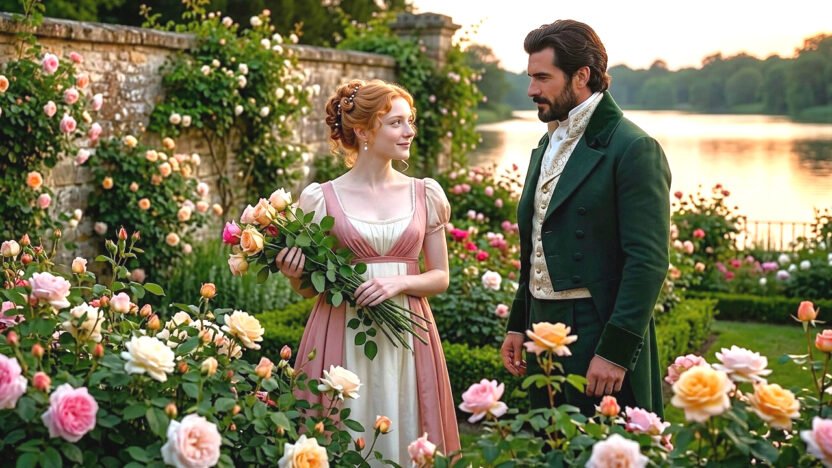
He swore he’d never love again. She was a widow tending roses that weren’t hers, in a garden he didn’t know still existed. Their secret afternoons by a forgotten lake are about to force an impossible choice — between safety, and a second chance at love.
The garden had not existed, as far as Benedict Wycliffe was concerned, in nine years.
He had walked past the overgrown hedge that marked its boundary more times than he could count, riding out toward the lake in the gray hours before his household woke, and he had never once thought to turn his horse aside and look behind the tangle of brambles that had swallowed the old stone wall. There had been a garden there once, he supposed, the way there had been a great many things on the estate that predated his memory and no longer concerned him. He had duties enough without adding a derelict rose bed to the list.
So it was only by accident, on a warm afternoon in early June, that he noticed the gate standing open.
He had not known there was a gate at all.
He reined in his horse and sat for a long moment, frowning at the iron latch someone had clearly lifted on purpose, and told himself that a fox or a wandering dog could not have managed such a thing. Curiosity, which he had learned to distrust years ago because it so often led toward memory, got the better of him anyway. He dismounted, looped the reins over a fence post, and walked through the gate expecting to find nothing more than an accident of nature reclaiming what nature had always intended to keep.
He found a woman on her knees in the dirt instead.
She had not heard him. She was entirely absorbed in the work of freeing a rosebush from a choke of ivy, her sleeves pushed up past her elbows, a smear of soil along her jaw where she must have brushed a hand across her face without thinking. The roses around her — and there were a surprising number of them, climbing what remained of an old trellis, spilling untended over a low wall — had clearly not been cared for in a very long time, but neither had they been given up on. Someone had been cutting back the dead wood. Someone had been watering.
“You are trespassing,” Benedict said, before he had decided whether he minded.
She startled, sat back on her heels, and looked up at him with an expression that held no guilt whatsoever — only a kind of frank, unhurried assessment, as though she were deciding what sort of man had just interrupted her rather than bracing to be scolded by one.
“I suppose I am,” she said. “Though I confess I did not think anyone would notice. No one has noticed for a great while, from the look of things.”
“This is my land.”
“Then you have been neglecting a very fine garden, Your Grace.” She said it without malice, glancing back at the roses as though the fact pained her more than his presence did. “It seemed a shame to let it die simply because no one remembered it was here.”
He ought to have asked her name. He ought to have asked what business she had wandering onto his property at all, widow or not, relation of his neighbors or not — he had gathered enough from her bearing and her voice to know she was gently born, whatever else she was. Instead he found himself looking past her, at the roses, and feeling something shift uncomfortably in his chest, the way a door might shift on a hinge that had rusted shut and was being asked, without warning, to open.
“I did not know it was still here,” he admitted. It was not the answer he had intended to give.
“Most gardens hide very well, once people stop looking at them.” She returned to the ivy, tugging it loose with quick, practiced hands. “I am Lady Beatrice Fairchild. I am staying with my aunt and uncle at Ashworth, just beyond your east wood. I promise you I am not in the habit of trespassing on the land of dukes. This garden simply asked to be rescued, and I did not have the heart to refuse it.”
He should have sent her away. He understood, distantly, that propriety required it — a duke and a widow alone on his grounds, unchaperoned, was precisely the sort of thing that gave rise to talk he had spent years avoiding. But she was not looking at him the way women usually looked at him, weighing his title, calculating his worth, and the garden around her was, he saw now that he allowed himself to truly look at it, remarkable. Roses he could not name, in colors gone half-wild with neglect, straining upward toward a sun they had clearly been waiting for.
“That bush,” he said instead, nodding at the one she’d been fighting, “has beaten better men than you. My gardener gave it up as dead the year I inherited.”
“It isn’t dead. It’s only frightened. Ivy will do that, if you let it wrap around something long enough — convince it there’s no room left to grow.” She glanced up at him, and there was the faintest curve of humor at the corner of her mouth, there and gone. “Perhaps you might make yourself useful, Your Grace, since you’ve caught me at it. There is a second pair of shears in my basket, if you’re not too proud to use them.”
He was not entirely sure, afterward, why he had knelt down in the dirt beside her instead of remounting his horse. But he had, and for the better part of an hour they worked in a silence that was not really silence at all — she directed him with brisk, unbothered authority, telling him which shoots to cut and which to leave, and he found himself, for the first time in longer than he could remember, thinking of nothing at all beyond the small task in front of him. When he finally rode home in the fading light, his hands were scratched and his coat was ruined, and he could not account for the fact that he felt lighter than he had in years.
He told himself he would not return.
He returned the next afternoon anyway, and told himself it was only to see whether the bush had survived her ministrations.
She was there again, as he had somehow known she would be, and this time he did not pretend the visit was accidental. He had brought a basket — bread, a wedge of cheese, a jar of something his cook had put up the autumn before, a small flask of tea — and he set it down at the edge of the flower bed with the studied casualness of a man who had rehearsed the gesture and was now regretting how transparent it looked.
“I thought you might not have eaten,” he said.
Beatrice looked at the basket, then at him, and something in her face told him plainly that she was not fooled, not for a moment, and did not intend to embarrass him by saying so. “That was thoughtful of you,” she said instead, and there was warmth in it, and amusement, and something gentler than either that he did not have a name for yet. “Though I notice you brought enough tea for two.”
“I may have miscalculated.”
“You may have.” She was already reaching for the flask. “Sit down, Your Grace. You look entirely too dignified standing there among my ivy.”
He sat. It was not dignified in the least — the ground was damp, his boots were already ruined from the day before, and he was a duke sharing a picnic basket with a woman he had known for exactly one day, in a garden neither of them had any particular right to. And yet he could not remember the last time he had felt so entirely at ease.
They talked. He could not afterward have said what about — small things, mostly, the state of the roses, an opinion she held rather firmly about the folly of pruning too early in the season, a dry observation about the vicar’s sermons that made him laugh aloud before he could stop himself, a sound so unfamiliar to his own ears that he found himself faintly startled by it. She asked him nothing about his title and nothing about his intentions, and he found that he was grateful for it in a way that went deeper than simple relief.
When the light began to slant gold through the trees and it was time for her to return to her aunt’s house before she was missed, she gathered her basket and her shears with the same unhurried competence she did everything else, and paused at the gate.
“Tomorrow?” she asked, and there was nothing coy in it, only a plain question, honestly put.
“If you’ll have the company,” he said.
“I find I don’t mind it,” she said, and left him standing among the roses with the peculiar sensation of a man who has been asleep for a very long time and has just, without quite meaning to, opened his eyes.
They did not, in the end, meet every day. He came to understand this was not accident but instinct on both their parts — some unspoken agreement that to meet daily would be to admit to something neither of them was yet prepared to name, and besides which, he found, an afternoon when she was not there taught him things an afternoon in her company never could. He arrived at the garden one Tuesday to find it empty, the gate standing open on nothing but birdsong, and stood there a full quarter hour longer than sense required, telling himself he was only inspecting the roses, before admitting to himself that he had missed her.
She admitted something similar to him weeks later, laughing at her own foolishness, confessing that she had gone twice to the lake on afternoons he had not come, and had stood at the water’s edge feeling absurdly disappointed before catching herself and marching home. “I told myself I was merely tending the garden,” she said. “I am not certain I believed it even as I said it.”
“I am glad you came anyway,” he said, and meant it more than the words could hold.
The basket became a habit, then a ritual, then something neither of them bothered to comment on anymore. He learned, without being told, that she preferred her tea before the bread rather than after, that she took a small, private pleasure in the deep red roses over the pale ones though she would not say why, that she went quiet in a particular way when a memory caught her unaware and needed a moment before she was ready to speak again. She learned that he arrived earlier than he needed to on the days he came at all, that he brought a blanket without comment once he noticed she felt the cold before she did herself, that his reserve, which society read as coldness, was in fact a kind of careful gentleness he had simply never been given reason to show anyone.
They spoke of small things for a long while, because small things were safe, and there was a great deal beneath the small things that neither of them was ready to disturb. But even the small things, said often enough in that quiet garden by the water, began to feel like something neither of them had expected to have again — a companionship that asked nothing, and simply was.
One evening, as the sun went down copper over the lake and neither of them had risen to leave though the hour was well past when either of them ought to have, they fell into a silence that lasted several minutes and troubled neither of them at all. Beatrice broke it first, not with words, but with a small, unguarded smile in his direction, the kind a person offers only when they have forgotten, for a moment, to be careful.
Benedict found he could not look away from it.
Neither of them spoke of what that meant. But something had shifted between them all the same, quiet and unremarked, the way the garden itself had shifted from a ruin into something closer, each week, to what it must once have been.
The trigger, when it came, was small enough that neither of them could have anticipated it.
They had been working companionably at the far end of the bed, where a stubborn climbing rose refused to take to its new trellis, when a child’s laughter carried across the water — one of the tenant families out walking the far shore, a small boy chasing something through the grass with the particular, headlong joy that belonged only to children who had never yet learned caution. Beatrice went still. Benedict noticed it the way he had come to notice all her small changes of weather, and said nothing, only waited, his hands quiet on the trellis wire.
“I was carrying a child once,” she said, so simply that for a moment he was not certain he had heard her correctly. “During my marriage. I lost her before she was born.” She did not look at him. She was looking at the boy across the water, who had stopped his chase to fling himself down in the grass, laughing at nothing at all. “My husband was very good to me, after. Better than I think I deserved, in the state I was in. We had some good years yet, before he died. I do not think of our marriage as a tragedy. I think of it as something brief and kind that ended the way all things end.” She paused. “But I think of her. Still. More than anyone would expect me to, after so long.”
“How long has it been?”
“Four years, this autumn. She would have been walking about by now, I expect. Getting into everything.” A small, unsteady laugh. “I am aware that grief is meant to have an ending. People are very kind about telling me so, without ever quite saying it. I have simply found that mine has not read the instructions.”
Benedict set down the shears. He did not offer her the things people usually offered — the observation that she was young yet, that there was still time, that surely in due course. He had learned, from the inside, exactly how little such comforts were worth.
“My wife died in the same hour as our son,” he said instead. It came out of him plainly, without the careful distance he had used on the rare occasions he had spoken of it at all. “I have told almost no one that plainly. I usually say only that I lost my wife, and let people assume whatever grief fits the sentence best. It is easier than watching their faces when I say the rest of it.”
Beatrice turned to him then, and there was no pity in her expression, which he found he was profoundly grateful for. There was only a kind of recognition, one survivor to another. “What was his name to have been?”
No one had asked him that in nine years. “Edmund,” he said, and felt the word land somewhere it had not landed in a very long time. “After my father.”
“Edmund,” she repeated, gently, as though testing the weight of it, giving it a moment of existence it had never properly been allowed. “And your wife?”
“Cecilia.”
“I am sorry, Benedict.” It was the first time she had used his given name, and neither of them remarked on it, though he felt it settle into him like something long overdue.
They sat with it a while, the two of them, the boy’s laughter still drifting faintly across the water, the roses breathing their quiet scent around them. Neither of them wept. There was, he found, something almost restful in grief that did not need managing — grief that could simply be set down between two people and left there, without either of them rushing to pick it back up and apologize for its weight.
It was Beatrice who moved first, reaching for his hand where it rested on his knee — not with any great drama, only the small, instinctive gesture of a person offering comfort without calculation. Her fingers covered his, warm from the sun, and he turned his hand beneath hers so that they were, for a moment, simply holding on. Neither of them withdrew.
It ended anyway, because such moments always do. But something had changed in the ending of it, and they both knew it, and neither of them spoke of it directly for several days after.
The world, unhelpfully, chose that same week to intrude.
“You cannot mean to go on like this forever, Benedict.” Lady Ashcombe had cornered him after church with the particular relentlessness of a woman who considered herself an old family friend and therefore entitled to say whatever she pleased. “Wycliffe needs an heir. You are not getting younger, and half the eligible young women in the county have given up hope of you, which I assure you does neither them nor your house any good. Miss Pelham’s girl is said to be quite sensible. You might at least call.”
He had made some noncommittal answer and escaped as soon as decency allowed, and found, to his own faint alarm, that his first thought upon reaching the privacy of his study was not relief at having deflected the conversation but a kind of cold unease at how easily he could picture himself calling on Miss Pelham’s girl and marrying her within the year, purely because it would be sensible, and because everyone would finally stop asking.
He thought of Beatrice instead, and the unease sharpened into something closer to fear.
Beatrice, for her part, returned from an afternoon call at her aunt’s to find her uncle mentioning, with the studied casualness of a man executing his wife’s instructions, that a Mr. Hollis — a perfectly amiable gentleman with a comfortable living two parishes over — had asked after her particularly, and might be persuaded to call, if she were amenable.
She was not unkind about Mr. Hollis when she met him a week later. He was, in fact, exactly as advertised — pleasant, sensible, entirely unobjectionable, and so thoroughly uninteresting to her that she found herself, halfway through an excruciatingly polite conversation about the price of wool, thinking instead of a man who brought her tea before bread and had once laughed aloud at her opinion of the vicar’s sermons.
She recognized the thought for what it was, and it frightened her rather more than Mr. Hollis’s dullness did.
She said as much to Benedict the next time they met, because she had never been a woman who could hold an unpleasant truth silently for long. “I had a caller this week. A Mr. Hollis. My aunt is quite hopeful.”
Something in Benedict’s chest went tight and cold before he had decided he had any right to feel it. “And?”
“And nothing. He is perfectly nice, and I have no wish to marry him, and I do not think I am being unfair in saying so.” She was watching him closely, and he understood, with the particular clarity of a man being asked a question he did not want to answer, that she was waiting to see what he would say next.
He said nothing, for a moment too long.
“I understand the constraints we are under, Benedict,” she said, more quietly. “I am not a foolish woman. I know what it would cost you, to be seen keeping company with a widow of no particular fortune, and I know what people would say of me if it became known we met here, alone, as often as we do. I have made my peace with a great deal in my life. I find I have not made my peace with being anyone’s shameful secret.” She looked at him steadily. “I will give you your privacy, Benedict, gladly, for as long as you need it. I will not give you my dignity. If it ever comes to a choosing between the two, I want you to know now which one I will choose.”
He wanted, badly, to tell her that it would never come to that. He found the words would not quite come, and he watched something in her expression register his silence, and file it away, without accusation, for later.
It was some weeks after that — weeks of continued afternoons, continued small kindnesses, continued careful avoidance of the thing that now sat plainly between them — that the roses came fully into bloom for the first time since Beatrice had begun her work. She had sent word by way of a note left at the gate, in a hand he had come to recognize instantly: Come see what we have done.
He came at dusk, when the light lay low and gold across the water and the whole garden had turned, almost overnight, into something he barely recognized — the deep red roses she favored spilling in full, unrestrained glory over the old stone wall, the air so thick with their scent that it seemed to press gently against his chest. Beatrice stood among them with her face turned up to the last of the light, and when she heard him she turned, and smiled, and did not try to hide how glad she was to see him.
“We did this,” she said, gesturing at the roses around them, at the garden restored from ruin to something almost unbearably alive. “You and I.”
“You did this,” he said. “I only carried water.”
“You did rather more than that.” She was closer to him now than he had quite noticed, or perhaps he had simply stopped keeping careful track of the distance between them weeks ago. “I do not think I could have done it without somewhere to bring the water.”
He looked at her in the fading light, at the color the roses had put into her cheeks, at the small, unguarded happiness in her face that he had come, slowly and without ever deciding to, to think of as one of the finest things he knew, and something in him that had been holding very still for a very long time simply stopped holding.
He kissed her.
It was not sudden, in the way such things are sometimes described. It felt, rather, like the natural end of a sentence they had both been speaking for weeks without quite saying the words aloud — unhurried, certain, her hand coming to rest against his chest not to push him away but to hold on, his own hand finding her face with a gentleness he had not known he still possessed. When it ended, neither of them moved away.
“Benedict,” she said softly, and he heard in his own name everything she was not yet saying.
He should have felt joy, purely and simply. He found instead that the joy came tangled with something else, something that closed cold fingers around his chest even as her warmth remained pressed close against him — a fear so sudden and so total that it took him a moment to recognize it for what it was. He had spent nine years guarding himself against grief, building his solitude into something he had mistaken for safety, and he understood now, with her still so near that he could feel her breath, that he had never once considered what it would cost him to be happy again.
He did not let her go. But he did not answer her either, not with the words she was plainly waiting for, and after a long moment she stepped back, searching his face for whatever it was she found there, and did not press him for it.
“It’s late,” she said instead, gently, giving him the silence to have without demanding he explain it. “I should go before I’m missed.”
He walked her to the gate in a quiet that was no longer entirely comfortable, and stood there long after she had disappeared into the dusk, among roses that had never bloomed so fully in his memory, feeling for the first time in a very long while that he did not know what he was afraid of losing more — her, or the careful, guarded peace he had built to survive without her.
Beatrice did not hear from him for eight days.
It was not, she told herself at first, so very long. He had a household to manage, tenants to see to, the ordinary business of a dukedom that did not pause for a woman’s feelings. She went to the garden twice regardless, and twice stood at the gate in the fading light before walking back to her aunt’s house with her basket untouched, telling herself, without much success, that she was not disappointed.
By the fifth day she understood what his silence meant, even if he had not yet found the courage to say it aloud, and by the eighth she had made up her mind about what she meant to do with the understanding.
She found him, in the end, because he came to her — arriving at her aunt’s house on the ninth afternoon with a correctness so stiff it was almost an apology in itself, requesting, with careful formality, the pleasure of a walk in the garden if Lady Beatrice were amenable. Her aunt, delighted at what she took for the beginnings of a proper courtship, all but pushed her out the door.
They walked in silence for the better part of a quarter mile before Beatrice stopped walking altogether.
“You have been avoiding me,” she said. Not an accusation. A simple statement of fact, offered the way she offered most difficult things, plainly and without flinching.
“I have been thinking,” he said.
“For eight days.”
“It is a great deal to think about.”
“I am aware.” She turned to face him fully. “Benedict, I told you once that I would give you your privacy gladly, and I meant it. I have never asked you to declare yourself before the county, or to defy your own household for my sake. But I will not go on like this — waiting to learn whether I am someone you have chosen, or merely someone you have not yet found the resolve to refuse. I have buried a child and a husband, and I did not do either of those things by hiding from what was true. I am not willing to hide from this, whatever it costs me to say so plainly.” Her voice did not shake, though something in her eyes told him the composure was costing her a great deal to hold. “I will not be anyone’s secret, Benedict. Not even yours. I would rather lose you honestly than keep you dishonestly, and I think, in whatever quiet part of yourself you have not yet listened to, you already know which one of us is meant to choose.”
“Beatrice—”
“I am not finished.” She drew a breath. “My aunt has had a letter from my cousin in Bath, asking whether I might come to her for the autumn. I have not yet answered it. I find I am waiting to see whether I have any particular reason to stay.” She looked at him, and there was no anger in it, only a terrible, patient honesty. “I will need your answer soon.”
She left him standing on the path, and did not look back, and Benedict stood a long while in the golden, ordinary light of an afternoon that had just quietly become the most important of his life, understanding at last what his silence had very nearly cost him.
He did not sleep that night. He sat long in his study with a letter from Lady Ashcombe unanswered on his desk — an invitation, gently insistent, to a dinner at which Miss Pelham’s family would also be present, an evening clearly engineered toward an outcome he had once assumed, wearily, he would eventually have to accept. He thought of Cecilia, and found, to his own quiet surprise, that thinking of her no longer felt like betrayal but like memory — a room in his heart he had kept locked out of fear rather than loyalty. He thought of Edmund, who would have been nine years old, and of the boy’s laughter across the water that had opened something in Beatrice she had needed opened. He thought, finally, of eight wasted days spent guarding a solitude that had never once made him happy, only safe.
He wrote his answer to Lady Ashcombe before he allowed himself to reconsider it. He declined the dinner, and he did not trouble to soften the refusal with excuses.
He appeared at the dinner anyway — not as a guest weighing Miss Pelham’s suitability, but two evenings later, uninvited, arriving precisely when the assembled company would make his purpose impossible to mistake. Lady Ashcombe’s face, when he informed her plainly and without apology that he did not intend to marry for the sake of convenience or duty, that his heart was already spoken for by a woman of his own choosing, was a study he would remember with some private satisfaction for years afterward. He did not stay to argue the point. He had said what he had come to say, and there was only one place left he wished to be.
He found Beatrice at the garden gate at dusk, as though she had known, without being told, that this was the evening he would come.
“I have refused Lady Ashcombe’s dinner,” he said, before she could speak. “I have told her plainly that I do not intend to marry where duty points me. I came here instead, because there was never any question of where I meant to be.”
“Benedict—”
“Let me finish, please, because I have been eight days working up the courage to say it properly.” He took a breath. “I do not want to meet you in secret any longer. I do not want a garden that only we know exists, or afternoons no one else may learn of. I want to court you plainly, Beatrice — call on you at your aunt’s house in full daylight, walk with you where anyone may see us, dance with you at whatever assembly will have us, and let the whole county say whatever it likes about it. I have spent nine years believing that loving you — loving anyone — would be a betrayal of what I lost. I understand now that it is not betrayal. It is only proof that my heart was never as small as I believed it to be.”
Beatrice was very still, her eyes bright in the fading light. “I will not be your secret, Benedict. I meant that.”
“Nor would I ever ask you to be. Not for one more day.” He took her hand, not as he had that afternoon weeks before, in comfort, but deliberately, plainly, in front of no one but the roses and the darkening lake. “I am asking you to let me love you openly, Beatrice Fairchild. Whatever that costs either of us. I find I would rather pay it than lose you to my own cowardice.”
She looked at him for a long moment, searching his face the way she had searched it once before, on the evening he had kissed her and then said nothing at all — and this time, whatever she was looking for, she found it.
“Yes,” she said simply. “Not because you are a duke, and not because it would be sensible, and not because my aunt will very likely faint with joy at the news. Only because I have come to trust you, Benedict Wycliffe, with the truest and most fragile part of myself, and I find I would like to go on trusting you for a good deal longer than an afternoon at a time.”
He kissed her then, in the open evening air, with no wall or hedge to hide them, and this time no fear came tangled with the joy of it.
The garden bloomed fully that autumn, more richly than anyone on the estate could remember it blooming in living memory, and it was there, among the restored roses, that Benedict and Beatrice were married the following spring, in the full and open sight of a household, a village, and a county that had once whispered about a duke’s strange solitude and now spoke instead of weddings, and roses, and a man who had finally come home.
The old roses climbed the same stone wall they always had, unchanged in themselves, exactly as stubborn and exactly as lovely as they had been the day Beatrice first knelt in the dirt to save them. But new growth had come in among them that year, fresh canes twining up through the old wood, new blooms opening where none had grown before — not replacing what had always been there, but simply, quietly, taking their place beside it. Benedict found Beatrice among them at dusk, her hands full of cut stems for the house, and stood a moment just watching her before she noticed him and smiled, unhurried, entirely at home.
Benedict and Beatrice learned that loving again doesn’t erase what came before — it simply makes room beside it. Their garden, once forgotten, bloomed into something neither of them thought they’d have again: a second chance, chosen freely, in the open light of day. If this story moved you, give it a like, subscribe for more heartfelt historical romance, and tell us in the comments which moment stayed with you most. Thank you for spending this time with Benedict and Beatrice — we’ll see you in the next story.